What happens when an ordinary man allegedly builds an extraordinary identity around himself?
In Khagaria, Bihar, authorities have uncovered a case that sounds almost too cinematic to be real.
A man identified as Manish Gupta is accused of posing as an IAS officer and using the identity to allegedly deceive people across different districts of Bihar.
A police investigation into his activities has reportedly uncovered luxury vehicles, expensive liquor, multiple financial instruments, properties and an elaborate security system at his residence.
The case has now raised a much bigger question:
How was an alleged fake government identity allowed to operate for so long?
The Man Who Allegedly Became an “IAS Officer”
According to police statements reported by Navbharat Times, Manish allegedly introduced himself at different times as an IAS officer and even claimed to be a secret agent of National Security Adviser Ajit Doval.
The police allegation is that he used these claims to gain credibility and carry out fraud in different parts of Bihar.
His vehicles reportedly carried markings such as “Government of India” and “IAS”, allegedly helping him create the appearance of official authority.
That is where this case becomes particularly serious.
Pretending to be a government official is not simply an unusual lifestyle choice.
It can potentially allow someone to gain access, influence decisions, intimidate people or convince victims that they are dealing with a person who has official powers.
Then Came the Raid
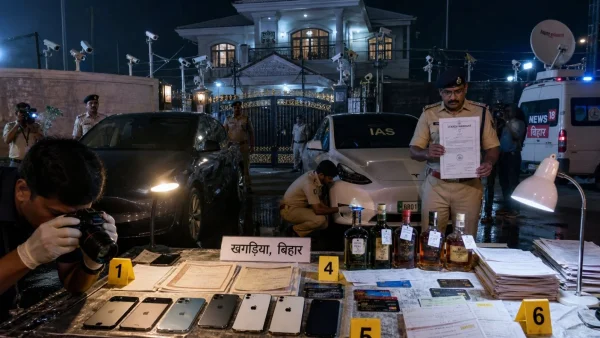
Police conducted a detailed search of Manish’s premises in Khagaria.
According to the reports, investigators recovered two luxury vehicles and a range of other items during the operation. The exact legal status and ownership of the vehicles will form part of the investigation.
The reported recovery has attracted particular attention because of claims circulating about a Tesla vehicle, with social-media posts describing it as a “driverless car.”
That claim should be treated cautiously.
A luxury or advanced vehicle is not automatically evidence of illegal wealth. What matters is how the vehicle was acquired, who owns it, where the money came from and whether the documentation is genuine.
Those are questions investigators can answer through financial records and registration documents.
A House That Looked More Like a Private Fortress
The investigation reportedly found an unusually elaborate setup at Manish’s residence.
According to the claims circulating around the raid, approximately 100 CCTV cameras had been installed around the property.
If confirmed, that would raise another interesting question:
Why would an individual allegedly running a decade-long deception need such an extensive surveillance network? There could be legitimate reasons for extensive security.
But investigators will naturally want to establish whether the system was being used to monitor visitors, protect valuable assets or maintain secrecy around his activities.
The Luxury Lifestyle Raises Even More Questions
Reports surrounding the raid have described a lifestyle far removed from that of an ordinary individual.
Among the items reportedly recovered were:
Multiple luxury vehicles
Five iPhones
Around 20 credit cards
Eight ATM cards
Four chequebooks
Expensive foreign liquor
Multiple property documents
Reports have also claimed that approximately 31 litres of liquor were recovered and that some bottles were worth more than ₹1 lakh each.
These figures still need to be established through the official seizure memo and investigation.
But if the reported valuation is confirmed, investigators will have a very obvious question:
Where did the money come from?
The ₹100-Crore Property Question
One of the most striking claims is that a lengthy police investigation allegedly found evidence of property worth around ₹100 crore linked to Manish.
Police reportedly spent approximately seven and a half hours investigating the premises and financial/property trail.
However, an important distinction must be made:
“Property worth ₹100 crore” is currently an investigation claim, not a court-established finding of illegally acquired wealth.
Authorities will have to establish:
What properties actually belong to him?
Who paid for them?
When were they purchased?
What were the declared sources of income?
Were shell companies or proxies involved?
Were properties acquired using proceeds of alleged fraud?
Those answers will determine the real scale of the case.
Ten Years of Alleged Deception?
According to the police version reported in connection with the case, Manish may have been involved in allegedly deceptive activities for around a decade.
That claim, if substantiated, creates perhaps the most uncomfortable question of all:
How did nobody discover the alleged impersonation earlier? An IAS officer is not simply someone with a visiting card.
There are official records, service cadres, postings, government directories and administrative chains.
A basic verification of credentials should ordinarily establish whether someone actually belongs to the IAS.
So if someone successfully presented himself as an IAS officer for years, the case could expose weaknesses in identity verification and public trust mechanisms.
The “Government of India” Car Problem
One of the most striking allegations is that his car carried markings identifying him as:
“Government of India”
and
“IAS.”
That raises a very practical issue.
Ordinary citizens often associate government markings with authority.
A person arriving in such a vehicle can immediately appear more powerful and influential than he actually is.
That is precisely why false representation of government affiliation can be dangerous.
The sticker may be fake. The psychological effect can be very real.
The Family Angle
Reports also say Manish is the youngest of six brothers and is unmarried, while his five brothers are reportedly professionally established, including one described as a professor in Delhi and another living in Canada.
However, the occupations or lifestyles of his relatives do not establish involvement in his alleged activities.
That distinction is important.
A person’s family members should not become suspects simply because they share a surname.
The investigation should follow evidence, financial transactions and documented links—not family relationships.
The Sarcasm Writes Itself
Some people spend years preparing for the UPSC.
Some spend years studying administrative law.
Some spend years waiting for government postings.
And then allegedly someone decides:
“Why take the exam? Just put ‘IAS’ on the car.”
Except real government authority isn’t created by a sticker.
And neither is public trust.
The Bigger Problem: Why Do People Believe Fake Officials?
This case isn’t only about one alleged impersonator.
It highlights a broader social vulnerability.
People often hesitate to question someone who appears powerful.
A government vehicle.
An official-looking ID.
A formal designation.
A few references to senior officers.
Suddenly, ordinary citizens may assume:
“This person must be important.”
That psychological effect can make impersonation schemes particularly effective.
What Should Authorities Investigate?
1. Financial Trail
Investigators should establish how the alleged assets were financed.
2. Property Ownership
Every property allegedly linked to Manish should be verified through registration and financial records.
Authorities should determine where the alleged IAS credentials, documents and vehicle markings came from.
4. Victim Network
Police should identify people who may have been allegedly defrauded or influenced by his claimed position.
5. Digital Evidence
Phones, computers and financial records could potentially reveal communications and transactions relevant to the investigation.
6. Possible Associates
If the alleged operation lasted years, investigators should determine whether anyone knowingly assisted him.
The Real Test Begins
After the Raid A dramatic raid makes for dramatic headlines.
But the real investigation begins afterward.
Luxury cars can be seized.
Liquor can be counted.
Phones can be examined.
Documents can be collected.
But the central question remains:
How did the alleged deception generate wealth—and who else benefited from it? That answer will tell us whether this was simply an individual impersonation case or something much larger.
Final Take: The Fake Badge Is Only the Beginning
The Khagaria case has all the ingredients of a crime thriller—an alleged fake IAS officer, luxury vehicles, expensive liquor, multiple financial instruments, surveillance cameras and a property trail reportedly running into tens of crores.
But beneath the sensational details lies a serious institutional question.
How easily can someone manufacture the appearance of government authority? If the allegations are proven, the case should result in more than arrests and headlines.
It should also prompt authorities to examine how fake officials are able to build credibility, acquire influence and allegedly operate for years without their credentials being challenged.
Because an IAS officer is created through a competitive examination, formal appointment and public records.
Not through a car sticker.
And certainly not through a convincing story.