India’s electoral-bond controversy was never merely about political donations.
It was about transparency, access and the relationship between political power and big business.
Data released after the Supreme Court ordered disclosure of electoral-bond information showed that some of India’s biggest corporate groups and companies were among the largest purchasers of the bonds. The BJP was the largest beneficiary of the scheme, receiving more than ₹6,000 crore through electoral bonds during the period covered by the released data.
The numbers were enormous.
And then came the uncomfortable question:
What happens when a major political donor is also competing for major government contracts? That question does not automatically prove a quid pro quo.
But it is precisely the kind of relationship that deserves public scrutiny.
Who Were the Biggest Donors?
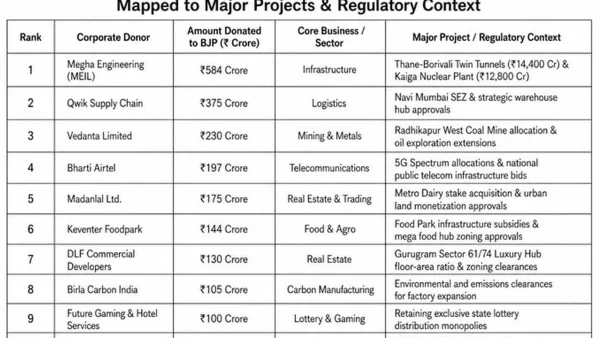
The electoral-bond data showed that the top purchasers included Future Gaming and Hotel Services, Megha Engineering & Infrastructures Ltd (MEIL), Qwik Supply Chain, Vedanta and Haldia Energy, among others.
The top 10 purchasers alone accounted for roughly ₹4,548 crore, or about 33% of the total value of electoral bonds purchased, according to data reported after the SBI disclosures.
Among them, MEIL was particularly significant for the BJP.
The company purchased electoral bonds worth hundreds of crores, with ₹584 crore reported as going to the BJP in the released data.
Another major donor, Qwik Supply Chain, purchased ₹410 crore in electoral bonds, of which ₹375 crore went to the BJP according to the disclosed data. Reliance has said Qwik is not a subsidiary of any Reliance entity, although public filings have shown links between the company and the wider Reliance corporate network.
Then Came the Contract Question
This is where the controversy becomes particularly interesting.
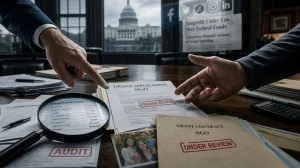
An investigation by The Indian Express examined MEIL’s electoral-bond purchases alongside major government and PSU contracts.
It identified at least nine instances between 2019 and 2023 in which MEIL purchased electoral bonds around the time it won government or PSU contracts. In five cases, the company bought bonds close to the awarding of major projects, while a sizeable portion of those bonds were subsequently redeemed by the BJP.
That is a legitimate public-interest question.
But it is equally important to state what the evidence doesn’t prove.
Timing and correlation are not proof of a political bargain. A company winning a government contract after making a political donation does not, by itself, establish that the donation caused the contract.
Government contracts can involve competitive bidding, technical qualifications, lowest-price considerations and other statutory procedures.
So the correct question isn’t:
“Did donations buy contracts?”
It is:
“Were all these contracts awarded through transparent, competitive and independently verifiable processes?” That is the standard that should apply to every government.
The ₹584-Crore Question
MEIL’s political donations became particularly controversial because the company was simultaneously involved in major infrastructure projects.
Infrastructure contracts are not small transactions.
They can involve thousands of crores of public money.
Therefore, even the appearance of a conflict of interest deserves serious scrutiny.
If a company donates hundreds of crores to a ruling political party and subsequently receives major public contracts, citizens have every right to ask:
Was the tender competitive?
How many companies participated?
Who else bid?
What was the winning margin?
Were eligibility rules changed?
Were contracts modified later?
Were cost escalations approved?
Was the project independently audited?
These questions do not accuse anyone of wrongdoing.
They demand proof that the system worked fairly.
The Supreme Court Changed the Conversation
The electoral-bond scheme was struck down by the Supreme Court in February 2024.
The court held that the scheme’s anonymity violated citizens’ right to information and ordered disclosure of the relevant information.
That disclosure changed the nature of the debate.
Before the data became public, citizens could debate political funding in the abstract.
After the data emerged, people could actually examine:
Who donated?
How much?
To whom?
And, increasingly:
What happened around the same period?
That last question is where investigative journalism becomes important.
Is This a “Subscription Model” for Crony Capitalism?
Critics have described the system as something resembling a subscription model:
Donate to political power today.
Hope for favourable access tomorrow.
But that is an allegation, not an established fact.
There is a legitimate distinction between:
Political funding and
Political influence over government decisions. Companies are legally allowed to support political parties through permitted mechanisms.
The problem arises when citizens cannot determine whether political contributions are completely independent of government decision-making.
That’s why transparency matters.
The Sarcasm Writes Itself
Imagine the hypothetical corporate pitch:
Company: “We would like to make a political contribution.”
Democracy: “Thank you.”
Company: “And we also happen to be interested in a ₹5,000-crore infrastructure project.”
Democracy: “Please submit your tender.”
Fair enough.
But citizens are entitled to ask:
“And who checked that the tender was actually fair?” Because when the same names repeatedly appear on both sides of the ledger, people naturally become suspicious.
And democracy shouldn’t require citizens to suppress reasonable questions just because there is no smoking gun.
But This Wasn’t Only About the BJP
This is another important fact.
Electoral bonds did not exclusively fund the BJP.
The disclosed data showed that companies donated to multiple political parties.
Future Gaming, for example, was the largest purchaser of electoral bonds but gave only ₹100 crore to the BJP; much larger amounts went to the Trinamool Congress and DMK. MEIL also donated to parties other than the BJP. Vedanta contributed to the BJP as well as opposition parties.
So the larger issue is not simply:
“BJP received corporate donations.”
The bigger issue is:
Should any political party have a funding system that can create such enormous corporate influence without sufficient transparency? That is a democratic question, not merely a BJP-versus-opposition question.
What Would Real Transparency Look Like?
Imagine if every major government contract automatically came with a public dashboard showing:
Winning company
All bidders
Bid amounts
Tender criteria
Political donations by the winning company
Contract value
Subsequent modifications
Cost overruns
Independent audit findings
Suddenly, conspiracy theories would have much less oxygen.
Because citizens wouldn’t have to guess.
They could simply examine the data.
The Real Risk: Perception of Pay-to-Play
Even if every contract was technically legal, there is another problem.
If citizens repeatedly see:
Corporate donation → political access → government contract
they may reasonably wonder whether the system rewards proximity to political power.
A democracy cannot survive purely on the statement:
“There is no proof of wrongdoing.”
It also needs systems designed to prevent conflicts of interest and even the appearance of undue influence.
What Should the Government Do?
1. Make major contracts more transparent
Tender documents, bidders, winning bids and contract modifications should be easily accessible.
2. Strengthen independent audits
Large infrastructure projects should face rigorous post-award scrutiny.
3. Disclose political funding transparently
Citizens should be able to identify significant corporate contributions to political parties.
4. Strengthen conflict-of-interest safeguards
Companies making substantial political contributions should not receive special access or preferential treatment.
5. Follow the same standards for every political party
Corporate influence is a democratic issue, not a partisan one.
Final Comment: Government or Corporate Subscription Service?
The phrase “subscription model for crony capitalism” makes for a powerful headline.
But the real story is more serious than a slogan.
The electoral-bond data established that enormous sums flowed from corporations to political parties. The data also revealed instances where major donors, particularly MEIL, were receiving major government or PSU contracts around overlapping periods.
That does not establish that contracts were bought with donations.
But it absolutely justifies asking whether the tendering process was independent, transparent and competitive.
And perhaps that is the most important question:
If public contracts are awarded fairly, why should anyone fear making the entire process completely transparent? After all, government is supposed to work for the public.
Not for donors.
Not for corporations.
Not for political parties.
For the citizens who ultimately pay the bill.