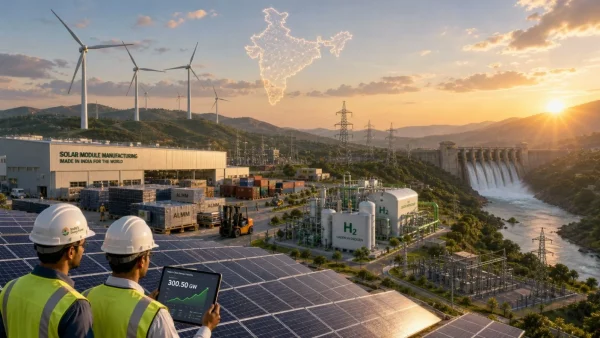
In many ways India has altered the conversation on energy both at home and overseas. As of July 31, 2026, installed non-fossil capacity stands at 300.50 GW, meaning 60 per cent of the 500 GW target for 2030 has been met. Solar was the vanguard, but it will be the next four years that determine if this momentum holds up.
Why this milestone matters for 2030
According to the renewable energy ministry, the country’s clean power base is now more than 54 per cent of the roughly 552 GW total installed electricity capacity. It is a structural change in the way India will underwrite growth and insulate itself from the vagaries of fuel imports while lowering emissions.
Getting to 300.50 GW ahead of schedule puts pressure on what follows. There is still some 199.5 GW to be added to hit the 500 GW mark by 2030. That will be an examination of the grid’s preparedness, the depth of financing and whether local manufacturers can turn out product with the necessary speed and volume.
Manufacturing muscle becomes the backbone
There is a good deal of policy work happening behind the scenes. The Production Linked Incentive scheme has seen capacity on the Approved List of Models and Manufacturers for solar PV modules top 200 GW, a far cry from the 2.3 GW of 2014. The ministry would have you see this as essential to an Aatmanirbhar energy ecosystem.
It is no window dressing. This manufacturing base is what supports the record installation rates and lessens reliance on outside supply chains. In a market of this velocity, having a domestic source you can count on is the difference between hitting or missing your annual numbers.
What is powering the jump
Solar is the clear leader. Capacity has gone from 2.8 GW in 2014 to 164.59 GW today. Wind has not been left behind either, putting in 58.14 GW against 21 GW in 2014 to add balance to the non-fossil portfolio.
Then there is hydropower at 57.24 GW and 11.75 GW from bio-power. With nuclear chipping in 8.78 GW, these have all combined to take non-fossil capacity over the 300 GW mark and provide a firmer, more flexible kind of clean power.
Record year turns the tide
The 2025-26 financial year set a new standard. With 55.29 GW of non-fossil capacity put in place (44.6 GW of it solar and 6 GW wind), the 2030 goal has been brought within reach. But such a one-year leap also sets a high bar for what is expected going forward.
Output and demand: generation surges
One has to look at the output as well as the capacity. Generation of renewable energy has gone from 190.96 billion units in 2014-15 to 477.79 billion in 2025-26, a sign that clean power is being woven into the daily needs of heavy industry and the household alike.
With that comes the need for a modernised grid, better storage and more astute dispatch. The figures are there, but the system must have the flexibility to match the capacity.
The official figures in brief:
– Non-fossil capacity: 300.50 GW (July 31, 2026)
– Share of total: in excess of 54 per cent of the 552 GW
– 2025-26 addition: 55.29 GW
– ALMM solar module capacity: 200 GW plus
Green hydrogen: potential meets pause
The pivot to clean energy is not confined to the power sector. Through the National Green Hydrogen Mission the ministry is looking to make India a centre for the production and export of green hydrogen and its derivatives, in service of industrial decarbonisation.
Advances have been gradual. Which is why the coming policy decisions are so important; in sectors where renewables cannot do the job alone, green hydrogen is the only way to make the required cuts in emissions.
What comes next
For the ministry, the current standing is proof of economic resilience and competitiveness. To maintain that position three things will be key: sustaining the manufacturing gains, seeing another record year of additions and pushing the hydrogen agenda in industry.
India has demonstrated it can scale quickly. The question for 2030 is whether the country can turn this 300.50 GW into something reliable and affordable for industry, and in doing so, do more than just tick off a target but redefine its energy future.