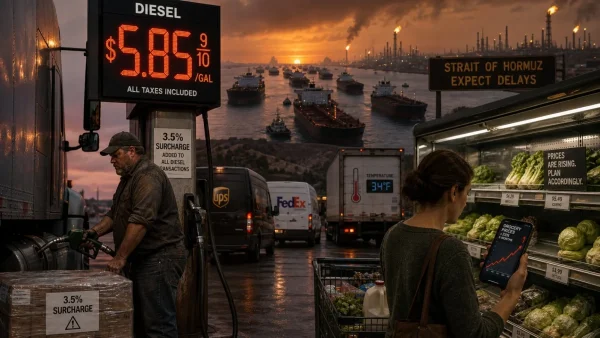
From the warehouse to the supermarket aisle, a new round of diesel costs is poised to upend budgets. The national average has set a record at $5.85 a gallon as the six-month war with Iran throws global fuel flows into disarray. Given that diesel is the lifeblood of freight and farming, one can expect the pain to be felt throughout the supply chain.
There is no appetite for companies to simply take it on the chin. Amazon has put a 3.5% temporary surcharge on some third-party sellers for fuel and logistics since April. Earlier in the hostilities, UPS, FedEx and the USPS tacked on fees for select packages, pointing to higher outlays. For any business with a heavy delivery footprint, the numbers leave little room for manoeuvre.
Record high and widening pump gap
Diesel has for the first time nationwide gone over the $5.85 mark, a peak reached on Friday. Regular petrol has not been so quick to rise; AAA figures put the average at $4.15 a gallon, up from $3.20 a year back. In times of crisis, diesel has a habit of climbing faster than gasoline and has long held the top spot.
One can look to past shocks for context if not solace. Government data indicate that the 2008 high of some $4.74 would be $7.20 in 2026 once inflation is factored in, and the near-record of $5.82 in 2022 would come to about $6.56 today. Even in June 2022 the average was close to $5.82. The sticker shock is undeniable.
Why prices surged
According to AAA, the US average was in the vicinity of $3.76 before things got heated in late February. Crude has run up since then on account of output cuts and disruptions in the Middle East, with tanker traffic clogged at the Strait of Hormuz. On Friday Brent was trading above $95 a barrel, a far cry from the $70 or so it was before the war.
There was a brief respite when peace seemed possible in early summer, but with the fighting intensifying, oil and the pumps have followed suit. It is a straightforward matter: refined fuel goes up with crude. Diesel is especially vulnerable when refineries are hard pressed for middle distillates and freight demand does not let up.
Pressure points across the economy
You will see the first signs of it in the more logistics-dependent parts of retail. Diesel is what moves the trucks, trains and boats, so transport costs for cosmetics or furniture are bound to swell. Grocers are in a particularly exposed position with perishables; the need for frequent, refrigerated shipping drives up their operating costs well before the product is on the shelf.
The squeeze shows up in food prices quickly enough. Not only does diesel run the farm machinery and fishing fleets, but also the cargo ships and trains that put stock in stores. The Independent Grocers Alliance says fuel makes up 15% to 30% of the total cost of food, meaning any sustained hike will find its way into the final price.
Chilled cargoes are prone to earlier markups, says David Ortega of Michigan State University. He points to July, when US grocery prices were up 2.7% on the year, with fresh fruit and seafood seeing jumps of 4.9% and 7% respectively. Then again, other factors can counteract the fuel impact, as was the case with lettuce where a cyclospora outbreak put a damper on demand and prices.
Ortega is quick to point out that such a lag is not permanent. ‘Early on, much of the cost increase gets absorbed along the supply chain through existing freight contracts and retailer margins,’ he said. With the repricing of contracts and the imposition of fuel surcharges, an increasing share of the cost is bound for the grocery store.
Freight and e-commerce strategies
Surcharges are the most straightforward tool for parcel carriers and platforms. Amazon’s 3.5% add-on is a case in point of how marketplaces put the onus on sellers to cover costs by way of higher shipping thresholds or adjusted tags. One sees the same approach from UPS, FedEx and USPS; it is their way of making clear that they will not be shouldering the burden of high fuel expenses on their balance sheets for long.
The trucking industry, the lifeblood of US goods movement, is under no illusion about the strain. "Diesel price has a very, very direct impact on everything that moves on pretty much any mode,” said Ajesh Kapoor, CEO of SemiCab. Fleets can make do for a time, he noted, but there is a limit.
Public services and global strain
These effects go beyond commerce. Municipal budgets come under pressure when the diesel used by some public transit or as backup power in certain communities gets more expensive, with service charges in areas lacking energy alternatives tending to rise as a result.
Then there is the matter of supply. “This is gradually becoming a major crisis because A) the prices themselves are very high – but the physical stocks of these products are dwindling,” Neil Atkinson, a senior fellow at the National Center for Energy Analytics, told Lloyd’s List Intelligence in a recent briefing. “This cannot go on forever.”
What this means for consumers and policy
Drivers have not been left out of it. The $4.15 average for a gallon of regular unleaded is well above the $2.98 seen before the Iran war, if not quite the near-$5.02 national peak of 2022. But the premium on diesel is what counts; it puts transport inflation into the milk and makeup people put in their cart every week.
Politically, the situation is delicate. With economic matters set to be the order of the day in November’s midterms, higher fuel bills can swiftly change what voters care about. Policy may differ, but for the household budget the reality is found in retail and shipping fees.
In the months ahead, shoppers will be shaped by three things: delivery surcharges, the lags inherent in contract resets and steeper prices on refrigerated items. Rather than one uniform wave of hikes, companies will move unevenly as they work through their own repricing and try to hold onto market share with promotions.
Some shifts to look for:
– An uptick in online order surcharges
– Quicker changes in the price of refrigerated foods
– A gradual passthrough as contracts are repriced
– Volatility from risks in the Strait of Hormuz
– The enduring difference between diesel and gasoline
Historical context and the road ahead
Today’s figures are altering behaviour even if past peaks were higher on an inflation-adjusted basis. Diesel has a way of outpacing gasoline given tighter supply and inelastic demand; it is central to global trade so pass-through is wider and declines are slower when oil goes up.
And it is not just an American problem. In parts of Africa and Asia that have already taken the hit from the war and are dependent on Middle East imports, the consequences could be more severe, made worse by a lack of refining capacity for diesel-type products.
Any relief is down to fundamentals like crude prices and refinery output that are beyond a household’s control. Keep an eye on Brent and carrier fee updates in the short run. Should diesel hold around $5.85, the question will no longer be whether to avoid the increase but how fast it comes.