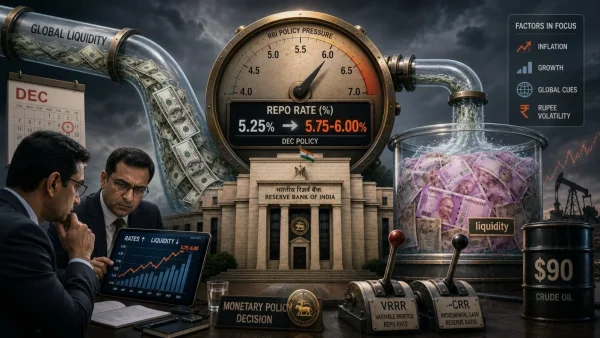
The prospect of cheaper loans in India may be waning once more. In its outlook for H2 FY27, Union Bank of India has the RBI set to put the brakes back on with rate hikes, pushing the repo rate from 5.25 per cent to somewhere in the 5.75-6 per cent band. Excess liquidity and the risk of inflation are the reasons given for the base case of a move in December.
RBI seen preparing for a new tightening phase
Union Bank of India would have you believe the policy conversation has changed. There is robust growth but price pressures are proving sticky, and a deluge of foreign currency has swelled rupee liquidity. All of this puts monetary tightening back on the agenda for the second half of FY27.
In terms of magnitude, the bank envisions a 50-75 basis point cumulative rise over the course of two or three 25 bps increments.
It is a tactical way of looking at it: to rebalance liquidity and then see if borrowing costs need calibrating should inflation risks fail to abate, moving the repo rate into the 5.75-6 per cent zone.
Why liquidity is back in focus
The impetus is the run-up in forex inflows through the RBI's special swap facility. By August 31, total inflows were in the vicinity of USD 136 billion. Most of that, USD 127.23 billion, was via FCNR(B) deposits, the balance being overseas and external commercial borrowings.
That has had the effect of a pronounced jump in rupee system liquidity. Union Bank of India puts core liquidity at Rs 8.05 lakh crore in mid-August, up from Rs 4.82 lakh crore in the middle of June.
An illustrative scenario from the bank has core liquidity hitting some Rs 14.17 lakh crore by September 11. At that level, absorbing it will be a near-term imperative for the RBI.
Timeline and size of possible hikes
December is the likely starting point for H2 FY27 according to the bank’s base case. An earlier date is not out of the question, provided surplus liquidity is put to rest in a credible fashion and the right domestic and global conditions are met.
Union Bank of India is clear on the numbers: two or three 25 bps moves to take the benchmark from 5.25 per cent to 5.75-6 per cent.
One cannot discount an October hike. Should the US Federal Reserve act in September and the RBI take more lasting steps to neutralise excess liquidity, the bank says a move could be made.
Tools the RBI could deploy first
Rather than go straight for the repo rate, the bank anticipates the RBI will make use of liquidity operations. Look for announcements ahead of the October policy, of a reversible nature.
There are short and longer-tenor variable rate reverse repos to consider, as well as an incremental cash reserve ratio. Bond sales and FX swaps are other levers available.
Union Bank of India thinks the RBI will begin with temporary measures and fine-tune as credit demand picks up in H2 FY27. A 50:50 split between short-term VRRR and longer duration tools is estimated to do the job of soaking up the surplus.
External pressures that could tilt policy
Then there is crude, the great unknown. Oil in excess of USD 90 a barrel is a warning from the bank that it will put the rupee under pressure and complicate matters for the RBI with higher inflation.
On the other hand, a de-escalation of geopolitical tensions would open up some room for the central bank to be more flexible in its approach, assuming inflation is cooperative.
What lenders and borrowers should watch
Expectations in the weeks to come will be driven by a handful of signposts:
– Any steps to absorb liquidity prior to the October policy
What this means for the market now
Union Bank of India has laid out a strategy of liquidity discipline followed by rate action where necessary. It is a matter of recalibration, not a complete pivot, with the timing dependent on global rates and the handling of the domestic surplus.
For the household or company, the advice is to follow the RBI’s liquidity play. That will determine whether we see the lift-off to 5.75-6 per cent in December.