Home cooks are no doubt wondering what has a place on the Lord’s preferred bhog thali as the 2026 festival nears. Devotees are turning to the likes of makhan mishri and dhaniya panjiri for their simplicity. To that end, chef Sanjeev Kapoor has put together four straightforward preparations for the family to enjoy.
There is more soul to a good bhog than an overwrought display. You will find the spirit of the occasion in a crunchy, fragrant bite or a dish with a gentle sweetness at midnight. It makes for a wholesome plate of prasad that is easy to offer and welcome.
The menu is really a celebration of the basics: milk, curd, butter, fruit, grains and nuts. These are the sort of ingredients that make for a comforting treat, whether on the family table or in the temple corner. One wants flavours that are pure and textures to soothe.
The spirit of a bhog that feels homemade
It is a case where less work can be more rewarding on this festival. Some of the best offerings are made from what is already in the pantry and are done in short order. Take dhaniya panjiri; it is nutty and aromatic but hardly takes 15 minutes to see to.
Then there are the cold, creamy desserts. Chilled makhana kheer is just the thing for the midnight hour, the roasted fox nuts giving the thickened milk some substance. A soft poha or a bowl of fresh fruit will offset the richness without being too heavy.
Chef Sanjeev Kapoor’s 4-dish bhog platter
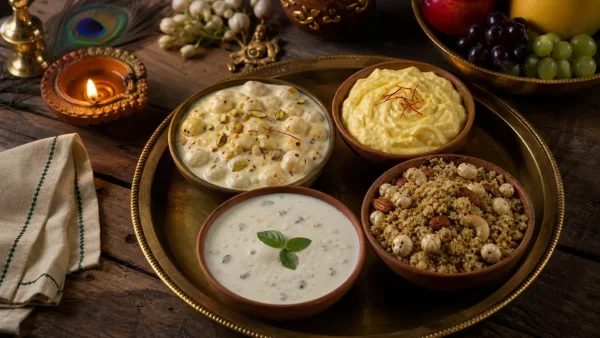
On Instagram not long ago, the chef laid out a simple, no-fuss spread for a home Janmashtami. His four dishes are:
– Makhana kheer, with saffron notes and reduced slowly
– Makhan mishri, of a gentle sweetness and well-whipped
– Panchamrit, the ritual blend of five
– Dhaniya panjiri, to put the coriander and nuts forward
Kapoor considers the panchamrit non-negotiable. He keeps it mellow by combining 16 tbsp milk with 8 tbsp yoghurt, 4 tbsp sugar, 2 tbsp ghee and a tablespoon of honey, capping it with a tulsi leaf. Stirred and served in small amounts, it is mild and creamy.
For the makhan mishri he has a trick: use whipped ghee in place of butter. Beat 1/2 cup of it over ice until it turns white, then fold in 2 tbsp of crushed rock sugar and some saffron strands. A scattering of pistachio slivers and it is ready for company in seconds.
His version of the dhaniya panjiri makes the most of the coriander’s warmth. The mix of 3/4 cup coriander seeds and 3 tbsp plus a teaspoon of ghee is complemented by chopped almonds and cashews, chironji and melon seeds. He adds in broken makhana, grated dried coconut, powdered sugar and a touch of green cardamom for a toasty, satisfying finish.
If you want the kind of comfort that comes in a bowl, his makhana kheer delivers on indulgence without any fuss. The recipe calls for 1 litre of milk to be halved in volume before the lotus seeds are added, along with 2 tbsp ghee, 1/2 cup sugar, cardamom and saffron. Garnish with pistachios and it is complete.
Ten easy bhog ideas you can finish fast
Those looking to put together a more extensive thali should go for complementary textures. Make a start with some makhan mishri for the first bite, then have a bowl of fruit on hand to keep things bright.
There is a gentle quality to this light and sweet combination.
One might then introduce some comfort and a bit of crunch. Makhana kheer has its creaminess, but for a snappy finish there are roasted makhana with cardamom powder and crushed mishri. It is a lovely contrast, the warm, perfumed bite set against cold spoonfuls of kheer.
Dhaniya panjiri and sweet poha suit the homely yet festive mood. The panjiri has a distinctive taste from the roasted coriander. As for the poha, soft and mixed with grated coconut, chopped banana and a touch of jaggery or sugar, it is a humble way to show that bhog can be nourishing without much ado.
Then there is the matter of a slow-stirred dessert. You would not want to put in Lauki halwa, cooked with milk, ghee and sugar and put to bed with nuts and cardamom. Hand-made in celebration style, it provides a centre to the thali that store-bought confections do not have.
For variety, fasting-friendly options have their place. A sabudana laddoo is compact and travel-friendly; made with roasted sabudana and peanut powders, cardamom and warm ghee, it has a character and bite you will not find in the flour-based sort.
Fasting-friendly bowls and balancing touches
To keep things on the lighter side, a bowl of fruit is hard to beat. Bananas, apple, pomegranate, pear and grapes will do. If one’s tradition permits, a little sendha namak and roasted cumin gives a savoury edge; if not, let it be plain and juicy.
Finish off with some panchamrit in small cups, made fresh. The creamy sweetness complements the dairy and grain offerings and ties the plate together.
Taste-first planning for a no-stress midnight thali
What makes a Janmashtami menu worth remembering is the way the food is eaten. Late hour textures should be calming, roasted notes provide warmth and light fruits stave off palate fatigue. Each item must justify its spot by what it brings to the table.
Think of the rhythm: makhan mishri, a sip of panchamrit, some panjiri and a cooling mouthful of kheer. Familiar flavours in a soothing order.
Some practical notes from the recipes at hand:
– Put the kheer in the chill for midnight
– Panchamrit should be fresh and in small measures
– Do not let the poha get runny
– Keep the panjiri fragrant and warm
– Roast the makhana to crispness
– Hold back on the fruit bowl’s sweetness
– Tulsi and sendha namak only where your custom allows
Why this matters for Janmashtami 2026
When the family comes together for the midnight aarti, the bhog is a memory in the making. These are not grand displays but devotion in familiar form. The milk, curd, butter and grains all hark back to the pastoral tales of Krishna’s youth.
It is an approach any busy kitchen can manage. Most of these come together in three or four steps. Even two dishes done with care can feel like enough.
Kapoor’s four recipes make a good template for those beginning from nothing. His makhana kheer and dhaniya panjiri give the necessary cream and crunch, while the makhan mishri and panchamrit see to the ritual. A tight plate that does not require crowding the stove.
The takeaway for your bhog plate
Do not just count the items, build for meaning. Have a dessert with some body, something to crunch on, a drink for the ritual and a fresh component. The thali will seem ample without being too much.
In the final analysis, the bhog that is most cherished is the one put together slowly and given as prasad with feeling. Whether it is a full spread or a couple of well-made classics, the plate will speak for the occasion.