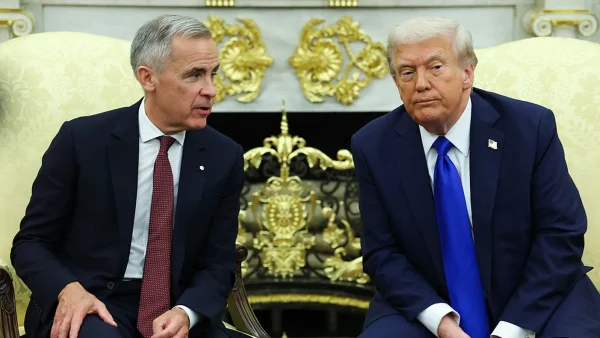
In a curious twist of fate, Canadian Prime Minister Mark Carney recently found his name flashing in the headlines over an anti-tariff advertisement that put the Canada-U. S. relations under strain. Regarding the ad, its very existence infuriated U. S. President Donald Trump, who precipitated a private apology by Carney during dinner in South Korea-an incident representative of the tightrope walk of international diplomacy and trade relations between Canada and U. S.
The Ad That Stoked Controversy
The ad went on air in mid-October and was particularly critical of President Trump’s tariff regime. It showed a clip of former U. S. President Ronald Reagan from a 1987 radio address: Reagan argued that tariffs are bad for every American, bringing economic downfalls. To use Reagan given the icon status he holds among Conservatives and his stance on protectionism is quite provocative.”
Ford would later say that Carney opposed airing the ad; yet it was put live in ad spots during the primetime of every major network during the World Series. The ad meant to challenge Trump’s trade policies—and it is said to have cost $75 million to produce and air.
Reaction by Trump and Therefore Increasing Tariffs
President Trump acted swiftly and without compromise. He announced the immediate freezing of trade negotiations with Canada until further notice and threatened a 10-percent tariff on Canadian goods. While these tariffs were never implemented, the threat itself poisoned relations between the two countries. His reaction indicated the administration’s susceptibility to issues around trade relations being portrayed in the media, with its ramification on U. S.-Canada trade relations.
Following their meeting in South Korea, Trump described the conversation with Carney as “very nice,” yet remained firm that talks will not resume until further notice. This shows the multifaceted nature of international diplomacy, where policies do not always change simply on the basis of a positive personal relationship.
Doug Ford’s Stance
Undeterred by Trump’s reaction, Doug Ford called the ad “the best ad I ever ran,” highlighting its ability to highlight the ills that come with tariffs and thus angered Trump. The ad’s continued traction indicates Ford’s steadfast belief in the message and felt that it could influence public opinion on trade policies.
The premier went even further and wrote in major American newspapers like The Washington Post and The Wall Street Journal about American free trade-style Reagan, where tariffs would harm American jobs and consumer costs.
Carney’s Diplomacy
Navigating the turbulent events of the controversy, Prime Minister Mark Carney had a difficult diplomatic atmosphere to maneuver. The apology served to patch things up while focusing on the broader context of Canada’s international relations. Carney has been attempting to diversify Canada’s economic partners, thereby weakening the dependency on U. S. markets-this was evidenced in his talks at the Asia-Pacific summit with Chinese President Xi Jinping.
Carney’s approach is part of the larger design to forge new partnerships overseas so that Canada is not too heavily dependent on its southern neighbor for economic welfare, an approach imperative as the dynamics surrounding global trade keep evolving.
A Wider Stage: Trade Relations and Diplomacy
The advertisement turmoil has come to symbolize yet bigger issues affecting modern-day global trade, where political statements have the power to alter relationships on the international stage. It signifies a kind of “back two-back” action, in that domestic political maneuvers reverberate beyond the national front to somehow influence diplomatic ties and economic policies.
For both Canada and the United States, however, maintaining good bilateral relations is important in an increasingly interdependent world economy. As both countries face these issues, their leaders must balance domestic political agendas with the competing international diplomatic responsibilities.
In conclusion, this turmoil might have acted as a temporary stain on American-Canadian relations; however, it also shows that international disputes must be solved through open dialogue and informed diplomacy. Since Carney is still very much engaged in trying to diversify economic relations in Canada, we should watch with bated breath how these developments play into the future relations between the two nations.
This situation-in fact-is a reminder of the delicate dance leaders must perform on the world stage-granted-the movements are carefully observed and could have consequences opposite end of the country in domestic policy or may set up opposite ends of the world in international alliance arrangements.