For years, the slogan has been loud:
“Boycott Chinese goods.”
The trade data, however, appears to be speaking in a different language.
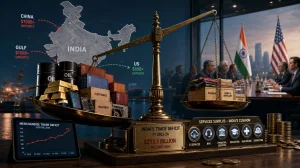
India’s trade with China over the past five financial years reveals a widening imbalance—exports have steadily declined, while imports have climbed to record levels.
If numbers could laugh, these probably would.
The Trade Story in Numbers
Financial YearExports to ChinaImports from ChinaFY21$22 billion$65 billionFY22$21 billion$94 billionFY23$16 billion$98 billionFY24$17 billion$101 billionFY25$14 billion$113 billionThe trend is unmistakable.
Exports have fallen from $22 billion to $14 billion.
Imports have risen from $65 billion to $113 billion.
The trade deficit has widened significantly over the five-year period.
The Deficit That Keeps Growing
Every year, India has bought far more from China than it has sold.
That gap has become increasingly difficult to ignore.
Economists point out that India continues to depend heavily on Chinese imports for:
Electronics and mobile components
Machinery and industrial equipment
Solar panels
Active pharmaceutical ingredients (APIs)
Chemicals and manufacturing inputs
In other words, while India may assemble many finished products domestically, a substantial share of the underlying components still comes from China.
Comment: Nationalism Doesn’t Manufacture Microchips
Calling for self-reliance is easy.
Building a complete manufacturing ecosystem is much harder.
Factories don’t appear because of hashtags.
Supply chains don’t relocate because someone changed their social media display picture.
If economic independence were achieved through speeches alone, India would probably be exporting semiconductors to Mars by now.
The Irony Is Hard to Miss
One day:
“Delete Chinese apps.”
The next day:
Import another $113 billion worth of goods.
Apparently, the boycott has been highly successful…
…for Chinese exporters.
Why Are Imports Still Rising?
The answer isn’t as simple as consumer preference.
Many imports from China are not toys or decorative lights—they are industrial inputs essential for Indian manufacturing.
Indian companies often rely on Chinese suppliers because of:
Competitive pricing
Large-scale production capacity
Established supply chains
Limited domestic alternatives in several sectors
Reducing dependence therefore requires long-term investment, not just short-term restrictions.
The Real Debate Isn’t China—It’s Competitiveness
The controversy isn’t whether India should trade with China.
Every major economy trades with strategic competitors.
The real questions are:
Why have India’s exports to China declined?
Why is import dependence still increasing?
Which sectors remain most vulnerable?
How quickly can domestic manufacturing reduce these dependencies?
Are current industrial policies delivering measurable results?
These are economic questions that deserve economic answers.
A Strong Economy Doesn’t Fear Data
Trade figures are neither patriotic nor anti-national.
They are indicators.
If the numbers improve, governments deserve credit.
If they worsen, policymakers deserve scrutiny.
Ignoring the scoreboard has never helped any team win.
Conclusion
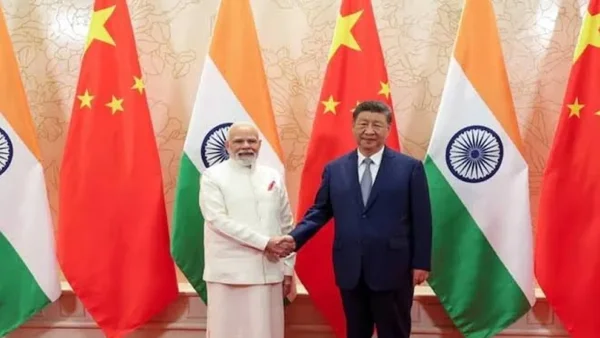
The five-year trade data highlights a growing imbalance between India and China. While the government has promoted domestic manufacturing and self-reliance through initiatives such as Atmanirbhar Bharat and production-linked incentive (PLI) schemes, the figures suggest that reducing dependence on Chinese imports remains a work in progress.
Economic self-reliance is not achieved by slogans alone.
It is built factory by factory, supply chain by supply chain, and export by export.
Until then, the loudest slogan in the India-China trade relationship may continue to come not from political rallies—but from the customs ledger.