Even as exports set an all-time high, India’s merchandise trade deficit for May was about where you’d expect it to be, a sign of how we’re holding our own in a changing geopolitical landscape. The figure was $28.21 billion; on the other side of the ledger, merchandise exports were up 18% year-on-year to $45.20 billion and imports in at $73.41 billion. It puts a fine point on India’s standing as supply chains make their adjustments.
The May shortfall, at $28.21 billion, was not much different from April’s $28.38 billion, per the provisional data put out on 15 June 2026. We saw exports come in at $45.20 billion, up from $43.56 billion in April, and a small nudge in imports to $73.41 billion from $71.94 billion. Put that against a year ago when the deficit was only $22.56 billion and the difference is clear.
Record exports, steady gap, tougher base
You had a 18% jump over last May to get to $45.20 billion in merchandise, the best month we’ve ever had, the commerce ministry will tell you. It’s a broad-based kind of strength, with the likes of engineering goods, petroleum and electronics leading the way.
On the import side, we’re at $73.41 billion, a 20.6% increase from $60.86 billion twelve months back. That has the merchandise deficit at $28.21 billion, up from $22.56 billion in May 2025. There is strong home-grown demand and higher import bills to account for.
Rajesh Agrawal, the Commerce Secretary, would put it this way: May is one of the better months for merchandise export growth in some time. He has seen both sides of the ledger grow in April and May and figures if we keep this up, FY27 is in for a good run.
What is powering the rebound
It’s the higher-value items that are moving the needle. If you look at May, the uptick in engineering, petroleum and electronics is no accident – there is more capacity being used and a clearer line of sight on demand in those areas.
Agrawal also points to a turn for the better in West Asia. After some hiccups, shipments to the region in May were back to where they were in 2025, with the UAE, Saudi Arabia, Jordan and Yemen all chipping in on the demand side.
Hormuz reopening changes the risk map
There is a bit of a silver lining with the preliminary deal between the U.S. and Iran to stand down and let the Strait of Hormuz be. The ministry made its release right after the word came out, and exporters are hoping for less of a headache with freight and some calm in the Gulf markets.
We have had to reroute cargo before, which is costly and time-consuming for Indian companies. For the smaller operators – they make up 48% of our exports – the disruptions were felt hard. A stable Hormuz is just part of the equation for keeping our trade running smoothly.
Services cushion widens, but overall gap still rises
Then there is the services side of the house. Exports in that category were up to $36.76 billion in May, compared to $32.46 billion a year prior. Imports in services went to $19.06 billion from $16.70 billion. The surplus in services does some of the work in offsetting what is happening with the goods.
But if you add it all up, the total trade deficit is $10.51 billion, versus $6.79 billion in May of last year. All in, we are looking at $81.96 billion in total exports and $92.47 billion in imports.
The RBI put it in a nutshell on 5 June: with the kind of uncertainty and volatility we are seeing in the world, it has made for some rough trading conditions of late.
On the upside, you have higher energy costs and some policy headwinds to worry about for the FY27 current account deficit. But there’s a counterweight in the form of a services surplus and steady remittances.
April was the harbinger
What we saw in May was an extension of a very solid April. Back then, merchandise exports put up $43.56 billion, up from $38.28 billion the prior year. Imports were on the move too, 10% higher at $71.94 billion, which left the merchandise deficit at $28.38 billion, a bit wider than the $27.1 billion we had a year ago.
You can see the hand of policy in how external shocks are being absorbed. The RBI has noted that even with freight and insurance running hot, April’s export numbers were strong. And services didn’t waver, not even with all the talk of AI’s effect on demand.
To deal with these outside risks, India’s policymakers have been at it with a number of different levers: propping up small and export-oriented firms, trying to produce more gas and crude at home, and making it easier to swap out imported inputs for something made in India.
The policy play: FTAs, digital tools and open markets
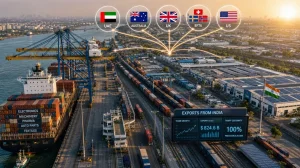
The commerce ministry is counting on trade pacts and some housekeeping to make our exports more competitive. We’re already seeing the fruits of deals with the UAE, Australia and EFTA, which have given Indian goods and services better access.
But having access is one thing; turning it into orders is another. So this year, the department is going on the road with a series of state-level workshops to make sure exporters and industry groups know their way around the tariff lines and certification under the new FTAs.
Then there is the matter of digitisation. “Over the last 12 years, we’ve put in place a fairly digital system for trade,” says Agrawal of the DGFT. He wants to be more open with the data, putting more on the table for the public and making the interface with the exporter side of things as clear as possible.
It has paid off. In those 12 years, merchandise has come close to doubling and services have tripled. Now the idea is to put us on a course for 20 or 25 years of steady growth.
Why it is in focus
You have record exports and a monthly deficit that is hardly moving. It’s a mixed bag, but an important one. The appetite for what we make is up against import needs that are just as firm, so the deficit is where it is relative to last year, if not any worse than the month before.
Assuming the Strait of Hormuz stays open and we don’t have to deal with as much volatility in shipping, some of the cost will go away. That is good news for the MSMEs in particular, who have to watch their margins and can’t afford to be hit hard by logistics.
With the new deals and the way we do business now, we should be in a position to pick up some extra work as supply chains look for new options. The question is whether we can hold the line on the import bill and still grow.
In short, for those keeping tabs on the numbers:
– Goods exports are at a high of $45.20 billion
– Imports in at $73.41 billion (a 20.6% jump)
– The May deficit is level with the month before
– The overall figure has come in at $10.51 billion
– Services are up to $36.76 billion
Looking ahead
The target is to get total exports over $2 trillion by FY31, with an even split between the two. The government has told its people to make a point of it with the MSMEs and farm sector, and to put some oomph behind the Brand India push.
For FY27, with the Gulf situation looking up and some policy help, we may be able to weather what is coming. But the math doesn’t lie: we have to keep exports on a record run and put a lid on a sizeable import tab. That will be the story for the next few months.