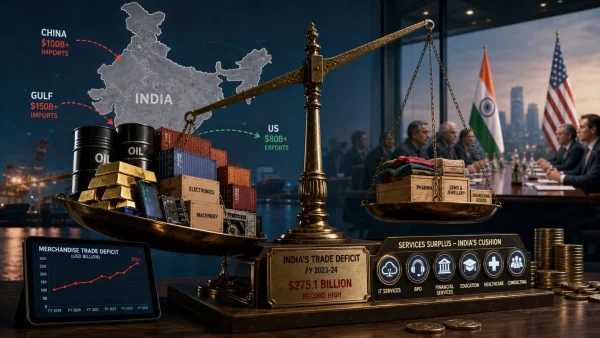
The numbers tell the story: the trade gap in June was 59% higher than a year ago, coming in at $30.43 billion to top the $26.63 billion that was on the table. With imports at $70.84 billion and exports at $40.41 billion, it is a wide margin. It is a figure that will be on everyone’s mind as India goes into its next round of talks with the United States.
What drove the record deficit
It is not only a matter of comparing this year to the last. Month over month, the situation has also turned for the worse. In May the deficit was $28.21 billion; by June, with exports retreating more quickly than imports, it had grown. Merchandise exports were down to $40.41 billion from $45.20 billion, even as imports came in at $70.84 billion, down slightly from $73.41 billion.
Sunil Barthwal, the Commerce Secretary, puts the import side of the equation down to steeper global prices for things like petroleum and fine metals. He is quick to point out, however, that you can’t read too much into the volume of what is being brought in; it is as much about the price tag and a healthy demand for home-grown electronics.
Prices, not volumes
You see the gap open up in petroleum, electronics and the gems and jewellery sector. There is a lot of buying power in the middle class right now, and that is where the flow of electronic goods is coming from. On the flip side, ready-made garment exports have been under some strain in the April-June period.
A few of the salient figures:
– Trade deficit: $30.43 billion in June
– Imports: $70.84 billion in June
– Exports: $40.41 billion in June
– Year-on-year import growth: 31%
– Year-on-year export growth: 15.5%
Shifting partners and supply lines
The kind of countries India is doing business with is changing. The Commerce Ministry notes that more than half of all merchandise is now going to places beyond Europe and NAFTA. We have seen a return to form with the Gulf, where exports hit $5.3 billion in May after shippers found other ways around, compared to $2.62 billion back in March.
Then there is the matter of China. The reliance on Chinese inputs is still there. In the first quarter of FY27, what we imported from there totalled $38.04 billion, up from $29.73 billion the prior year. There is a steady need for the components and intermediate products they provide.
US talks, investigations, and tariff overhang
New Delhi is moving forward with the framework for a trade deal with the US, even as some probes are in motion on the other side of the Atlantic. Rajesh Agrawal, the Commerce Secretary, has made it clear that the Section 301 work is underway and India has put in its answer to the questions on forced labour.
‘We are looking for the final word on the investigation this month,’ he said. A different look at excess capacity could be a few weeks out from the draft. As for the agreement, there is no hard date. The 10% tariff on our goods in the US is due to run out on July 24th.
Agrawal is in good spirits about the overall tie-up. ‘There is no obstacle in the way of these negotiations. We are on the right track and both parties are in a positive frame of mind. The deal is there to be signed when the time is right. And it is not just trade; we are seeing stronger links in energy as well.’
Buffers, outlook, and what comes next
Services have been a bit of a soft spot in an otherwise hard month. The Ministry has the services surplus at $15.11 billion, with $33.03 billion in exports against $17.92 billion in imports. For the three months to June, goods exports have put up a 15% gain, in part because of the war on Iran and the cost of the oil being shipped.
There is some policy headway on market access to be had. A free trade arrangement with the UK is to be in place this month and one with the EU is on the horizon for early next year. In the view of trade watchers, with new pacts in the offing and less risk, India is in a better position to make its case.
Santanu Sengupta of Goldman Sachs would agree. He sees the interim peace between the U.S. and Iran as a help to India by taking the edge off oil costs. The bank has put its 2026 growth number for India at 6.8%, with lower calls on inflation and the current-account deficit. A rupee that is not so strong has also made for a fairer playing field for exporters.
But do not count out the effect of heavy importers and metals. In the first three months of the fiscal, gold alone went from $7.49 billion to $11.01 billion. That is how quickly the balance of goods can be put under a strain when the price is right. Overall, for April-June, exports were up 15.92% to $129.32 billion, but imports have outpaced them at 19.89%, or $216.18 billion.