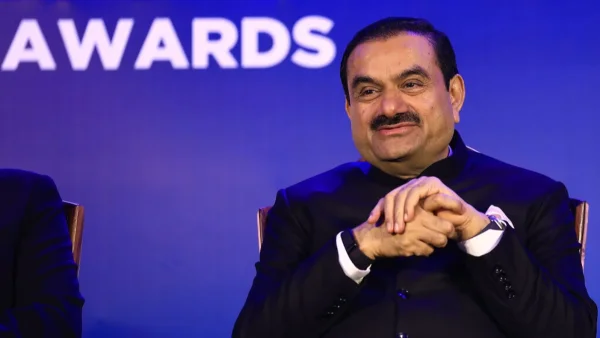
India can no longer consider energy and data as things that are secondary; they’re now essential. At the 2026 CII Annual Business Summit, Adani stated that power and computing power will decide which country will be the leader in the next economic cycle and bluntly said that India must build its own AI and energy infrastructure immediately, or it will become too reliant on other countries.
Why Adani’s warning matters now
The previously reliable ideas about free trade and easy sharing of technology are starting to break down. Adani explained that things like supply chains, financial systems, and cloud computing are now being shaped by international political relationships, not just by how efficiently the market works. Countries are rebuilding their digital and physical networks with security as the most important thing, and India has to react quickly.
He described energy security and digital security as the new ways countries gain power. A country with enough electricity can greatly expand its manufacturing. A country with enough computing power can be a leader in intelligence. And, he said, the country that manages both will be the one that leads in the coming century.
Energy and compute as national power
Adani said that semiconductors (the chips in computers) are now used as tools in international politics, and data is being considered a resource that belongs to the country. He also warned that cloud systems are becoming more and more like weapons and AI is being developed inside secure data centers.
Because of this, he urged India to move away from simply “renting” these things. India needs to build, provide the energy for, and own its AI systems within India. He believes true independence in energy and computing power is the only way to protect India’s economic and security interests.
India’s capacity milestones and projections
As of March and 500 gigawatts (GW) of power capacity, India has already installed. Adani thinks the country could have almost 2,000 GW by 2047, and he calls this a complete change, not just a gradual increase. He emphasized that this huge amount of power is essential for the age of AI.
He says building the data infrastructure will be a steep challenge. India’s AI-related data center capacity, which is expected to be 5 GW by 2030, could grow to nearly 75 GW by 2047. He warned that the massive increase in the need for computing power requires preparation now, not later.
AI as infrastructure, not just software
Adani said AI should be seen as essential infrastructure that includes energy, data centers, chips, networks, computing power, and skilled people. He emphasized that having your own data and computing power will be the key to technology competition in the next stage.
He responded to fears that AI will mostly cause people to lose their jobs. Instead, he said, India should use AI to increase how much is produced, make new jobs, and give more power to small businesses. The goal should shift from writing computer code for the rest of the world to developing intelligence that is mostly independent.
From UPI to AI: jobs and inclusion
To illustrate his point, he pointed to UPI (Unified Payments Interface) and how it completely changed India’s digital world. By bringing millions of Indians into the financial system, UPI allowed companies like Flipkart, Paytm, Ola, Swiggy, Meesho, Zepto and PhonePe to grow. He said AI could lead to even more people joining in.
For him, how many new tools Indians get to compete with the rest of the world and start companies more quickly will be the true measurement of AI’s success, not the number of jobs that disappear.
Where investment is flowing
Adani repeated the Adani Group’s earlier promise to invest $100 billion in changing to cleaner energy and building digital infrastructure. He also repeated a further $100 billion investment in the Group’s data center business, showing a plan to simultaneously build both electricity and computing power.
He highlighted the 30 GW renewable energy project in Khavda, Gujarat, describing it as the largest single-location renewable energy plant in the world, with 35% of it already up and running. Regarding digital infrastructure, he mentioned working with Google and Microsoft.
One project with Google is to build India’s largest gigawatt-scale data center campus in Visakhapatnam. He also spoke about working with companies like Flipkart and Uber on data infrastructure projects that fit with a system of independent computing power.
What changes for Indian industry
Adani sees India’s economy, which is driven by demand, as a strategic advantage. The need for both electricity and computing power from manufacturing, transportation, logistics, and digital services will continue, making it easier to get funding for large infrastructure projects.
He believes the next period of growth will go to those who build the essential foundations. As he put it, the future isn’t something that happens to you; you have to build it. This means designing power grids, data centers and networks that can grow without relying on other countries.
To translate the summit message into near-term priorities, here are the core imperatives he set out:
– Build sovereign AI and data centre capacity in India
– Accelerate power generation to meet AI-era loads
– Treat data as a national resource with safeguards
– Use AI to create jobs and productivity gains
– Align industry with long-horizon infra commitments
The stakes and the timeline
Adani’s plan is very specific. India’s progress from 500 GW now to 2,000 GW by 2047 needs to be matched by increasing computing power from 5 GW by 2030 to almost 75 GW by 2047. If India falls behind, important processes and data will be done in other countries.
He warned that if India’s data is processed in other countries, its future will be decided there too. He is calling for India to build the ability to handle data where the need for it is, so that national security, innovation and economic opportunity all work together.
Bottom line for policymakers and boards
Government policies need to make both expanding energy and having independent computing power top priorities. This includes creating power grids that can handle a lot of usage, encouraging the development of domestic chip and cooling systems, and making sure there are enough skilled workers.
For business leaders, he said, they should start planning now for power, how long it takes for data to travel (latency), and how data is managed. Adani suggested that those who invest early in reliable energy and AI infrastructure will determine how competitive India is in the coming decades.