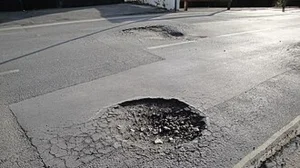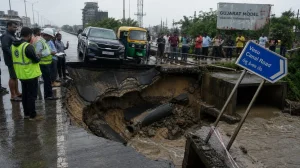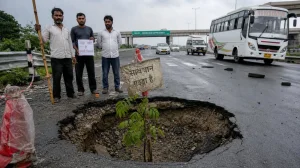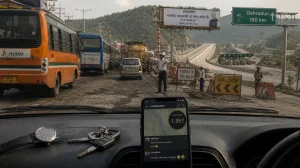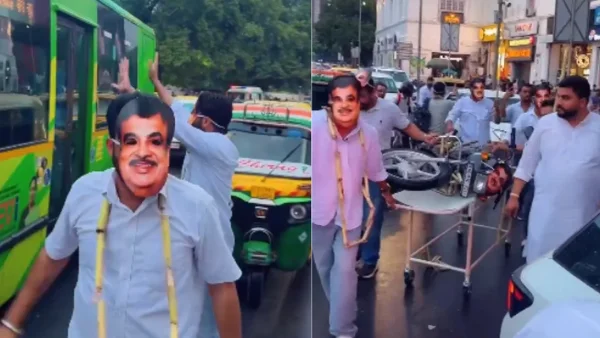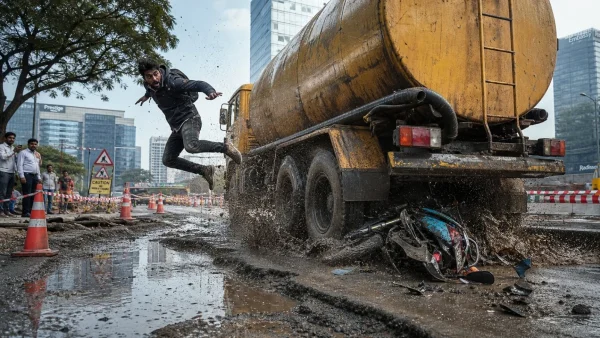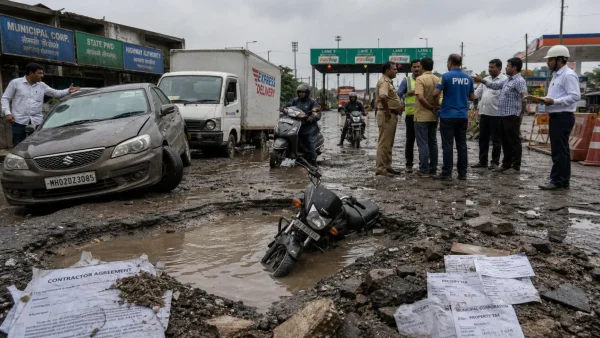
A severely damaged stretch of road has triggered renewed public anger over the condition of India’s roads and the value taxpayers receive in return for the taxes and charges they pay.
Images and videos of roads covered with large potholes, broken surfaces and damaged stretches have increasingly become a familiar sight across cities and highways. For motorists, the problem is not merely cosmetic. Poor road conditions can damage vehicles, increase travel times and create serious safety risks.
The controversy raises a straightforward question:
If citizens are paying at multiple points to use and maintain the country’s transport infrastructure, why are basic roads still deteriorating so badly?
A Motorist Pays at Multiple Levels
For an average vehicle owner, the cost of using a road does not come from a single payment.
Depending on the individual’s circumstances and location, the financial burden can include:
Income tax on earnings;
GST on the purchase of goods and services, including automobiles and related products;
Motor vehicle taxes and registration charges;
Fuel taxes incorporated into the price of petrol and diesel;
Toll charges on designated roads and highways; and
Various other fees and charges associated with vehicle ownership and transportation.
Not all of these payments are legally earmarked exclusively for road construction or maintenance.
That distinction is important.
Income tax, for example, goes into the broader government revenue pool rather than directly funding the particular road on which an individual drives.
Similarly, fuel taxation and GST have broader fiscal purposes.
Nevertheless, citizens reasonably expect government expenditure to translate into safe, usable and durable public infrastructure.
The Pothole Problem Is Bigger Than One Damaged Road
A pothole may appear to be a minor maintenance issue.
For two-wheelers, however, a deep pothole can cause a rider to lose control.
For cars and commercial vehicles, repeated exposure to damaged surfaces can contribute to tyre, suspension and steering problems.
During monsoon periods, the situation can become even more dangerous because water can conceal the depth of potholes.
What appears to be a shallow puddle can hide a substantial depression underneath.
The consequences can include accidents, traffic congestion and costly vehicle repairs.
Who Is Responsible for Maintaining the Road?
One of the biggest problems in India’s road infrastructure is that responsibility is divided between different authorities.
Depending on the road, maintenance may fall under:
Municipal corporations;
State public works departments;
National Highway authorities;
State highway agencies;
Development authorities; or
Local bodies.
As a result, when a road deteriorates, residents can sometimes find themselves moving from one department to another trying to establish who is responsible.
That creates an accountability gap.
A taxpayer does not care which department owns the road. They need the road to be safe.
Construction Quality and Maintenance Matter
A newly constructed road deteriorating rapidly can raise questions about the quality of construction, materials, drainage and supervision.
However, poor road conditions do not automatically establish corruption.
Road failures can have multiple causes, including:
Heavy traffic loads
Poor drainage
Waterlogging
Extreme weather
Substandard materials
Inadequate construction practices
Utility excavation
Delayed maintenance
Poor-quality repairs
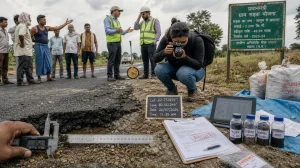
Determining whether there has been corruption or contractor malpractice requires an engineering and financial investigation rather than simply observing a damaged road.
Where Does the Accountability Begin?
When a road fails prematurely, the public should be able to obtain basic information.
For a major road project, citizens should ideally be able to find out:
Who received the contract?
What was the contract value?
What construction specifications were prescribed?
What was the expected lifespan of the road?
Who inspected and certified the work?
What maintenance obligations did the contractor have?
Were penalties imposed for defective work?
How much has subsequently been spent repairing the same stretch?
These questions are particularly important when the same road repeatedly requires repairs.
“World-Class Infrastructure” Needs a Reality Check
Governments frequently highlight new expressways, bridges, highways and other major infrastructure projects as evidence of India’s rapid development.
There is genuine progress in several areas.
But large flagship projects cannot substitute for basic infrastructure in neighbourhoods and smaller towns.
A country cannot claim world-class infrastructure while residents are forced to navigate dangerous roads every day.
Development is experienced not only on newly inaugurated highways.
It is experienced on the road outside a person’s home, the route to work, the street used by schoolchildren and the roads used by ambulances and emergency services.
The Taxpayer’s Return on Investment
The phrase “taxpayer’s return on investment” captures the frustration behind the debate, even though government taxation is not technically a direct investment account where every rupee paid must be returned through a particular service.
Citizens contribute to government revenues with the expectation that those revenues will support public goods and services.
Roads are among the most visible of those public goods.
When infrastructure works well, people rarely notice it.
When it fails, the consequences are immediate.
A broken road can mean:
A damaged vehicle;
A longer commute;
Higher fuel consumption;
Lost working hours;
Increased accident risk; and
Additional financial costs for households.
The economic cost of bad roads therefore extends beyond the cost of repairing the road itself.
The Real Demand Is Simple
The public does not necessarily expect every road to look brand new.
But taxpayers and motorists can reasonably expect roads to meet basic standards of safety, durability and maintenance.
If a road has deteriorated, authorities should repair it promptly.
If a newly built road fails prematurely, the reasons should be investigated.
If a contractor is responsible for defective work, contractual penalties and warranty provisions should be enforced.
And if public money is repeatedly spent repairing the same road, the expenditure should be open to public scrutiny.
The Bottom Line
The anger over pothole-ridden roads is ultimately about more than asphalt.
It is about value, accountability and public trust.
Citizens pay taxes and charges throughout their economic lives. They therefore have a legitimate interest in knowing whether public infrastructure spending is producing durable results.
A damaged road does not automatically prove that taxpayers have been “looted,” nor does it by itself establish corruption.
But when roads repeatedly fail despite substantial public expenditure, the questions become unavoidable:
Who built it?
Who inspected it?
Who maintained it?
How much public money has been spent on it?
And why has it been allowed to deteriorate to this condition? Because ultimately, infrastructure is not judged by the size of the announcement or the ribbon-cutting ceremony.
It is judged by whether the road remains a road when ordinary citizens actually need to use it.