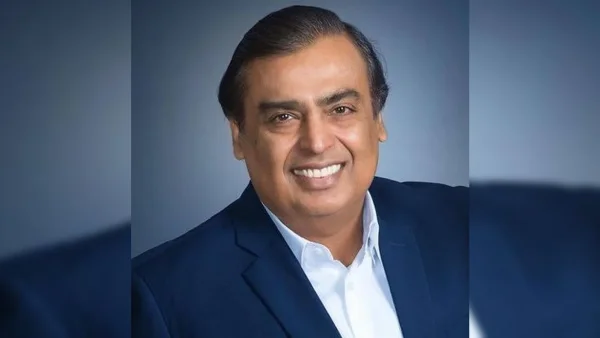
Mukesh Ambani has created a bold plan for India’s next ten years with artificial intelligence. Seeing AI as the coming universal technology, the head of Reliance Industries promised to make computing power inexpensive, safe, and available to everyone in the country. His main point was straightforward and far-reaching: India must develop its own intelligence, and can’t depend on getting it from other places.
A Rs 10-lakh-crore investment in independent AI infrastructure
Ambani said Reliance Industries and Jio will put Rs 10 lakh crore into creating independent computing infrastructure over the coming seven years. He called this a steady, careful, nation-building investment aimed at lasting worth – not just quick increases in a company’s estimated value. The investment is meant to lower the cost of intelligence just as Jio lowered the cost of data.
From connectivity to the Intelligence Era
This plan is a change from the connectivity boom of the last ten years, to what Ambani refers to as the Intelligence Era. Jio got India connected to the internet on a large scale; now it intends to give intelligence to every person, company, and public service. Being affordable and everywhere aren’t things being thought about after the plan is made – they are the main ideas behind it.
He insisted that a lack of and the high price of computing power are the real problems stopping people from using AI. Remove this issue, and progress will naturally happen. The money planned is for ability, energy, and delivery in one combined structure, so that strong AI isn’t only in technology centers, but in every district.
Ambani’s idea is based on ten years of digital preparation. India now has almost one billion people using the internet, some of the cheapest data costs in the world, and very little difference in quality between big cities and small towns. Aadhaar provides 1.4 billion digital IDs. UPI handles more than 12 billion transactions every month. There are now over 100,000 startups, and more than 100 “unicorn” companies.
Jio’s more than 500 million customers, and its 4G and 5G networks, made inexpensive broadband a common service. That same idea is now being applied to AI. The purpose is not a limited, high-end demonstration, but an everyday service that greatly increases output for farming, small businesses, industry, and public services.
Data centers at the gigawatt level and edge computing
To make AI possible on a large scale, RIL and Jio have identified three main parts. First, data centers at the gigawatt level in Jamnagar will provide training and large-scale reasoning ability. More than 120 MW is planned to be working by 2026, with a clear plan to grow to gigawatt computing, solving the country’s serious lack of ability.
Second, the building will make use of Reliance’s advantage in green energy. Ambani mentioned up to 10 GW of available extra green power, based on solar energy in Kutch and Andhra Pradesh. Connecting AI to clean energy can lower costs, protect operations from changes in the price of fuels like oil, and match growth with being environmentally friendly.
Third, a nationwide edge-compute layer will be closely linked to Jio’s network. This structure brings low-delay intelligence to where people live, learn, and work. From small shops and doctors’ offices to farms and schools, computing on devices and near cell towers will support quick reasoning without making every request go to a distant data center.
Ambani kept saying: make intelligence as common as connectivity. Edge computing doesn’t replace very large systems; it works with them. Together, they give safe, dependable ability for both everyday AI tools and difficult jobs for businesses.
Ambani explained five things that were absolutely necessary. First, AI must help advanced technology and high-value manufacturing, while also helping farming, small and medium-sized businesses, and the unofficial economy. He saw AI as something that greatly increases productivity and efficiency – not just a new search or chat tool.
Second, first-rate ability in many Indian languages is essential. When farmers, craftspeople, and students use AI in their own languages, real inclusion happens. Language access turns AI from a technology test into a service for the whole country.
Third, being responsible, security, keeping data in India, and trust are basic parts of the plan. Ambani said these protections won’t be added later. They are the foundation of independent computing, which must protect sensitive data and public belief.
Fourth, the plan will show that AI doesn’t take jobs away; it changes and creates them. New jobs in model engineering, data operations, edge deployments, and green power management will be created. The focus is on training people for more valuable work. Fifth, the AI competition isn’t really about finding the one best AI, but more about the system – the whole environment – that allows AI to be used quickly and by a lot of people. Reliance Industries Limited, and Jio, intend to form close working relationships with Indian companies, new businesses, the IITs, IISc, and research groups; they’ll also work with the top tech companies around the world as partners in design, not just as people they buy things from.
Using India’s digital public structures
The main thing to understand about this plan is India’s digital public structures. Aadhaar, UPI, and systems that work with each other already let people have secure IDs, make payments at once, and use public services easily. India’s DPI makes it easier to put things into practice and measure their effect, so it’s a good place for AI-based public services for people.
Ambani also stressed equal access. The difference in internet quality between Delhi and far-off villages has gotten smaller. The next thing to do is to make sure that AI has the same level of access – that a farmer in a small town can get farming advice as easily as a trader in Mumbai can do data analysis.
First uses show effect across the country
A number of uses have gone from just ideas to being tested in the field. In education, JioShikshak is an AI teaching assistant that changes to fit the student and speaks 22 languages. With 250 million school kids and 50 million students in college, AI tutors could free up what Ambani called India’s ‘Talent Wealth’.
In health care, Jio ArogyaAI gives first medical advice in local languages in minutes, on any phone. The idea isn’t to replace doctors, but to sort patients, give them an idea of what’s going on, and give them advice, cutting down on delays and improving health in places where there aren’t many resources.
In farming, JioKrishi changes satellite pictures and detailed weather data into simple advice, given by voice, for 140 million farmers. Turning hard data into local, practical advice could increase harvests and make incomes more stable.
For everyday life, JioBharatIQ is a voice-first helper that helps people learn, get work, and use public services. RIL is also making JioFrames, AI-powered glasses that bring smartness to things people wear. On media, AI-powered storytelling in many languages could strengthen India’s culture and its ‘soft power’.
Ambani presented AI as a choice between keeping things to a few or spreading them out. Computing power and data can be kept to a small group, or they can be shared to give more people opportunity. India, he said, is in a special place to connect the Global South and the Global North and to encourage working with each other, not being against each other.
Policy, world politics, and looking at the Global South
This position has a policy side to it. Having your own computing power reduces risk to the country and supports rules about where data must be kept. Linking computing to green energy deals with energy security and pollution. A system that puts computing power at the edge spreads capacity, making things stronger and cutting down on delays for people and companies.
Effects on the economy and jobs
This investment could speed up a large increase in industry. Making things is helped by AI-based quality control and predicting when things will need repair. Shipping and stores benefit from predicting what people will buy. Financial services make their risk models better. Public programs can give benefits to the right people with more accuracy and less waste.
Most importantly, new jobs and skills will be needed. Running data centers, managing power systems, making AI safe and judging it, managing the edge, and changing models for certain areas are all jobs that need a lot of people. Working with the IITs, IISc, and universities can make courses fit these new jobs and put responsible-AI practices into place.
People who invest, make policy, and make things will see how quickly capacity grows at Jamnagar and in other places. Look for milestones on 120 MW coming on line, the increase to gigawatt computing, and putting up to 10 GW of green power in place. How many edge nodes there are and how well they cover areas will show how quickly AI gets to users across India.
Another sign is cost. If Reliance can bring down the cost of each calculation and each training run as it did for mobile data, use could go way up. Expect ecosystems for developers, programs where new businesses work with Reliance, and benchmarks in many languages to shape how things go. Rules about data protection and AI safety will also shape how things are put into practice.
What to watch in the next seven years
Ambani’s message was practical and ambitious: make computing power a structure, price it so that many people can use it, protect it with strong rules, and link it to every area. If this is done, RIL’s Rs 10-lakh-crore plan could move India from being someone who uses AI to someone who is trusted to make AI and build platforms.
What’s at stake is clear. AI that’s spread out can make inclusion wider, raise how much people produce, and make opportunity bigger. With computing power owned by the country, green energy, and edge networks as its base, India’s Intelligence Era may come faster than many people expect, and on its own terms.