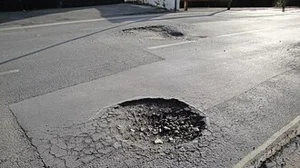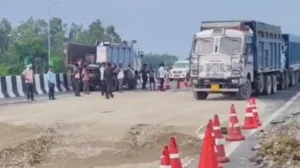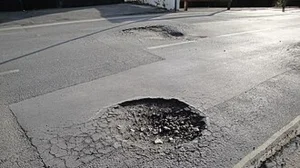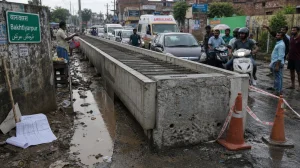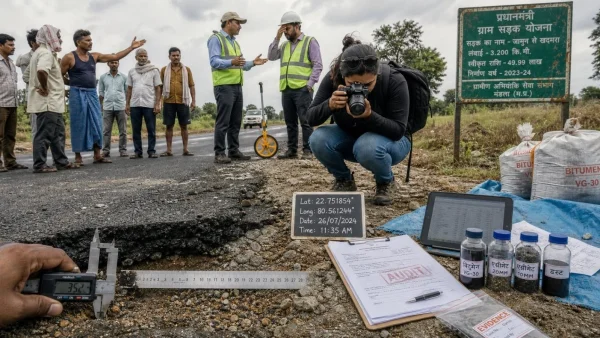
Questions over the quality of road construction and the use of public funds are once again attracting attention in Madhya Pradesh after a young journalist reportedly went on the ground to investigate allegations of irregularities in road construction.
The ground-level reporting has drawn public attention because it focuses not merely on political statements but on the condition of the road itself—bringing alleged construction deficiencies directly before the public.
While allegations made in a ground report must be independently verified before being treated as proven corruption, the broader concerns are not occurring in isolation. Official investigations and audit findings have separately identified serious irregularities in road-related projects in the state.
When the Road Becomes the Evidence
Road construction projects are generally carried out using public money and are expected to meet technical specifications relating to materials, thickness, drainage, compaction and durability.
When a newly constructed road begins deteriorating prematurely, questions naturally arise over whether the work was executed according to the approved design and specifications.
A journalist documenting such problems on the ground can provide an important first layer of public scrutiny—particularly when residents themselves report concerns about the quality of construction.
However, visible damage alone does not conclusively establish corruption.
Determining whether corruption occurred requires examination of project records, bills, measurements, material testing, contractor payments and engineering approvals.
A Larger Road-Construction Controversy in Madhya Pradesh
There is independent evidence that road construction in Madhya Pradesh has faced significant scrutiny.
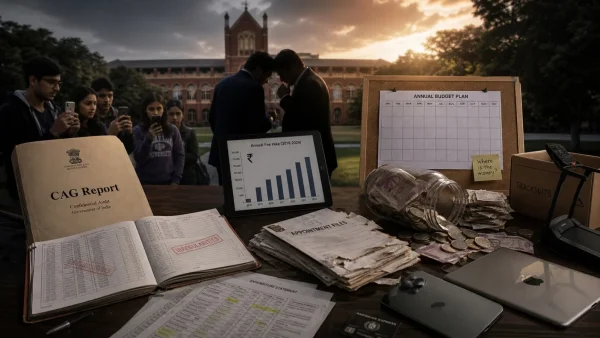
In February 2026, the Comptroller and Auditor General of India (CAG) tabled a performance audit examining road development by the Madhya Pradesh Public Works Department for the period 2018-19 to 2022-23.
The audit covered 25 of the department’s 56 divisions and subordinate organisations and examined hundreds of road and infrastructure projects.
The CAG’s findings have raised questions about project implementation, delays and financial management.
These findings provide important context for the growing public demand for greater transparency in road construction.
₹55.60 Crore Fake-Bill Investigation
An even more serious development came in June 2026.
The Enforcement Directorate (ED) conducted searches in Rewa and Jabalpur in connection with a money-laundering investigation relating to alleged fake bitumen bills used in road construction.
According to the ED, its investigation followed FIRs registered by the Madhya Pradesh Economic Offences Wing and involved alleged collusion between contractors and public servants associated with the Madhya Pradesh Rural Road Development Authority.
The agency alleged that forged invoices from oil companies including IOCL, BPCL and HPCL were submitted to obtain government payments for road construction work.
The alleged fake bills were valued at approximately ₹55.60 crore, according to the ED, with a corresponding alleged loss to the government exchequer.
During the searches, the ED said it seized records and digital devices, along with ₹23.50 lakh in cash, while bank balances and fixed deposits worth approximately ₹2.93 crore were frozen.
The investigation remains ongoing.
These are allegations under investigation—not a final judicial finding of guilt.
Rewa-Mauganj Also Saw an Asphalt Scam Investigation
Another investigation has focused specifically on Rewa and Mauganj.
Reports in April 2026 said an alleged asphalt-related scam involving the Madhya Pradesh Rural Road Development Authority dated back to 2017-2021, with the alleged irregularities estimated at around ₹18.59 crore.
The case involved allegations concerning poor-quality road construction and financial irregularities.
The existence of such investigations makes questions raised by ground-level reporting particularly relevant.
But each individual road project still needs to be examined separately.
Why Ground Journalism Matters
A journalist physically visiting a construction site can document things that may not be visible in official paperwork.
Photographs and videos can show:
Crumbling or peeling road surfaces
Inadequate road thickness
Poor drainage
Construction material lying at the site
Cracks appearing soon after construction
Local residents describing recurring problems
Contractors and workers carrying out construction
The condition of roads before and after repairs
Such reporting can force authorities to inspect a project that might otherwise remain unnoticed.
But responsible journalism must go one step further.
A road looking poor is evidence of a problem—not automatically evidence of corruption.
To establish corruption, the physical condition needs to be matched with documentary and technical evidence.
Follow the Money—and the Measurements
A proper investigation into alleged road-construction corruption should examine the entire chain.
1. What was sanctioned?
How much money was approved for the project?
2. What was promised?
What specifications were included in the tender and Detailed Project Report?
3. What was actually built?
Does the completed road match those specifications?
4. What materials were used?
Were bitumen, aggregates and other materials of the required quality?
5. What was measured?
Do official measurement books accurately reflect the work completed?
6. Who was paid?
Were contractors paid for work that was actually completed?
7. Who certified the work?
Which engineers inspected and approved the project?
8. How long did the road last?
Was the deterioration consistent with normal wear or indicative of construction deficiencies?
These questions can turn a viral allegation into an evidence-based investigation.
Public Money, Public Accountability
Roads may appear to be simple infrastructure, but they involve significant public expenditure.
Every kilometre constructed represents money collected through taxes and government revenues.
If a road fails prematurely because of poor workmanship, the public may ultimately pay twice—first for the original construction and later for repairs or reconstruction.
That is why road-quality monitoring is not merely an engineering issue.
It is a public accountability issue.
The Journalist’s Role
The young journalist’s ground report is significant precisely because it puts the issue in front of the public.
Independent journalists who visit construction sites, speak with residents and question officials can act as an additional layer of scrutiny.
But the strongest journalism does not stop at the allegation.
It asks for documents.
It seeks the government’s response.
It checks the tender.
It examines the contractor’s record.
It compares the sanctioned amount with the actual work.
And it gives authorities an opportunity to explain their side.
That is how allegations become accountable journalism rather than simply political rhetoric.
What Authorities Should Do
Where credible allegations are raised, authorities should conduct a technical inspection rather than merely dismissing a video or blaming the contractor.
A transparent investigation should include:
Independent quality testing of the road
Verification of construction thickness
Laboratory testing of materials
Examination of measurement books
Verification of contractor bills
Review of engineer inspection reports
Examination of tender conditions
Comparison between sanctioned and executed work
Responsibility fixing where violations are established
If deliberate fraud or corruption is established, criminal and departmental proceedings should follow.
If the allegations are found to be incorrect, authorities should publish the technical findings and explain why the work complies with specifications.
The Bigger Question
The debate should not be reduced to whether one journalist has “exposed corruption” or whether the government has been “defamed.”
The more important question is:
Are Madhya Pradesh’s roads being built according to the standards for which taxpayers are paying?
The answer should come from engineering tests, financial records and independent inspections—not political claims.
Recent ED action over alleged fake road-construction bills and the CAG’s performance audit demonstrate that road-sector accountability is already a serious issue in the state.
If a ground-level investigation uncovers another instance of poor-quality work, authorities should investigate it thoroughly.
And if corruption is proven, those responsible must be held accountable.
Because ultimately, the quality of a public road is not just about asphalt and concrete—it is a test of whether public money is being converted into public infrastructure as promised.