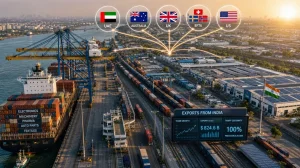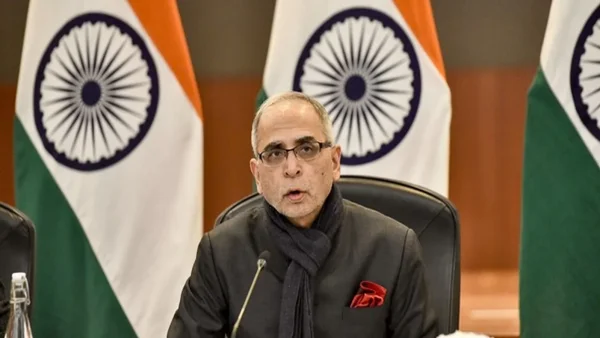
You could say India is putting itself on the table as an anchor of the world economy when you need one most. This past Monday, the Indian Ambassador to the US, Vinay Mohan Kwatra, made it plain: the nation’s ascent is no small matter for global well-being, and there is a hard-edged, time-sensitive economic plan to back it up.
In his view, what happens in India has a way of rippling out, be it in how we make things or who we do business with with. Put simply, India isn’t just along for the ride in this global reordering; it is part of what holds it together.
Why India sees itself as an anchor
According to Kwatra, the changes in the Indian economy have put it right where it needs to be in the new order – as a dependable source of growth for everyone from the advanced to the emerging world. In a climate of uncertainty, he called the country an essential part of the global fabric.
It is not a question of scale alone. What gives India its standing, he says, is the ability to be a bridge between different systems and regions, something that is only bolstered by a track record of seeing disruptions through and earning the trust of partners.
The roadmap to 2047
The numbers are laid out in black and white. At the IX USISPF Leadership Summit 2026 in Washington DC, Kwatra pointed to an economy of about $4.3 trillion today, with plans to hit $7 trillion before the decade is out and $14 trillion in the mid-2030s – figures that would change the complexion of the global rankings.
For the long haul to a developed nation in 2047, he set out these markers:
– Where we are: $4.3 trillion
– End of the decade: $7 trillion
– Mid 2030s: $14 trillion
– 2047 goal: $25 to $30 trillion
Getting to that upper tier won’t be easy. It will take some steady, high-octane growth, more reform and a good deal of productivity and investment, he made clear.
What will power the climb
As production moves away from the usual haunts, India is all but a given for those looking to retool their supply side. The government is putting money behind semiconductors, AI, clean energy and defence to make sure it has a seat at the table in global value chains.
Kwatra was quick to point out that the next chapter of India-US relations will be written in the language of new tech like biotech and chips. On the home front, you have the youth, the digital shift, a building-out of infrastructure and a manufacturing sector on the up – all of which should keep things moving.
Why the US partnership matters
There is a lot of common ground with Washington these days. The ambassador is in favour of going deeper on trade, on the technologies that matter and on making sure our supply lines can take a hit. You can see it in the bilateral trade numbers, which have been on a steady incline.
Some of the areas he put at the top of the list:
– Making and co-developing in defence
– The semiconductor and supply side of things
– Securing the flow of critical minerals
– Putting AI to work
– Clean energy
– New kinds of manufacturing
The global stakes and what comes next
For Kwatra, India’s rise and the world’s prosperity are of a piece. He is keen to see some tangible results from the G20 and the US in the run-up to the next Summit, so we can put some ballast against the kind of headwinds we see today.
Read between the lines and it is obvious. When the rest of the world is covering its bases, India wants to be the one you can count on to keep commerce and innovation on the move. The goals are big, but the idea is to make the rough patches of now into the wind at your back down the road.