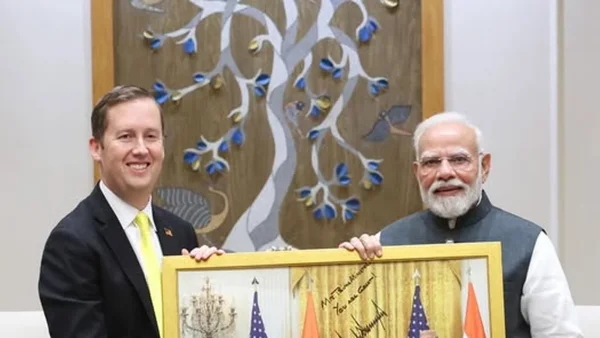
Sergio Gor, the US Ambassador to India, said he wants to get US-India trade to $500 billion by 2030. He said this after a meeting with the American Chamber of Commerce in India. This is a time of big growth for how the US and India work together, and it will be driven by what businesses do.
After his meeting with the board of AMCHAM India, Gor said that increasing trade and investment is the priority right now. American companies in India are essential to increasing US sales, increasing trade in general, bringing in investment, and continuing to strengthen the partnership.
A clear $500 billion target for US-India trade
This plan came after a significant strategy meeting with AMCHAM India, the main organization for US businesses in the country. Gor described the goal as a definite one with a deadline, and he indicated that bringing the economies of the two nations together will continue to be a key part of the overall strategic relationship between the US and India.
Experts believe the $500 billion goal shows that the US and India are increasingly agreeing on important new technologies and are actively finding other sources for their supplies. The relationship between the two countries is in a period of strong growth, and businesses are expected to be the main force behind that growth in many different areas.
What the roadmap will prioritise
The discussions centred on three priority tracks:
– Streamlining rules to unlock faster, trusted trade corridors
– Leveraging US firms in India for manufacturing and export growth
– Attracting capital into tech, defence, and green energy
Members of AMCHAM India apparently are optimistic about India’s changes to make it easier to do business there. They think these changes are a main driver for reaching the $500 billion goal by logically reducing problems and speeding things up.
Sectoral focus and regulatory clarity
Those at the meeting also said they need regulations that are predictable if they are going to carry out projects that cross borders. Because people are increasingly interested in investing, they said clear rules and quicker approvals are necessary to increase manufacturing, the transfer of technology, and collaborative innovation.
Gor also emphasized that the private sector will be what keeps the diplomatic connection between Washington and New Delhi strong. He said that continuing to have businesses lead the way will determine how quickly things progress in the coming months.
Private sector at the core
Gor explained, “American companies in India are increasing U.S. exports, expanding trade, bringing in investment, and making our partnership stronger.” He said these companies are crucial for both getting into the market and increasing exports.
After the AMCHAM India meeting, he repeated this, saying the goal is to reach $500 billion by 2030 while also making trade and investment connections deeper. This statement makes it clear that the results of business are how we’ll measure whether or not we’ve succeeded.
Momentum, milestones, and what comes next
After being in office for 100 days, Gor talked about progress on a possible trade agreement, cooperation on defense, and India’s involvement in projects like Pax Silica. He said India is extremely important and that the relationship is in an excellent position.
When discussing his recent travels, Gor said he met with US President Donald Trump, Vice President J. D. Vance, and Secretary of State Marco Rubio in Washington to improve the relationship. He also said that several important announcements are coming in the next few weeks.
Here are the near-term milestones he flagged for attention:
– Progress on a proposed trade deal framework
– New steps in defence industrial cooperation
– Updates on India’s role in Pax Silica
– Scheduling for a ministerial-level Quad meeting
Gor said Secretary Rubio will come to India next month for the first time. They are also preparing to host a high-level meeting of the Quad (a group of four countries: the US, India, Australia, and Japan) in India, and this diplomatic effort is happening at the same time as the push to increase trade to $500 billion.
The US mission has made doing things the central focus by setting a clear goal that both countries share. If regulations are simplified, exports increase, and investment continues to come in, both the US and India could turn their plans into real increases in trade by 2030.