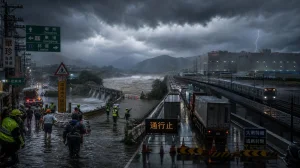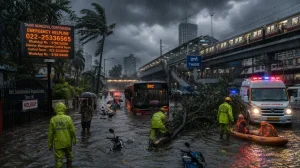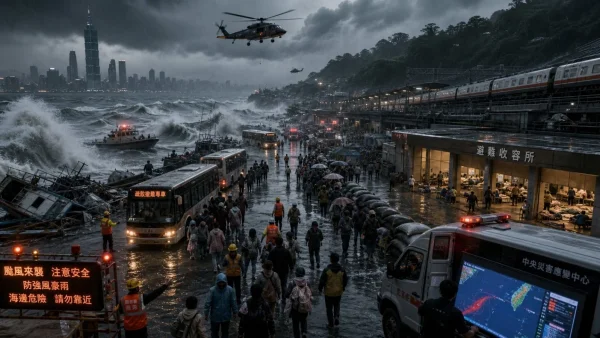
Bavi has been the cause of a broad-scale shutdown in Taiwan and a wave of evacuations in eastern China. There is a hazardous period ahead for the night as the system is due to make for Zhejiang any time before midnight or on Sunday morning. According to officials, the figure for those moved in China tops 1.7 million, and Taiwan has put over 14,200 residents out of harm’s way.
China mobilises for landfall
The National Meteorological Centre in China has Bavi on a course for Zhejiang, where it is expected to go inland not long after it comes ashore. An orange alert for the typhoon – the second most serious – was put out by authorities, along with the first red warning for rainstorms of the year on Saturday.
Zhejiang’s numbers were in at 1.7 million by Saturday. In Shanghai, some 34,000 were taken from vulnerable spots by midday. Down in Ningde in Fujian, over 3,700 have been moved, and 17,000 rescue personnel are on hand throughout the province.
It has been a day of curtailed travel and schooling. Ferry routes are off, there are hundreds of no-show flights and some high-speed rail has been put on hold. To see prevention and recovery through in Zhejiang and Fujian, Beijing has put aside 40 million yuan (USD 5.9 million) in relief money.
Taiwan shutters services amid heavy rain
Though a direct hit was averted, the island put its offices and schools to rest on Saturday as Bavi made its way to the north. The Central Weather Administration is talking about 144 kph winds at the heart of the storm and close to a metre of rainfall in parts of the country.
Some 87 have been hurt so far, with 8 am on Saturday as the cut-off point, some of them in mishaps on the wet roads. More than 14,200 have been evacuated from places like Hualien in the east and Taichung in the centre, as the government has put in place some pre-emptive measures even as the storm eases up.
Transport curbs and a rare typhoon holiday
The effect has been felt in the travel sector. That means 917 international and every one of the 274 domestic flights in Taiwan are a no-go. Most of the cities and counties have called a typhoon holiday, and the high speed rail running north to south is on a limited run.
In Taipei, the wind and rain have put most people inside, if only for a while. “It’s ok, it’s not that serious,” says 68-year-old Yeh Mao-hsiung as he puts in a walk with his dog. “Just a bit of extra wind.”
Regional toll from Philippines to Japan
There is more to this than what is happening in the Taiwan Strait. The Philippines has seen 17 lives lost, in many cases to landslides stoked by monsoon and Bavi. A slide in Malapatan in the early hours of Friday left 10 dead and three unaccounted for.
Five are dead and six missing from another in Calanogas. Two others perished in the flood in Bukidnon on Wednesday. Some 11,000 have found refuge in 77 shelters in the last few days as the southern provinces have been pummeled by the downpour.
On the southern side of Japan in Okinawa, the word from local officials is to be on guard for waves and surges. Over 200 flights have been called off in the area, and you can expect squalls on islands like Ishigaki as the typhoon goes by to the north.
What happens next
Once Bavi is done with the Sakishima Islands and has passed to the northeast of Taiwan, it is set to hit Wenzhou, an eastern Chinese city of 10 million, in the early part of Sunday. The plan from Chinese officials is for the storm to come in to Zhejiang before the clock strikes twelve or in the wee hours of Sunday, then head in.
This is where the focus is now:
– Dealing with the effects of landfall into Sunday
– Keeping a watch on any flooding or surge from the rain
– Having the funding and the means for rescue at the ready
You can see the stakes: the ground is already soft, the coasts are full and there is not much time to react as Bavi comes in. When the storm is inland, it will be up to the defences and the relief teams to see how they hold up.