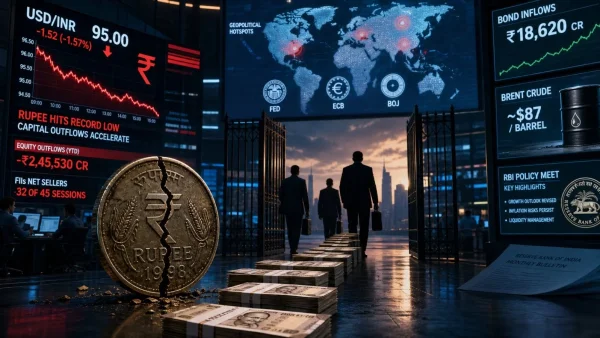
FPIs aren’t in any hurry for things to make sense before they act. In the first two weeks of June alone, they bailed on Rs 62,853 crore of Indian stock. That has brought total 2026 equity outflows to Rs 2.87 lakh crore, well past the Rs 1.66 lakh crore we saw in 2025. It’s a clear sign of the kind of risk-averse stance you see when currency stress is in the air.
Why the selloff is hard to ignore
Then there is the rupee. It has been under pressure, having given up nearly 6% this year and 10% over the last 12 months. We’ve seen it go from the mid-80s to roughly 95 to the dollar, and the RBI has had to work to keep the market in check.
“Investors are dealing with an odd combination of rate uncertainty from the big central banks, geopolitical noise and a slowdown in the world at large,” says Himanshu Srivastava of Morningstar Investment Research India. On top of that, he notes, India doesn’t look as cheap as some of its peers, so you’re seeing more picky allocation.
In short, these are what have FPIs on the sidelines:
– Geopolitics and the not knowing if it will de-escalate
– No clear direction on where major central bank rates are headed
– A soft rupee that adds to the currency risk
– Valuations in India that are steeper than in other EM markets
Debt as a safety valve
The FPIs may be done with equities for now, but they haven’t left the country. NSDL figures show that in the first part of June, they channeled over Rs 13,200 crore into debt on the Fully Accessible Route, for a year-to-date total of close to Rs 28,000 crore.
On the policy side, there are moves to stem the tide and support the balance of payments. The authorities have put in place a few things, like having the RBI cover hedging costs on FCNR deposits from commercial banks, or opening up the FAR for government bonds. They’ve also hiked the limits for NRI and OCI equity investments.
Some help is coming from the energy front too. V K Vijayakumar of Geojit Investments points to the talk of a US-Iran deal as the reason Brent is under $87 a barrel. “It’s a big plus for us,” he says, with a $60 billion deficit in the balance of payments to manage in FY27.
Not a one-time event, but a way of de-risking
If you look at the numbers from NSDL, this is no anomaly. FPIs have been net sellers in every month of 2026, February being the only exception.
It was a hard turn. They put in an exit in January, made a show of being net buyers for a month in February, and then went back to selling in force.
Then March hit. Foreign investors made off with a record Rs 1.17 lakh crore. The exodus didn’t let up: April saw outflows of Rs 60,847 crore and May another Rs 32,963 crore. You could contrast that with the relative calm of February’s Rs 22,615 crore in inflows, or even the Rs 35,962 crore that left in January.
June has only put the pedal to the metal. In a matter of two weeks, Rs 62,853 crore has been siphoned from domestic equities, more than all of May and not far behind what we saw in April. And this is happening even with some policy cover and cheaper oil, which ought to be calming macro nerves.
Selling is tiring, but you can’t let your guard down
You can spot a bit of a lull. The data shows FPIs have dialed back the pressure; on Friday they were only in the market to sell Rs 1,082 crore in the cash segment. Risk appetite is still low, but the slowdown means some are holding fire for a better read on things.
Srivastava puts it in context: in times like these, you see a bit of tactical de-risking as money moves from emerging to developed markets and into safer ground. It’s what has been at play in India this year-solid fundamentals getting in the way of currency risk and the wider macro picture.
Where we go from here
The next few days will be telling, says Pabitro Mukherjee of Bajaj Broking, with central bank action and geopolitics in the driver’s seat.
All eyes are on:
– How US-Iran talks pan out
– Word from the US FOMC
– A rate call from the Bank of Japan
– Any noise from the big central banks
The bottom line for positioning
In India, it’s not just how much capital comes in, but what kind. Equity sales put a crimp on valuations and liquidity in some of the better growth areas, whereas debt coming in through the FAR side of things helps underwrite the current account.
We’re trying to make room for longer-term money and hold the line on the rupee. If Brent stays under $87 and we get some clarity from the top, you take away a couple of the major headwinds for foreign investors. Valuation concerns vis-à-vis other EMs will remain, of course.
The figures for June say it all: the fight for global capital is on. We have the structural story, but when it comes to the numbers and the uncertainty, the smart money is playing it safe. We’ll know if this is over once the central banks speak.