If you see a snake with a hood flared up, knowing the difference between an Indian cobra and a rinkhals will determine what you do next. Though both are poisonous and look a bit alike at first, they do have differences in size, poison, where they live, and how they act. Here’s a clear explanation to tell them apart safely.
Where they live and why it matters
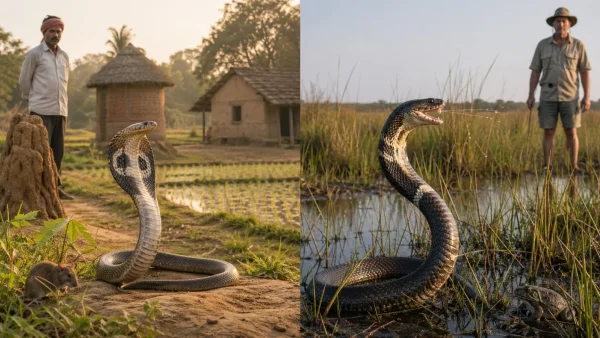
The Indian cobra (Naja naja) lives throughout the Indian subcontinent – in India, Pakistan, Sri Lanka, Bangladesh, and Nepal. It can live in forests, grasslands, swampy areas, farms, and even near houses.
Indian cobras use holes dug by termites, rocks, thick bushes, and abandoned animal burrows for shelter. Because they can live in so many places, they often come into contact with people, particularly on farms where there are fields, water and places to hide.
The rinkhals (Hemachatus haemachatus) is found in southern Africa, including South Africa, Zimbabwe and Botswana. It prefers open grasslands and marshy areas close to water. Damp areas provide the frogs and toads it likes to eat.
Size, hood patterns, and scalation
Both snakes can raise up and spread a hood, but if you look closely, they aren’t the same. An Indian cobra usually gets to be one to one and a half metres long, and some get even longer. When it spreads its hood, it often has a marking that looks like glasses.
The rinkhals is heavier and can be the same size as, or a little longer than, the Indian cobra. It doesn’t have the glasses marking. Instead, it has dark skin with one or more lighter coloured bands around its neck. Also, the Indian cobra has smooth scales, but the rinkhals has scales with a ridge on them.
Venom, spitting ability, and bite risk
Indian cobras have a very strong poison with neurotoxins and cardiotoxins. These poisons affect the nerves and heart and can stop you from breathing or cause paralysis if you don’t get treatment. It’s one of the four snakes in India that are responsible for most of the bites.
The rinkhals’ poison is also medically significant. As well as affecting the nerves, it can damage the body’s tissues. It can also spit its poison towards someone’s eyes if it feels threatened, and this makes it even more important to keep your distance.
Key risk takeaways at a glance:
– Both species are venomous and dangerous
– Indian cobra is among India’s ‘big four’
– Rinkhals can spit venom at the eyes
– Both avoid conflict unless provoked
Neither snake usually attacks unless it feels it has to. They will only become aggressive if they are threatened, trapped, or handled. Staying away from them and slowly moving back will lower the risk if you unexpectedly meet one.
Hunting behaviour and diet
Both of these snakes are meat eaters and use their poison to weaken their prey. They strike, inject the poison, and then wait for the animal to get weaker before they swallow it. How they get food also depends on where they live.
Indian cobras eat rodents, frogs, lizards and small birds. On farms, they can help to keep the number of rodents down. Rinkhals eat small mammals, amphibians and reptiles, but really like frogs and toads, which is why they hang around wetlands.
Defensive displays, classification, and reproduction
When an Indian cobra is threatened, it lifts the front of its body, spreads its hood, and hisses. This is usually enough to scare off anything that might want to attack it. If it is still in danger, it might bite, but it will usually try to get away if it has room to.
The rinkhals also raises its body and spreads a hood shape. Its way of defending itself is a little more complicated. It can spit poison at someone’s eyes and can even pretend to be dead by rolling onto its back. It does these things to confuse predators and give itself a chance to escape.
From a scientific point of view, they are fundamentally different. The Indian cobra is in the Naja family and is a true cobra. The rinkhals is in the Hemachatus family, so it looks like a cobra, but isn’t one in terms of classification.
How they have babies is also very different. Indian cobras lay eggs, like many cobras. The rinkhals gives birth to live young, which isn’t common for snakes that look like cobras.
And beyond the science, they have different places in culture and what people think of them. The Indian cobra is very important in the traditions and stories of South Asia, and is often connected with the god Shiva. The rinkhals isn’t as important in culture, but people in the area it lives in know it for its unusual ways of defending itself.
For quick identification in the field, focus on visible cues:
– Look for the spectacle mark on an Indian cobra’s hood
– Check for pale neck bands on a darker rinkhals
– Feel is not advised, but rinkhals scales are keeled
– Remember, rinkhals can spit; keep eyes protected
So, what does all this mean for people who live in the same areas as these snakes? Hints about where they live, marks on their hoods and how they act are all things you can rely on. Knowing that Indian cobras are often near people, while rinkhals prefer the damp grasslands of southern Africa, helps you quickly work out which one you are looking at.
Knowing how the poisons work tells you how quickly you need medical attention. Indian cobra bites can quickly affect your breathing and heart. Rinkhals poison can damage tissues and your eyes if it’s spat at you. In both cases, you need to get medical help immediately and the best thing to do first is to get away from the snake.
In the natural world, both snakes do a good job. By eating rodents, amphibians and other small animals, they keep the numbers of these animals under control. This helps to keep fields and wetlands healthy and reduces the spread of diseases that come from too many pests.
The main point is this: They look similar, which can be confusing, but if you pay attention to where they live, what they look like and how they act, you can tell them apart. Indian cobras and rinkhals aren’t the same, and understanding the differences makes it safer for both people and snakes.
If you live in or visit areas where these snakes are found, being aware of them is important. Watch from a distance, don’t bother them and give them a clear way to get away. These simple steps, based on the differences explained above, can stop you from being harmed and protect an important part of the local wildlife.