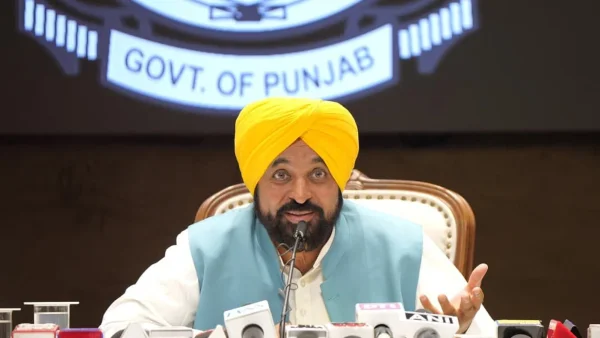
The meeting with President Murmu is scheduled for 12 noon on May 5th and was confirmed by Mann himself. He had been asking to meet the President quickly, and had planned to go with a group of AAP lawmakers from Punjab to ask for these six MPs (those from Punjab) to be ‘recalled’ after this division in the party that has really hurt AAP in the Rajya Sabha.
What triggered the meeting
On April 24th, seven AAP members of the Rajya Sabha left the party to join the BJP. This cut AAP’s number of members in the Rajya Sabha by two thirds. Mann believes these MPs have broken the trust of the people who voted for them, particularly the six from Punjab.
The seven MPs who switched to the BJP are:
– Raghav Chadha
– Sandeep Pathak
– Ashok Kumar Mittal
– Harbhajan Singh
– Rajinder Gupta
– Vikramjit Singh Sahney
– Swati Maliwal
Timeline and outreach
He asked to meet the President on April 25th, intending to go with Punjab AAP lawmakers. He said at a press conference in Chandigarh on Wednesday that his request for May 5th had been approved.
He hasn’t said whether the party lawmakers will accompany him to the President’s house, Rashtrapati Bhavan.
Mann’s demand and constitutional roadblocks
Mann has said he will officially request the ‘recall’ of the six Punjab MPs who have switched parties. This shows he’s trying to make those who left answer to the people of Punjab who sent them to the Rajya Sabha as AAP representatives.
However, according to legal experts, the Constitution doesn’t offer any way to ‘recall’ someone. Ashok Aggarwal, a former Advocate General for Punjab, explained that “recall” isn’t included in any part of the Constitution and so isn’t possible.
Political reactions and stakes
Inside AAP, the attempt to meet with the President is seen as a way of showing they are determined to do something after this very public and damaging loss. The party has lost important people and much of its influence in the Rajya Sabha.
Opposition parties have said this action is only to look good. The Shiromani Akali Dal stated that dealing with MPs who have switched parties, using the anti-defection rules (the Tenth Schedule) is the responsibility of Parliament, and not something the President decides.
This situation has made political tensions in Punjab even stronger. AAP has presented itself as the defender of what the people of the state want. Because of the MPs leaving, the balance of power in Parliament has changed, and questions are being asked about how united AAP actually is.
What comes next
President Murmu has agreed to meet with Mann at 12 noon on Tuesday, May 5th. He intends to explain AAP’s view of the situation with the MPs leaving and ask her to do something about it, even though there’s no actual way to ‘recall’ them.
He has said he will focus on the MPs who were chosen from Punjab, because he thinks they should be accountable to the voters in that state. It’s still unknown if AAP lawmakers will join him at the meeting.
The Constitution doesn’t allow for MPs to be removed from their positions between elections, but this meeting is a way for AAP to bring the issue of MPs leaving to the attention of the highest levels of government. As some critics have pointed out, any important action will likely depend on what happens in Parliament, not on the President’s choice.
For now, the May 5th meeting is a very important moment for Mann and AAP as they try to deal with the problems caused by the MPs leaving and get the support of their voters.