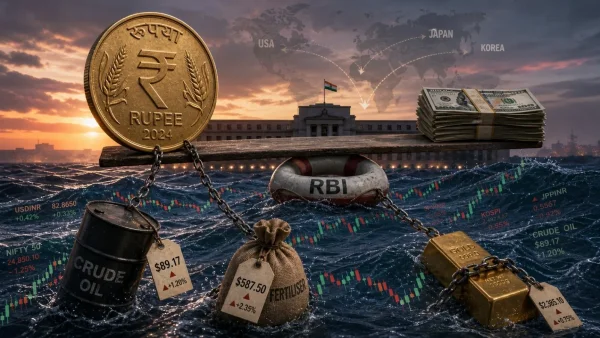
There will be more of these swings, the Finance Minister made clear on June 14, 2026, when she said the Reserve Bank of India is only in the business of putting a lid on the kind of sharp moves you don’t want to see. Don’t count on us to prop up a certain level, but if the market gets too volatile, we will act on it.
Why the RBI steps in, and when
It’s not about dictating a price for the rupee, Sitharaman was quick to say. The central bank is in to even out the rough patches. And when we do, it’s a brief, no-nonsense affair.
If the markets are in disarray, the RBI will put some of its foreign exchange reserves to work to steady the ship, and then we’re done. We are after the volatility, not a peg.
What is moving the rupee now
You can trace where the currency is going to a tangle of factors, both here and overseas. The minister pointed to changes in US policy, some profit-taking from abroad, and what is happening with other Asian currencies as part of the mix. Then there is the matter of paying for the crude, fertilisers and gold we have to bring in. That is something we have to keep an eye on. These are the ones she sees as in the driver’s seat today: – What the Fed does with interest rates – Inflows and outflows from foreign investors – A soft yen vis-à-vis the dollar – The same for the Korean won – The size of our import bill
An import example: fertiliser costs and subsidies
Take fertilisers, for instance. To show how world prices make themselves felt at home, the minister noted that we have been holding the price of a bag at Rs 300 since the pandemic. But once the dust settled, an imported one would run you Rs 3,000. So the farmer is being subsidised by Rs 2,700 a pop. It is a good case for why you can’t afford to be haphazard with your foreign exchange in an economy like ours.
A market lens: flows, not fixes
Sitharaman sees the rupee as responding to the news and policy from over in the US. The Fed says it might nudge rates up or down and the market is on top of it, repricing risk in a hurry. And when those institutional and direct investors from outside see what is happening in the US, they will take their profits and move on, which has its effect on our reserves and the rate of exchange. Put simply, the RBI is in the business of keeping things orderly, not of standing in the way of change.
The bigger picture
Sitharaman put it in perspective: by the numbers and by what the rest of the world is saying, India is still the top-growth story among major economies. The most recent GDP figures back her up, with strong showings from everything on the ground – manufacturing, farming, to services and the logistics that move them. Then there’s the matter of jobs. Unemployment is on the wane, she says, and the government is putting its money where its mouth is with internships and some AI-driven training to make sure people are work-ready.
States, funds and the rules of the road
There was also a need to put to rest a tiff over funding between the state and the Centre. When Karnataka made the case that they were being short-changed, the minister was firm: the Finance Commission has the final say on the formula, not New Delhi. And once you have your metrics, you’re bound by them for five years, politics be damned. As for the notion that a state should be handed back every rupee it puts in, she has no time for that.
Empty promises don’t add up
You can only make as many welfare guarantees as your budget allows, Sitharaman warned. If you have the means, put it in the budget, put it to the Assembly and do it. But don’t go around making commitments you can’t back up and then point fingers at the Centre when the money isn’t there.
Where the money could be
On the subject of farm logistics, she gave Karnataka a nudge to make use of what’s in the central budget for cold storage and the like via Farmer Producer Organisations. So far, she said, they haven’t put in any proposals. It’s a no-brainer: good supply chains mean you can better absorb the cost of imports and stay resilient.
What it boils down to
For the man on the street or the head of a company, it’s a matter of reality. The rupee is going to ebb and flow with what’s happening at home and abroad, particularly in energy and agriculture. We’ll see some action from the RBI if the swings get out of hand, but don’t expect them to draw a hard line. Investors would do well to look beyond the local headlines and keep an eye on the Fed, how Asian currencies are doing, and where the capital is moving.
A different way of looking at it
All this came out of an event in Devanahalli, just outside Bengaluru, to mark 12 years under the NDA. It was a way of tying together a no-nonsense approach to the macroeconomy with a fiscal system that has some teeth. To her, managing the exchange rate is a technical matter of mopping up volatility. Fiscal transfers and the like, on the other hand, have to be done by the book.
Looking ahead
The rupee-dollar dynamic will be as much about the data as anything. You have US rates, the yen, the won – the ripples from all of that will be felt here. Stability is the priority, not rigidity. With that, and some talk of growth and skilling, you have the lay of the land for the coming months.