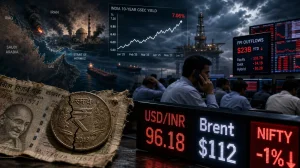
It was a clear risk-on day in the currency market as the rupee hit a high not seen since May 8, at Rs 94.68 to the dollar. The overnight news of a US-Iran deal to put an end to hostilities changed the oil equation. As Brent eases into the low 80s, the view is that the energy shock is over and the numbers for India are looking up in a hurry.
A geopolitical truce resets currency momentum
Donald Trump put it out there: a deal with Iran is done. They’re calling a halt to all military action, in Lebanon and elsewhere, and you can expect a formal signing in Switzerland later in the week.
That kind of headline, plus the Strait of Hormuz being open for business again, has Indian assets in a rally. On June 15 the rupee was 43 paise in the black, at Rs 94.68, compared to the 95.11 we saw before. In the early going it even went to 94.60 after a 94.70 start, a 58-paise gain on the close.
Market snapshot
Here’s how the numbers tell the story of the quick risk repricing:
– Rupee at Rs 94.68 per dollar, best of the year so far (since May 8).
– 94.60 in early trade, having opened at 94.70.
– Brent at USD 83.26, 4.66 per cent in the red.
– Dollar index 99.53, down 0.22 per cent.
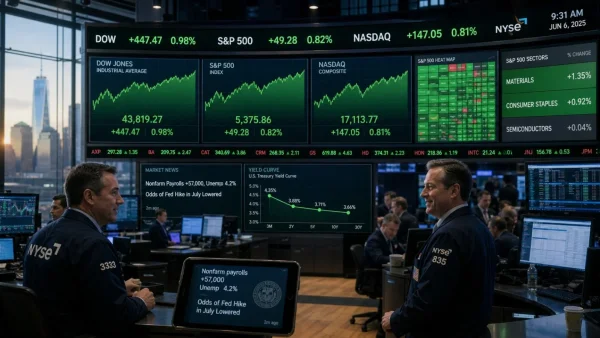
– Sensex 76,648.74, 1,112.70 points higher.
– Nifty 23,956.40, 335.55 up.
Energy choke point and India’s exposure
Hormuz has been a thorn in India’s side for over three months. A 107-day stand-off put a crimp in a waterway that is the main artery for Saudi, Iraqi, Kuwaiti, Emirati and Qatari exports and sees about 20 per cent of the world’s oil go through it.
You don’t have to look far to see why. India brings in 88 per cent of its crude, and half of that is from the Gulf and has to make the crossing. Then there’s LPG – 60 per cent is imported, and 90 per cent of those ships are coming via the strait. We also source around 65 per cent of our natural gas from Qatar and the UAE, which makes up for about half of what we use.
Why the rupee’s rebound could stick
It’s the oil that’s carrying the day. We had Brent above $90 a barrel, but it was down 4 percent or more last night to the $83 mark, the first time we’ve been here since April. Some figures put it at $84 as the market comes to terms with no more blockades and free passage through Hormuz.
When the price of crude comes in, you see the dollar demand from the oil side of the house wane and the import bill for India doesn’t look as steep.
“You have less demand for the dollar from oil majors, some of the strain on India’s trade is taken off, and the rupee has a friendlier place to be. I’d put it as the best thing for USDINR we’ve seen this year,” says Amit Pabari, MD of CR Forex Advisors.
Policy tailwinds and where we stand
The rupee was on the upswing last week even before the RBI put out its plan to draw in more capital. Open up the rules on overseas deposits and external commercial borrowings and you could see over $50 billion come in, which would be a good backstop for the balance of payments.
Then there is the matter of the peace deal and the drop in Brent. “It has made a dent in our FY27 numbers for the better,” says V K Vijayakumar of Geojit Investments. “We saw the rupee move up from 96.96 on May 20. That’s going to hold. I expect us to be in the 94.80-94.60 zone today, with room to go further.”
What the shock did to the ground level
When the hostilities started in late February, Brent was at $70-72; it was $119 in no time. New Delhi’s first move was to take Rs 10 off excise on petrol and diesel on March 27, but they put the prices back up by about Rs 7.50 a litre not long after. CNG went up by Rs 6 a kilo.
LPG got an Rs 89 hike per 14.2-kg cylinder, done in two steps. And yet, the public sector OMCs are still in the red. By some counts, they’re putting up with a loss of some Rs 650 crore a day.
Who comes out on top if crude stays down
You get less inflation to worry about, a slimmer current account deficit and fuel retailers can breathe. Aviation and fertilisers will see the most of it since their costs are so tied to energy. The government has set aside a Rs 10,000 crore fund to keep airlines afloat on turbine fuel.
Refiners have been on the prowl for new sources, buying from Russia, the US, Africa and Latin America. On the LNG side, with the authorities making sure households have their LPG, some commercial users had to make do with curbs.
A lasting kind of normalisation would give you:
– OMCs with fewer under-recoveries and cash to spare.
– Easier shipping and logistics for everyone.
– A break on the fertiliser subsidy front with gas being cheaper.
– Airfares that don’t jump around as much when ATF cools.
– More of a risk-on mood from investors in Indian assets.
Some of the risk is gone, but we’ll be watching
Energy is what India’s macro is built on. So when FII sold off over Rs 1,082 crore on Friday and reserves fell to $681.610 billion for the week, any sign of a let-up was a welcome one. There is a formal signing in Switzerland on June 19. After that, we’ll be looking to see how things flow through Hormuz.