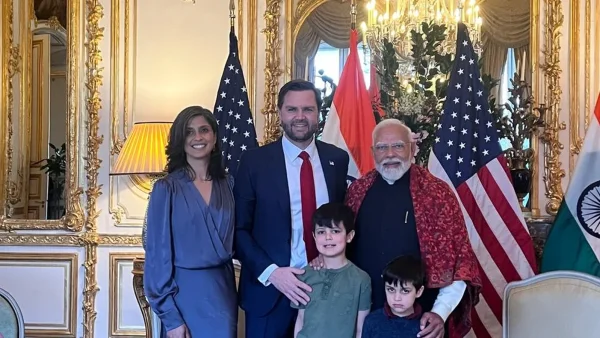
Recently, there’s been a very active conversation about what US Vice President JD Vance said regarding Usha Vance, his wife, and her Hindu background. The problem started at an event when Vance said he hoped his Hindu wife would eventually become Christian. A lot of people have reacted badly to this, and especially the Hindu American Foundation (HAF) has been very outspoken with their criticism.
Understanding the Controversy
The main point of the trouble is Vance’s statement at a Turning Point USA event in Mississippi. He said, when asked about his wife’s religion, that he wished she would one day share his Christian faith. But Vance quickly said this was just a wish, not that he expected her to change or that he planned to force her to. He said their different religions don’t cause issues because they respect and understand each other.
In response, the Hindu American Foundation used social media to ask why Vance hadn’t shown interest in learning about Hinduism if his wife has encouraged him to return to Christianity. HAF explained that Hinduism, by its very nature, welcomes all and doesn’t try to get others to convert, and that it values having many different beliefs.
HAF’s Concerns Over Religious Freedom
HAF’s complaint isn’t only about what Vance said, but about wider issues of religious freedom and feelings against Hindus that are appearing on the internet. The foundation says some religious groups seem to feel they must convert people to their faith, and this is disrespectful and harmful. They also pointed out that Christian accounts on social media are sharing worrying amounts of content that is critical of Hinduism.
HAF asked Vice President Vance to publicly say all the good things about Hinduism and to confirm that Hindus have the right to follow their religion in the United States. This request for acknowledgement is in line with a main idea that the US was built on: freedom of religion.
JD Vance’s Clarification
During all the complaints, JD Vance went to social media to explain himself. He said that while he hopes his wife will one day feel as strongly about Christianity as he does, he respects what she believes now and won’t try to make her convert. He called Usha “the most wonderful thing in my life,” and said she’s actually the one who got him interested in religion again.
Vance also responded to being accused of being prejudiced against Christians, saying that in many religions, sharing your beliefs is normal. He insisted his words weren’t meant to attack Hinduism, but to talk about his own spiritual path and what he hopes for.
The Broader Implications
This disagreement shows the difficulties people in interfaith marriages have, and how important it is to respect each other’s beliefs. It also makes us think about how people in America today understand and practice religious freedom.
Though JD Vance’s comments have led to a lot of argument, they also give us a chance to have a useful conversation about relationships between different religions and accepting each other’s beliefs. As people in the public eye balance their own beliefs with what they do in their jobs, it’s increasingly important to be careful and respectful of different religions.
This discussion reminds us how important it is to support inclusivity and respect for all religions. It makes us consider how we can best help families with different faiths manage their particular problems, and celebrate their different cultures.
In short, while JD Vance’s words have caused controversy, they have also brought up important conversations about religious freedom and inclusivity. It’s still essential for people in the public eye, and for everyone in society, to approach these talks with an open mind and sympathy, making a space where people can all freely practice their religion without being judged or pressured.