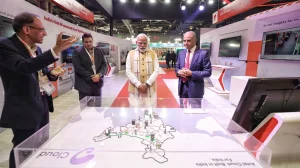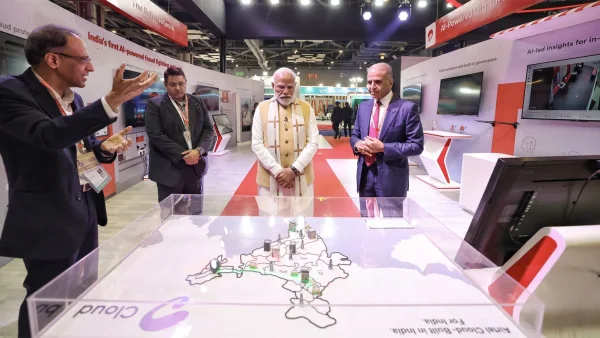
Held in Delhi, India AI Impact Expo 2026 saw Kerala-made robots in action showcasing practical AI applications in industrial and disaster situations considered high risks. While almost all attendees had witnessed the impartiality of the broad ecosystem that is evolving in the region to crisply interconnect hardware, AI, and social outreach.
Country Innovation Speeds and Regional Momentum at Expo
The event, India AI Impact Expo 2026, was a unique point of convergence where startups, researchers, and industry partners tested real-world AI deployments. The general feeling among a large number of attendees was of a shift from sophisticated demos to field-ready systems that must be safe and durable. Kerala teams provided a focus on practical engineering and actual problem-specific purposes. It is noteworthy that robots take pride in the local software, mechanical design, and manufacturing excellence, becoming visible at even the national and international levels.
Daksha Gen-2 Industrial AI for Hazardous Work
Daksha Generation Two, developed at iHUB Robotics in Kochi, aims to carry out heavy industrial tasks like cutting and welding in hazardous environments. It secures lives of operators by working in heat, fumes, or unreliable structures where access is difficult. Daksha was the outcome of effort invested by a group of 65 members, the members who laid the entire foundation, which were namely Athil Krishna, Akhil K. Haridasan, and S. Sharath. The startup also zeroed in on establishing the largest facility at Kalamassery in robotic humanoid manufacturing, signaling their potentiality in scaling production possibilities and export facilities.
Design, Safety, and Industrial Integration
Memorized for AI perception plus heavy-duty materials for tough tooling as well as repeat operations, Daksha Gen-2 furnishes itself with sensors and a vision system for precise guidance on cuts and welds. While more modest ones are interlocked to prevent more damaging situations, safety sensors establish the extent and location of their interfacing with operational precision and through their limited movement around humans and fragile equipment. An industrial pilot illustrates faster cycle times and less incidents with such metrics useful in purchasing teams’ asset revaluation and phased deployment planning through manufacturing plants and energy sites.
Scout Reconnaissance Robot for Extreme Terrain
The Scout, engineered by the Malayalees V. Arun Kumar and Subramanian Ganesh, works for reconnaissance in inaccessible or hazardous terrain; it captures images and environmental readings, while it also gains structural data from disaster areas and industrial lands. The engineers made the Scout modular, so that different sector-based sensors and tools could be added. These teams could configure it for mining surveys, pipeline inspections, or search-and-rescue operations that could be dangerous for humans.
Data, Autonomy, and Operational Value
Faster image and sensor data processing provides actionable reports to the operators that help make informed decisions. The onboard autonomy helps the robot negotiate rubbles, steep slopes, and confined spaces while transmitting high-resolution situational awareness. At a key expo, organizations were emphasizing the Scout’s role as a force multiplier: expanding the reach of the inspection teams, speeding up the hazard assessment process, and providing safer planning for human responders.
AI Literacy in Kerala and the Wide Ecosystem
Kerala’s hardware innovators ascend the steps along with state-led AI literacy programs that provide public understanding of the benefits of AI as well as AI hazards. The major initiative involves training parents through the school network, imparting these parents with practical know-how and reinforcing them with digital safety. To some degree, such activism enhances the coming forth of technical talent and the development of a user community with an understanding and acceptance of its use; and creates ability within families to spot deepfakes and disinformation as inter-networking systems become widespread.
Looking Forward: Designing for Commercialization and Policy Context
Commercial scale-up will hang on the expansion of infrastructure, partnership networks, and regulatory guidelines. The prospective Kalamassery factory and pilots with strategic partners will test the waters concerning supply chains and certification routes. Changes in policy and standards, such as those for various intercessors and safety guidelines, will play an essential part in the timelines for deployment. For now, Daksha Gen-2 and Scout provide a glimpse of opportunities. These robots arise from regional engineering teams capable of delivering field-ready robots that resolve real safety concerns. At the same time, they ignite the AI-industrial ecosystem in the making.