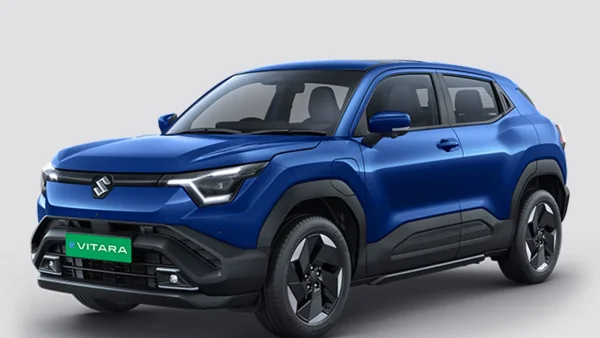
The Maruti Suzuki e-Vitara comes in Delta, Zeta, and Alpha versions. The Delta – which has the smaller battery – begins at Rs 15.99 lakh (ex-showroom).
The Zeta, which has the larger battery, is Rs 17.49 lakh (ex-showroom). The top-spec Alpha is Rs 19.79 lakh (ex-showroom), and you can get it in a two-tone colour for an extra Rs 22,000, making it Rs 20.01 lakh.
Charging, warranty, and how you can own it
Maruti Suzuki also provides the e-Vitara using a Battery-as-a-Service scheme. Under BaaS, the Delta is from Rs 10.99 lakh, the Zeta from Rs 11.99 lakh, and the Alpha from Rs 14.29 lakh – all ex-showroom – with a fee for battery rental based on how many kilometres are driven.
The rental is Rs 3.99 per km for the smaller battery and Rs 4.39 per km for the larger one. An Alpha two-tone under BaaS is Rs 14.51 lakh plus battery rental.
Battery sizes, power, and range
There are two lithium iron phosphate batteries: 49 kWh and 61 kWh. Both use LFP blade cells from BYD, which is a type of battery that’s known for being thermally stable and having a long life.
The power is different depending on the battery size. The 49 kWh version has a single motor driving the front wheels, producing 144 hp. The 61 kWh version also uses a front-wheel-drive, single motor, but its power goes up to 174 hp. Both versions have the same 189 Nm of torque.
The stated range is 440 km for the 49 kWh version and 543 km for the 61 kWh version on a full charge. The front-wheel-drive arrangement should help with economy and make it easier to put the battery in the car.
All e-Vitaras come with a free 7.4 kW AC home charger and free fitting, which makes owning one easier at the start. Using this charger, it takes around 6.5 hours to charge the 49 kWh battery from 10 to 80 percent, and about 9 hours for the 61 kWh battery.
Maruti Suzuki is also giving away free charging – up to 1,000 units, or for a year, whichever comes first – at its dealers’ charging points. The ‘e for me’ app controls access and the charging session.
The battery pack has an 8-year or 160,000 km warranty for long-term peace of mind. The car itself has a 3-year warranty, and you can get this extended for 5 years. There’s also a buyback guarantee: 60 percent of the car’s original value after 3 years or 45,000 km, and 50 percent after 4 years or 60,000 km.
The BaaS option separates the battery cost from the vehicle, making the first price lower. This might be good for people in towns who drive the same route every day, though people who drive long distances a lot may be better off buying the battery outright.
Style, size and what it looks like
The e-Vitara is very similar in shape and surface to the eVX concept car. The car’s front has a shut grille with tri-LED daytime running lights on either side, a lower bumper similar to the Brezza, skid plate pieces, and small fog lights. A charging port is on the front fender for simple street-side use.
From the side, the SUV has strong rear fenders – a noticeable curve above the back wheel – and aerodynamically good alloy wheels, probably 18 inches. A rear door handle mounted on the C-pillar makes the shoulder line tidier and the side look more streamlined.
At the back, a single light bar goes across the tailgate under a built-in spoiler. The bumper has a skid plate and a square fog light low down. ‘e-Vitara’ is written in the middle, showing it’s electric, but not in a showy way.
It’s 4,275 mm long, 1,800 mm wide, and 1,635 mm tall, and has a 2,700 mm wheelbase. It has 180 mm of ground clearance, and its weight at the kerb is about 1,900 kg, depending on the version and battery.
Inside, what equipment and comforts it has
The e-Vitara has a new dashboard and centre console design which isn’t like other Suzuki models sold around the world. The inside is based on two floating screens: a totally digital instrument panel of 10.25 inches, and a 10.1-inch screen for information and entertainment.
A floating centre console in shiny black has the gear selector, the electronic parking brake, and controls for drive modes, and a wireless charging pad is built in. A two-spoke steering wheel, square air vents with brushed frames, and a rotary drive state selector give the space a new-fashioned, tidy feel.
It’s well-equipped for comfort and convenience. Important features are a panoramic sunroof, cooled front seats, mood lighting with 12 colours, and a JBL sound system. Wireless Android Auto and Apple CarPlay, navigation using the cloud, automatic air conditioning, lots of USB ports, and an air cleaner for the cabin finish off the tech.
The safety and driver help tech is complete. Seven airbags are standard on all models. Electronic help includes ABS, EBD, and ESP. A 360-degree camera helps with slow-speed turning, and Level 2 ADAS has things like Lane Keep Assist, Blind Spot Monitor, Adaptive Cruise Control, and Rear Cross Traffic Alert.
The mix of screen tech, linked features, and modern safety sets the e-Vitara up well in the midsize electric SUV class. The way the controls work and how easy it is to use them seems to be for easy, daily use – not tech just for the sake of it.
When you can order it, when it will arrive, and who it’s up against
You can now pre-order it on the web and at dealers, with a deposit of Rs 21,000. Deliveries have started, though at first not many will be available in the first six months of the year as the maker balances what people in the country want with what it sends abroad.
In the market, the e-Vitara goes into the growing midsize electric SUV area. It goes up against the MG ZS EV, Hyundai Creta Electric, Tata Curvv EV, Vinfast VF6, and the soon to come Toyota Urban Cruiser Ebella. Its price is between the cheapest good value cars and the more expensive ones which have a lot of features.
The good value is made better by the 7.4 kW home charger which is included, a good warranty on the battery, and a buyback scheme. The BaaS plan makes it better still, especially for people who want to pay less at the start and pay as they drive.
For people in towns and suburbs who want a known brand, a long claimed range, and a good set of features, the e-Vitara makes a good case. The top Alpha version has more upmarket touches and a long range, and the Delta keeps the entry price low without seeming basic.
As charging networks grow and more midsize EVs come on the market, the e-Vitara’s mix of battery options, safety tech, and freedom in how you own it should help it get a good place in the market. With the official prices now known and orders being taken, the midsize EV battle in India has just got more exciting.