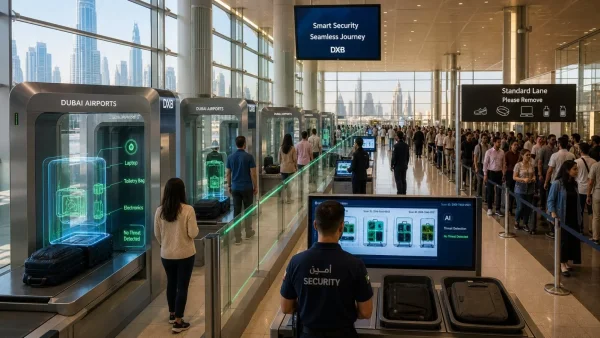
The plan is to have over 100 machines up to standard by 2026 as part of a wider strategy to get more out of the airport without having to resort to major infrastructure work.
The passenger experience is set to change
Before long, the stop-start routine that clogs up the lines will be a thing of the past. You can expect to simply put your hand luggage on the tray and walk through rather than unpacking your toiletries and electronics. It is all about speed and convenience without any compromise on security.
Paul Griffiths, CEO of Dubai Airports, put it bluntly: “The whole process is getting slicker, quicker, faster, and more convenient.” He says the era of taking off your belt and shoes is one we can leave behind.
Rollout across DXB: what to expect now
Not every checkpoint has been given the new treatment just yet. The rollout is being done in stages so you may still come across conventional scanners and need to heed the crew’s instructions in your particular lane.
Work is already under way. A number of the hand-luggage screening machines were operational when the project was made public in February, and the rest of the 100 plus units are being upgraded throughout 2026. The technology was first put in place last year and is being rolled out across the network.
These changes are part of a general refurbishment in all three terminals. Terminal 1 is being fitted with new flooring and security lanes, for instance, while Concourse B’s Hammerhead remote terminal is also being refreshed.
The tech behind the quicker checks
Smiths Detection was handed a contract in May 2025 to put in place the new checkpoint screening systems. With high-resolution 3D imaging, the equipment allows security to see inside a bag without asking the passenger to empty it.
There is also artificial intelligence to triage any bags that warrant a closer look. For the majority of people this means fewer manual interventions and a quieter time at the checkpoint, even when there are heavy volumes.
Why Dubai is investing now
It is a question of boosting efficiency without waiting on new infrastructure. Griffiths has made it clear that making the most of existing facilities is key to DXB’s growth in the years ahead.
He has a vision of how it should be for the customer: “You’ll be able to just literally walk into the airport and get your plane, and maybe stop for a coffee or a burger on the way through.”
What travellers should do today
For the time being, take each checkpoint as it comes. While some lanes have the new scanners, others will have you go through the familiar unpacking motions. The staff at the belt will let you know what is required and you will find rules can vary from one lane to the next during the transition.
A few things to bear in mind for your next departure from DXB:
– New scanners are in use on some lanes
– Where the system is enabled, you can leave laptops and liquids in your bag
– Upgraded lanes will allow you to keep on your shoes and belt
– But do not be surprised if old procedures are still in force at certain checkpoints
What comes next
Griffiths describes the installation as an ongoing programme to phase out older screening gear. “The idea is we’ll replace all of the old technology so that every customer has the same level of convenience,” he says.
That is the endgame. As the switch-over is completed, the stress of unpacking should be replaced by a more predictable journey from kerb to gate, with security handled in the background and not in your carry-on.