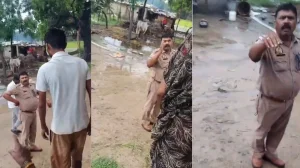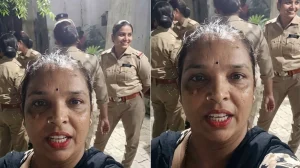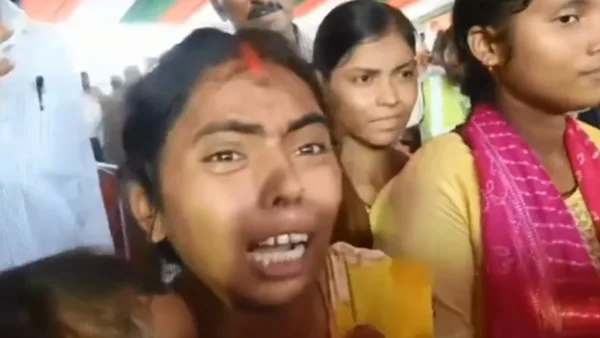
A video circulating on social media has drawn attention to the plight of a woman who reportedly arrived at an event attended by Uttar Pradesh Chief Minister Yogi Adityanath, hoping to personally present her grievance.
The woman, visibly distressed and crying in front of media personnel, alleged that she had not received a satisfactory hearing from the police and wanted to bring the matter directly to the Chief Minister.
According to the claims accompanying the video, she was prevented from approaching the Chief Minister at the event.
The allegations have not, however, been independently established from the video alone, and it is not clear from available reports what her underlying complaint was or whether any police official demanded a bribe.
“The Police Are Not Listening”
The woman reportedly expressed frustration over what she described as a lack of action at the police station.
Her allegation, in essence, was that repeated attempts to have her grievance heard had failed, leaving her with no option but to seek the Chief Minister’s intervention.
The most serious claim circulating alongside the video is that bribes were being sought or that police personnel were not properly hearing complaints. Such an allegation would require an official investigation and supporting evidence before it can be treated as established fact.
Chief Minister Was in Raebareli
The incident comes during Yogi Adityanath’s August 24 visit to Raebareli. Local reports confirm that the Chief Minister was in the district, where he addressed political and public programmes. (Public App)
Security arrangements around the Chief Minister’s visit were reportedly tightened, with police monitoring routes, parking areas and the programme venue. (Chetna Manch)
Such security arrangements can make direct access to a visiting chief minister extremely difficult, particularly for members of the public who arrive without prior authorisation.
But that does not eliminate the underlying question raised by the woman’s complaint:
If an ordinary citizen cannot get justice at the local level, where should that person go?
Raebareli Already Has a Formal Grievance System
Interestingly, Raebareli’s district administration operates a Jansunwai grievance-redressal system, through which citizens can submit and track complaints online.
The district administration says the system is intended to facilitate communication between citizens, government departments and officials and to allow complaints to be monitored. (District Raebareli)
The district also lists a number of police stations and provides official channels for contacting the administration.
This makes the woman’s alleged experience particularly important—not because every complaint can be resolved immediately, but because citizens should have a functioning mechanism through which their grievances can be registered, investigated and tracked.
The Bigger Issue: Access to Justice
For an ordinary citizen, approaching a police station can already be intimidating.
If the person is poor, unfamiliar with legal procedures or unable to navigate the bureaucracy, the problem becomes even greater.
The system is supposed to provide alternatives when a complainant believes that a local police station has failed to act.
Those can include:
Senior police officers
District administration
Formal grievance portals
Written complaints
Judicial remedies
Anti-corruption authorities where bribery is alleged
Raebareli’s official website lists the UP Police helpline and Chief Minister’s helpline, among other public-service contacts. (District Raebareli)
The Allegation Must Be Investigated, Not Dismissed
The emotional nature of the woman’s video has made it easy for the incident to become a political talking point.
But the most useful response would be an impartial inquiry.
If police officials genuinely refused to register or properly investigate her complaint, appropriate departmental action should follow.
If there is evidence that money was demanded for police action, that allegation should be investigated separately as a potential corruption matter.
Conversely, if the allegations are found to be inaccurate, authorities should explain what actually happened.
The objective should be facts—not political narratives.
A Chief Minister Should Not Have to Be the Last Door
The incident raises a broader question about governance.
A citizen should ideally not have to chase a chief minister’s convoy or break through layers of security simply to get a police complaint heard.
The system should work before a grievance reaches the Chief Minister’s doorstep.
That means:
Police station → senior police officer → district administration → grievance mechanism → independent legal remedy.
Every level should provide a meaningful opportunity for the citizen to be heard.
When that chain works, people don’t need to cry outside a VIP event to be noticed. And when it fails, the answer should not be to blame the complainant for making noise—it should be to find out why the complaint reached that point in the first place.