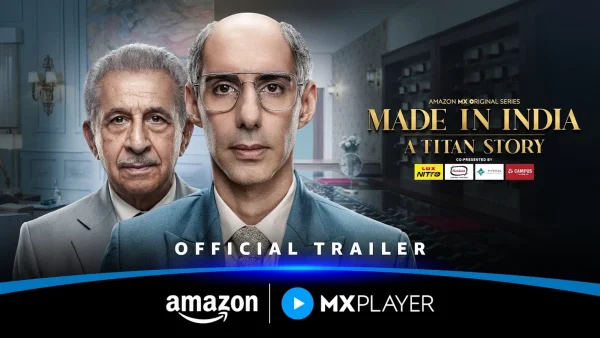
Don’t go in thinking this is just for the sake of nostalgia. The show is a no-nonsense examination of how Titan put an end to a monopoly and redefined what consumers expected. Over six parts, and with Shah and Sarbh at the helm, it makes for some compelling drama out of hard-nosed corporate maneuvering.
You won’t be told that Titan was a foregone conclusion; the series treats it as a risk that was well worth taking. There’s a sense of a strategic comeback to a global snub, one that is said to have driven J R D Tata to put Indian manufacturing on par with the rest of the world. You can feel that in the show’s pulse.
It all starts with a provocation from overseas and the long road to making it work. Xerxes Desai and his people put together a new way of operating, the kind that is built on design and service, and in so doing, made a brand something you could actually own.
A market-making origin story
Titan came about in the mid-80s out of a deal between the Tatas and the Tamil Nadu Industrial Development Corporation, and it didn’t take long to ruffle some feathers in a staid market. When they put out the slimmest watch in the world in the 90s, it was more than a product; it was a statement of intent.
Why Titan’s approach is worth looking at
Then there are the values. The show makes a point of showing that for Titan, looking after your employees, standing up for women, and running an honest shop were never an afterthought. The takeaway is simple: if you put people first, you can build something that lasts.
Some of the brand-building lessons you’ll come away with:
– Seeable, wantable innovation
– Service that is a promise, not an afterthought
– Inclusion you can put your finger on in the workforce
– No shortcuts when it comes to ethics
– Building up local know-how so you can stand on your own
Performances that carry the strategy
The actors give some weight to the numbers. As J R D Tata, Naseeruddin Shah has a quiet way of mentoring that is hard to argue with. And you can see the kind of determined focus in Jim Sarbh’s Xerxes Desai. Put them in a room and you have the best argument for leading with both principle and ambition.
Vaibhav Tatwawadi, Joy Sengupta, Viraf Patel and Namita Dubey make for a cast that doesn’t seem put on. Robbie Grewal, the director, makes sure the stakes don’t feel too removed, while the writing team of Niraj Dasa, Kandarp Shroff, Vinay Kamath and Karan Vyas find the human side of the boardroom.
With some old footage and the right score, you’re put in the middle of an era where India as a consumer nation was coming into being. It’s as much about feeling the time as knowing the facts, and once the rivalry is on, the show doesn’t let up.
Where the docudrama pushes and pulls
There is no pretence here about not being a fan of the subject. It is what it is – a bit of hagiography, which is part of the package with stories like this.
You can spot the patterns in some of the rhythms, and a handful of characters are typecast to their single-note quirks for a while.
Desai’s brand of leadership has its moments of overreach, as you’d expect. The script is happy to let that be the price of his genius. There are your time-worn metaphors, too. But put aside the sermons and you’ll find the story has a certain heft and warmth to it.
What sticks with you
Then there are the details for the connoisseurs. You might be told, offhand, that a quartz crystal hums 32,000 times a second. It’s a way of showing the kind of exactitude at work in the product, and where the show makes good on its word.
This isn’t a tale of overnight wonders. What we see is a steady hand. Desai’s move to put down roots in Hosur with a new plant, with some prodding from Tata in Bombay House, is all about making home-grown quality a reality and being done with what we have to import.
The series puts Titan in the ring with old guard like HMT. You watch as the latter’s hold on the market wanes in the face of Titan’s brand and the way they do business. It’s not just a case of casting a wider net; the show makes a point of how the company has an inclusive way of talking to everyone, from men and women to kids, no matter the means.
A lot of the feeling in the room comes from the mentor and the one he’s with. Shah’s J R D Tata doesn’t micromanage; he will put a question to you or make sure you own your part. Sarbh’s Desai is on it with a fire, even if it means the home front takes a hit. The show notes it and moves on.
There is a charm to Made In India when it doesn’t follow the book. A plot twist here, an unlooked-for ally, or some hiccups in the logistics that turn into something else entirely – it keeps things from getting too self-congratulatory and the stakes very much in the human realm.
It is a deliberate choice to put some light in the picture. You won’t be wading through the usual scams and sordidness of a longform drama. This is clean capitalism. The argument is made that you don’t have to be a cynic to build a brand in India and go head-to-head on the world stage.
The fine print
Robbie Grewal is behind the camera for Made In India: A Titan Story, with a writing room of Niraj Dasa, Kandarp Shroff, Vinay Kamath, and Karan Vyas. It is an adaptation of Kamath’s book on the subject and you can find it on Amazon MX Player.
In six parts, the show would rather be earnest than hard-nosed, and for the most part it has the right stuff to back it up. By making the strategy part of the character, it’s a good reminder that our brands can make the rules.
If you’re into the business of storytelling, you should put this on. If not, it’s still a good way to see how a little resolve and a clear vision can change the way a market works, and maybe the country’s outlook with it.