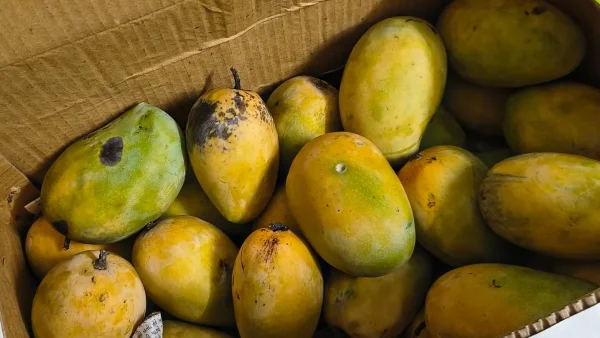
For a home cook in Mumbai, the first mangoes of the season tasted like a trick. She’d paid 1800 rupees for mangoes a seller said hadn’t been treated with chemicals, and when she cut into them a few days later, the inside was pale and tasteless. The seller gave her all her money back immediately, and her story going viral has really fuelled the debate about fake “organic” claims and mangoes being forced to ripen.
A glossy exterior, a bland surprise
Posting as @Naliniskitchen, the buyer said she got 10 kilograms for 1800 rupees from a local seller who said the high-quality fruit came directly from the farms. They looked amazing, a lovely bright orange-yellow.
But when she cut into them almost five days later, how they looked wasn’t how they were. Many were white inside and had no flavour. She said they were lovely on the outside but pretty much rubbish on the inside – and a lot of other shoppers looking at more expensive mangoes felt the same way.
In her post she also pointed out that mango season seems to have arrived with a lot of dishonesty, explaining she’d bought 10kg for 1800 rupees and was told the mangoes were chemical-free and ready to eat.
The return that raised more questions
Annoyed, she went back to the seller’s stall that evening. Before saying anything to the seller, she asked about the price and quality again. He said the same thing: 1800 rupees for 10 kilograms, without chemicals, and straight from the farms.
He’d also said you could return any bad mangoes. She handed over the mangoes she’d bought five days before and he gave her a full refund right away, without even looking at them or asking any questions. She says this quick refund showed her she was right to think the batch wasn’t what he said it was.
She’s calling it fraud and says sellers use words like “organic”, "farm fresh” and “chemical-free” to make people pay more.
Online backlash and warnings
Her post became very popular very quickly, and hundreds of people responded who had also been disappointed by attractive looking mangoes that tasted of nothing. One popular reply said you can’t find anything truly natural these days. Another described it as the usual trick: looking good on the outside, awful on the inside.
Lots of people said mangoes are often ripened with calcium carbide and then sold as “farm fresh”. The discussion has been about how “chemical-free” labels are used to persuade people to spend more, without any proof of how the mangoes have been looked after.
How buyers are coping
People are also sharing ways to avoid being ripped off. One person said they only buy one mango to try, and they don’t try a piece someone has already cut. If it tastes good, they buy more.
Another person said they pay 5000 rupees for 10 kilograms of 100% organic mangoes, which arrive green and hard, and take about 5 to 7 days to ripen at home, and if any are damaged they are replaced. They think paying more for quality you can be sure of is a good deal.
What this means for shoppers now
This situation has reminded people of the usual things to watch out for with summer fruit. Mangoes that are all the same bright colour and unusually soft are a warning. Mangoes that ripen naturally get colour more slowly and aren’t necessarily perfect all over.
A lot of shoppers now say they only buy from sellers they know, and they don’t believe claims of being “100% organic” unless the shop can show some proof. And trying a small amount before buying a lot is becoming a common thing to do.
Based on the discussions, here are quick checks to avoid regret:
– Test one piece before buying in bulk
– Prefer raw green mangoes; ripen at home 5 to 7 days
– Be wary of uniform colour and too-soft fruit
– Do not rely on labels without certification
What comes next
People have told the buyer to share the seller’s details and to make a formal complaint, saying that a refund without being checked shows the seller knows there’s a problem. Others have shared their own experiences of sellers to help others avoid offers that seem too good to be true.
As the busiest time for selling mangoes comes, this isn’t just about one box of incorrectly labelled mangoes. It’s about whether we can trust sellers. And when a perfect looking skin hides a tasteless mango, it’s not just 1800 rupees you’ve lost. It’s people’s faith in what they’re buying. And people say that shouldn’t be so easily lost.