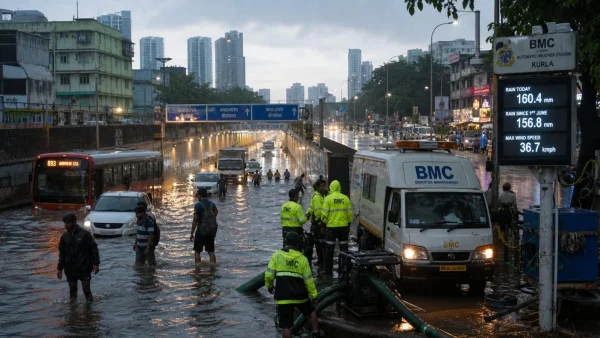
Mumbai’s weather was anything but quiet overnight. The suburbs got drenched, with a few neighbourhoods well over the 100 mm mark in just a few hours. If you asked civic officials, they’d point to waterlogging and the odd spot where traffic had to slow. BMC figures back that up, showing some stark differences from one side of town to the other. Most of it came down between midnight and 4 am, making for a rough start to the day for some.
Suburbs took the heaviest hit
This wasn’t a citywide deluge; it was hyperlocal. The numbers from the Brihanmumbai Municipal Corporation don’t lie: Veena Nagar in Mulund led the way with 160.4 mm. Not far off in the west was Versova at 156.8 mm. These were the kind of spikes that made the night what it was.
Over in the east, the BMC’s automatic stations picked up a cluster of high marks. You had 123.4 mm at the Maharashtra Nagar School in Mankhurd. Paspoli in Powai was at 122, and Mithagar in Mulund at 120.8. Even the S Ward office saw 120.6 mm.
Where the rain peaked in the west
The western flank had its share too. The pumping station in Versova put in 121.6 mm. Marol fire station was at 108.4, and Pratiksha Nagar in Oshiwara at 108. Then there was Malpa Dongari in Andheri with 104. It all adds up to show how much the suburbs had to take on.
City core saw moderate rainfall
Then you have the island city, where it was a lot more subdued. Matunga was the wettest of the bunch at 53.4 mm. Rawali Camp was 46.72, Dadar fire station 45.6, with 37.2 at Malabar Hill and 33.77 at Nair Hospital. A much lighter touch, south of the suburbs.
It is a clear divide. The suburbs were in for some heavy going while the centre of town was left to a more even-keel accumulation. For those living here, the difference can be felt within a matter of blocks.
Commuters slowed by waterlogging
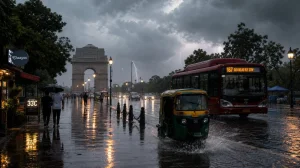
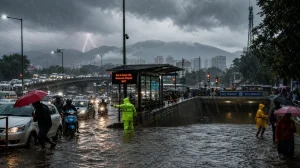
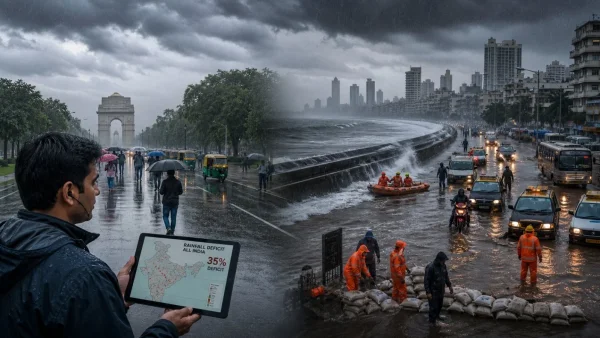
Between midnight and 4 am, the rain made for some standing water on parts of LBS in Mulund and the Andheri underpass, holding up cars for a bit. There were also some pictures doing the rounds of the Coastal Road after the fact, a reminder of how new builds are put to the test when the heavens open up.
The trouble spots were easy to see: any low-lying road or underpass. But for the most part, it was contained. The kind of microburst activity the data would have you believe, as opposed to a blanket pour over the whole metropolis.
A run-down of what we’re seeing from the ground and the books:
– Suburbs in excess of 100 mm in four hours
– 160.4 mm in Mulund to top it off
– 156.8 in Versova
– Some water on LBS and in the Andheri subway
– The rest of the city was fairly mild
Why it matters and what is next
These aren’t just numbers. They put a finger on how risk in Mumbai is a matter of microzones. The BMC has a good handle on where the pressure points are, thanks to their stations, and that helps in knowing where to put in the work for clearance and response.
It also tells you what to expect. The forecast for the city at large may be fine, but an overnight peak can still mean a few short, sharp holds in your morning. Monday was a case in point, with things moving a little slower where the water had a chance to pool, like near LBS and Andheri.
As for the authorities, they have been on about the narrow window of the downpour and how local the effect was. With so many of our eastern and western outposts in the triple digits, the suburban belt is where the eyes are fixed as they go over the station reports.
In the end, it is simple enough. When the suburbs are under water and the island isn’t, you have to look at the footprint of the burst. The stats from Mankhurd, Powai, Mulund, Versova and Andheri make it plain. We deal with it by reading those signs and being where we need to be.