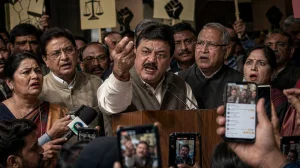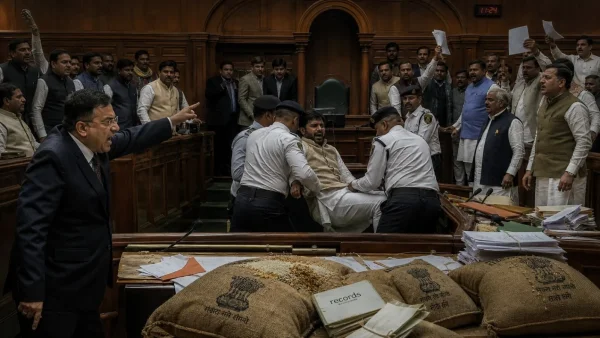
The Delhi Legislative Assembly witnessed a heated confrontation after Aam Aadmi Party (AAP) MLAs sought answers from the BJP-led government over allegations surrounding the alleged ₹22,000-crore diversion of subsidised rice.
The controversy took another turn when Delhi’s Parliamentary Affairs Minister Pravesh Verma was heard using aggressive language while directing marshals to deal with protesting Opposition MLAs.
The reported remark—“Oh Marshal, pick them up and throw them out… don’t escort them out with such affection!”—has triggered criticism over the tone and conduct expected from a senior minister inside the House.
The political battle, therefore, is no longer just about rice.
It is also about a much bigger question:
When elected representatives ask questions inside the legislature, should the answer be an explanation—or an instruction to throw them out?
The ₹22,000-Crore Allegation: What Is the Dispute About?
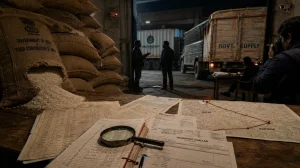
The controversy centres on allegations made by AAP leader Saurabh Bharadwaj, who has claimed that subsidised rice meant for economically vulnerable sections was diverted and sold to a private company in Haryana.
According to the allegation, the potential value of the alleged diversion could reach ₹22,000 crore over three years.
However, an important distinction must be made:
₹22,000 crore is an allegation, not an established scam figure. The claim needs to be examined through official records, procurement documents, distribution data, audit findings and any investigation ordered by competent authorities.
The BJP-led Delhi government should therefore be given an opportunity to respond to the allegation and place its version of events on record.
That is precisely why the Assembly becomes important.
The Bigger Controversy: The Question Was Asked—But What Was the Answer?
The Opposition’s argument is straightforward:
If the allegation is false, show the documents.
If the rice was not diverted, explain where it went.
If there was no financial loss, publish the records.
If there was wrongdoing, investigate it.
A legislative assembly exists precisely for such scrutiny.
Opposition MLAs are not supposed to function merely as spectators. Their job includes questioning the government, demanding accountability and raising issues concerning public money.
Of course, there are parliamentary rules governing interruptions, disorderly conduct and the removal of members.
But that raises another question:
Should political disagreement inside the House descend into language that sounds more like a street confrontation than a legislative debate?
“Pick Them Up and Throw Them Out”: Why the Remark Matters
The reported remark has become the centre of the political controversy because it came from a senior minister responsible for Parliamentary Affairs.
There is an obvious difference between saying:
“Please ask the marshals to restore order.”
and language that effectively sounds like:
“Pick them up and throw them out.”
The latter inevitably invites criticism.
Parliamentary institutions depend not only on rules but also on institutional restraint.
A minister can disagree with Opposition members.
He can challenge their allegations.
He can demand evidence.
He can ask the Speaker to take action against disorderly conduct.
But when the language becomes openly aggressive, the debate shifts from “What happened to the rice?” to “Why are elected representatives being treated this way?”
And that may be exactly the distraction that neither side needs.
The Speaker Is Not the Government’s Political Enforcer
Another interesting aspect of the controversy is the role of the Parliamentary Affairs Minister.
The minister is part of the government and has political responsibilities.
The Speaker, however, occupies a different constitutional and procedural position inside the House.
The Speaker is responsible for maintaining order and ensuring that legislative proceedings follow the rules.
That distinction matters.
If Opposition members cross the line, the rules should be applied.
But if the government is facing uncomfortable questions, the solution cannot simply be to make the question disappear.
A government does not become stronger by removing the question. It becomes stronger by answering it.*
The Rice Controversy Needs Documents, Not Just Political Slogans
The alleged ₹22,000-crore figure is politically explosive.
But enormous numbers can become meaningless without evidence.
The government should clarify:
1. How much subsidised rice was procured?
What was the total quantity handled during the period under question?
2. Where was the rice distributed?
Government records should establish the movement of the stock.
3. Who were the authorised beneficiaries?
Were distribution records properly maintained?
4. Was any rice sold to private entities?
If so, under what authority and at what price?
5. Who approved the transactions?
The chain of responsibility should be identifiable.
6. What does the government’s audit say?
Any audit findings should be placed before the legislature.
7. Is an independent investigation required?
If documentary inconsistencies exist, an impartial investigation should determine whether wrongdoing occurred.
And Here Comes the Political Theatre
Indian politics has mastered a peculiar formula:
Opposition: “Answer the question!”
Government: “You are creating a disturbance!”
Opposition: “We want an investigation!”
Government: “Marshals!”
Public: “But… what happened to the rice?”
At this point, even the rice might be wondering why it has become the quietest participant in the entire debate.
But There Is Another Side Too
Criticism of the minister’s language should not automatically mean that every action by the Opposition was justified.
Legislative privilege does not mean legislators can behave without limits.
If MLAs disrupt proceedings, enter prohibited areas, ignore the Speaker’s directions or otherwise violate House rules, disciplinary action can be legitimate.
The important question is whether the rules were applied consistently and impartially.
The standard should be the same whether the member belongs to the ruling party or Opposition.
What Should the Delhi Government Do Now?
Instead of allowing the controversy to become another political shouting match, the government could take several concrete steps.
Publish the Relevant Records
Make procurement, allocation, transportation and distribution records available wherever legally permissible.
Order an Independent Audit
If there is a credible allegation involving thousands of crores in public resources, an independent audit would help establish the facts.
Answer the Opposition in the House
A detailed statement would be far more powerful than simply dismissing the allegation as political propaganda.
Examine the Minister’s Conduct
If the reported remarks violate the standards expected of a minister or the rules of the House, the appropriate authority should examine them.
Protect Legislative Debate
Opposition members should be able to raise legitimate questions without intimidation, while also being required to follow House rules.
The Real Test of Democracy Is What Happens When the Questions Are Uncomfortable
It is easy to run a government when everyone agrees with you.
The real test comes when the Opposition stands up and asks:
Where did the money go?
Who benefited?
Who approved it?
Who is responsible?
Those questions should not be treated as an insult to the government.
They are part of the job of a legislature.
And if the allegation is wrong, the government has an excellent opportunity to demolish it—with facts, documents and numbers.
Final Take: Throwing Out MLAs Won’t Throw Out the Question
The controversy surrounding Pravesh Verma’s reported remark has created a second political battle around the alleged ₹22,000-crore rice diversion issue.
But the fundamental question remains untouched:
What exactly happened to the subsidised rice?
If the ₹22,000-crore allegation is exaggerated or false, the government should establish that clearly.
If there is evidence of wrongdoing, the responsible people should face investigation and appropriate legal action.
And if Opposition MLAs broke Assembly rules, the rules should be enforced.
But the answer to an uncomfortable question should never be:
“Pick them up and throw them out.” The better answer is much less dramatic—and much more democratic:
“Here are the documents. Now examine them.” Because marshals can remove a legislator from the chamber, but they cannot remove an unanswered question from the public debate.