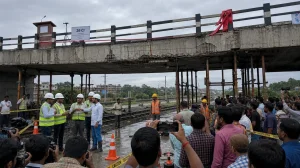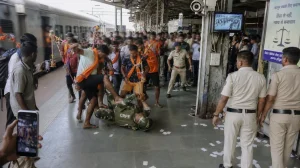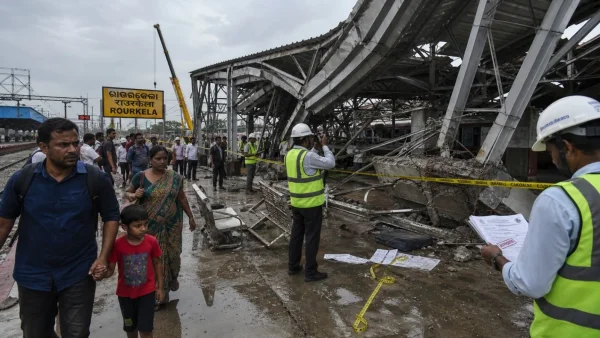
A passenger facility at Rourkela railway station in Odisha has reportedly collapsed just months after its inauguration, triggering criticism over construction quality and maintenance at a facility meant to provide safety and shelter to passengers.
The incident has sparked an uncomfortable question: How does a newly inaugurated public structure become unsafe within months of being opened?
For passengers, a shed is not merely a roof. It is supposed to provide protection from rain, heat and other weather conditions while people wait for trains. When part of such a structure collapses, the issue immediately becomes one of public safety and accountability.
Six Months Later, a “Foundation” That Couldn’t Stand
The criticism is particularly sharp because the structure is reportedly only around six months old.
That timeline raises obvious concerns about:
Construction quality
Materials used
Structural design
Supervision during construction
Quality-control inspections
Contractor accountability
Post-construction safety checks
A facility designed for public use should not become a potential hazard shortly after inauguration.
If the reported timeline is accurate, authorities should explain why the structure failed so early and whether the failure was caused by construction defects, weather conditions, inadequate maintenance or another factor.
The Real Question: Who Approved It?
Whenever public infrastructure fails, the contractor is only one part of the story.
There is also a chain of responsibility involving:
Design → Tender → Construction → Inspection → Certification → Inauguration → Maintenance
At every stage, officials and agencies are expected to ensure that the structure is fit for public use.
So the important question isn’t simply:
“Who built it?” It is:
“Who inspected it, who certified it and who declared it safe?”
Public Money, Public Risk
Railway infrastructure is built using public resources.
Passengers therefore have every right to expect basic standards of safety and durability.
When a newly constructed facility deteriorates or collapses prematurely, taxpayers are effectively faced with a double burden:
First, they pay for the construction.
Then, they may have to pay again for repairs or reconstruction.
And if a passenger is injured because of structural failure, the consequences become far more serious than financial loss.
Sarcasm Aside, This Isn’t a Small Issue
“Congratulations! Six months and the roof has already retired.”
That might make for a funny social-media post.
But there is nothing funny about a public structure collapsing where passengers could potentially be standing.
A railway station is a high-footfall public space. Even a relatively small structural failure can cause injuries, panic and disruption.
Infrastructure should age. It shouldn’t give up.
What Should Railway Authorities Do Now?
The authorities should conduct an immediate technical inspection of the structure and make the findings public.
The investigation should establish:
1. Why did the structure collapse?
Was there a design, material or workmanship problem?
2. Who was the contractor?
The public should know which agency executed the work.
3. Was the structure properly inspected?
Were quality and safety certificates issued before opening?
4. Was there any warning before the collapse?
Were cracks, leakage, corrosion or other defects reported?
5. Who will bear the repair cost?
Taxpayers should not automatically be made to pay for preventable construction failures.
6. Will responsibility be fixed?
If negligence is established, action should follow—not merely another repair order.
The Bigger Problem: Build Fast or Build Right?
India is investing heavily in railway infrastructure and station redevelopment.
That investment can improve passenger experience—but speed and visibility should never come at the expense of quality.
A newly inaugurated structure may look impressive on opening day.
But the real test comes six months, one year and five years later.
A ribbon-cutting ceremony is not a quality certificate. Infrastructure should be judged by how safely and reliably it serves the public—not by how grand its inauguration looks.
Final Take
The reported collapse at Rourkela raises questions that deserve clear answers from the railway authorities.
If a passenger facility really became unsafe within six months of inauguration, the priority should not be damage control or political blame games.
It should be:
Inspect it.
Find the cause.
Fix the danger.
Publish the findings.
Fix responsibility.
Because passengers don’t need “grand foundations” for photographs.
They need infrastructure that remains standing when they actually need it.