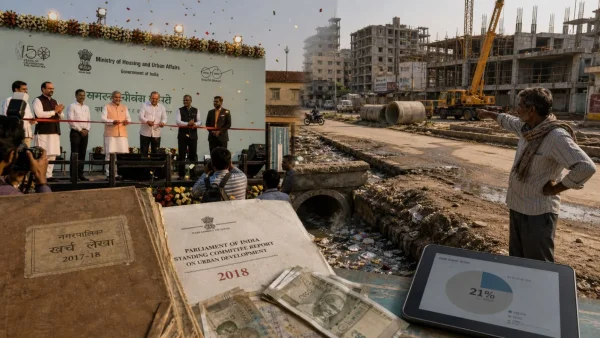
A political debate has resurfaced around a fundamental question: How much of India’s development story is genuinely new, and how much is continuation, expansion or rebranding of programmes and institutions created before 2014?
An image circulating online highlights a 2018 parliamentary standing committee report that criticised the implementation of six flagship urban programmes associated with the Narendra Modi government. The report said these initiatives had spent only about 21% of the funds allocated, raising concerns about planning, funding and execution. The government, however, disputed the interpretation, arguing that expenditure figures did not fully capture projects that were under implementation. (The Business Times)
That distinction is important.
The story isn’t simply “Modi schemes failed.”
The more interesting question is:
Are governments being judged by what they announce, what they spend, what they build—or what they brand?
What Did the Parliamentary Report Actually Say?
The 2018 parliamentary committee examined six major urban initiatives:
Swachh Bharat Mission
AMRUT
Pradhan Mantri Awas Yojana
HRIDAY
Deen Dayal Upadhyaya Urban Livelihoods Mission
According to contemporary reporting on the committee’s findings, around $5.6 billion had been allocated, while average spending was approximately 21% of the allocation.
The criticism was particularly sharp for the Smart Cities Mission, where the committee reported that only around 1.8% of released funds had been spent at the time of its assessment.
The committee questioned whether the government had made realistic projections and adequately planned implementation.
In other words:
The announcement was fast. The execution was considerably slower.
But the Government Had a Response
The government rejected the suggestion that low reported expenditure automatically meant that projects were failing.
The Housing and Urban Affairs Ministry argued that payments were linked to completion and utilisation certificates, meaning the expenditure figures could lag behind actual construction activity.
A ministry spokesperson said that projects worth billions of dollars had already been completed or started, even though the expenditure recorded in the committee’s data was lower.
That is a legitimate counterargument.
So it would be inaccurate to describe the parliamentary report as proof that all six schemes were “big failures.”
It was a warning about implementation—not a judicial verdict declaring the schemes failures.
The “Credit” Controversy: What Actually Existed Before 2014?
This is where the political debate becomes more nuanced.
Some programmes and infrastructure systems often cited in today’s development narrative have roots predating the Modi government.
MGNREGA
The Mahatma Gandhi National Rural Employment Guarantee Act was enacted in 2005 under the UPA government.
Aadhaar
The Unique Identification Authority of India was established in 2009. The Aadhaar ecosystem was subsequently expanded and given a statutory framework through the Aadhaar Act in 2016. (UIDAI)
UPI
This one requires more nuance.
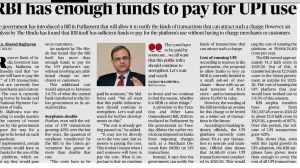
UPI itself was not created before Modi became Prime Minister. The NPCI says its pilot launch took place on 11 April 2016, during the Modi government, under RBI oversight. (NPCI)
However, UPI was built on India’s existing digital banking and payment infrastructure, including IMPS, rather than appearing from nowhere.
So saying “UPI was created before Modi” is factually incorrect.
The more accurate argument is:
UPI was a Modi-era technological rollout built upon institutional and financial infrastructure developed over earlier years.
And there is no question that its scale has exploded since 2016. The government says UPI processed more than 24,000 crore transactions in FY 2025–26, compared with about 2 crore in its first financial year.
Continuation Is Not the Same as Failure
This is perhaps the most important point missing from much of the political debate.
Governments don’t start from zero every five years.
A new government inherits:
roads + databases + laws + institutions + schemes + technology + unfinished projects.
It can:
Continue them
Expand them
Rename them
Change their design
Increase funding
Integrate them with other schemes
Or discontinue them
And every government will naturally highlight its own contribution.
That isn’t unusual.
The real problem begins when political credit becomes more important than institutional continuity.
The Modi Government Has Also Created Major New Initiatives
Criticism should not erase this fact either.
The Modi government launched or substantially redesigned numerous programmes, including Swachh Bharat Mission, Smart Cities Mission, AMRUT, PMAY, Ujjwala, Jan Dhan and UPI, among others.
The question is therefore not whether everything existed before 2014.
It didn’t.
Nor is it correct to claim everything began in 2014.
It didn’t.
India’s development story is cumulative.
Smart Cities: The Perfect Case Study
Smart Cities is an excellent example of the gap between political messaging and implementation.
The programme was presented as an ambitious attempt to transform 100 cities using technology and improved urban infrastructure.
But the 2018 parliamentary criticism showed how difficult it was to convert a nationally advertised mission into completed projects on the ground. (The Business Times)
Today, the debate has moved considerably beyond that initial phase.
But implementation remains relevant: a recent parliamentary-panel finding reported that only 18% of sewerage-management projects under AMRUT 2.0 had been completed over five years, highlighting continuing challenges in urban infrastructure execution.
So the uncomfortable question remains:
Why does India’s urban infrastructure repeatedly look better in presentations than it does on the street?
The ₹36,500-Crore Question
The graphic circulating online highlights approximately ₹36,500 crore allocated across the six initiatives at the time of the committee’s review.
But the number alone doesn’t tell the whole story.
There is a difference between:
Allocated → Released → Contracted → Under construction → Completed → Paid → Audited
If someone compares only “allocated” with “spent,” they may produce an incomplete picture.
But if years pass without completion, the government cannot hide behind allocation numbers either.
Money allocated isn’t development.
Money spent isn’t automatically development.
A completed, functioning project is development.
That should be the benchmark. The Branding Problem Modern politics increasingly operates through slogans.
Swachh Bharat.
Smart Cities.
Housing for All.
Digital India.
Make in India.
Amrit Kaal.
A catchy name makes a policy memorable.
But the citizen doesn’t live inside a government advertisement.
They live in a city with:
overflowing drains,
broken roads,
unreliable public transport,
water shortages,
waste-management problems,
expensive housing,
pollution.
That’s why the real test should always be:
What changed after the scheme arrived?
Sarcasm Alert: The “Scheme Launch” Economy Indian politics has perfected one particular ceremony:
Announce scheme.
Launch logo.
Print posters.
Hold event.
Release press note.
Take credit.
Wait for implementation.
Blame state government.
Blame bureaucracy.
Blame utilisation certificates.
Announce Phase 2.
Meanwhile, the citizen is standing beside the same pothole.
At least the pothole has achieved continuity across governments.
But There Is a Federalism Problem Too Many major development programmes require cooperation between the Centre and states.
That means delays cannot always be attributed solely to New Delhi.
Land acquisition, municipal capacity, tendering, local approvals, contractors and state-level implementation can all affect timelines.
The 2018 report itself acknowledged the importance of Centre-state cooperation for transformative projects. (The Business Times)
Therefore, if a project fails, the investigation should ask:
Centre? State? Municipality? Contractor? Bureaucracy? Funding? Design?
Not simply:
“Which party is in power?” So Who Deserves the Credit? Perhaps the most honest answer is:
The government that actually makes the system work.
If an earlier government creates an institution and a later government expands it dramatically, both parts of the story matter.
If a scheme is renamed but substantially redesigned, the changes matter.
If an old programme is abandoned and replaced with something new, that matters too.
And if a government announces a massive programme but fails to implement it, the criticism is justified.
Credit should follow contribution—not political ownership.
What Should Citizens Ask? Instead of asking:
“Did Modi create it?”
or
“Did Congress create it?”
ask:
How much was allocated?
How much was actually released?
How much was spent?
How many projects were completed?
How many are operational?
What did they cost?
Were deadlines met?
Was there an independent audit?
Did citizens actually benefit?
What happened to projects that failed?
These questions are far more difficult for any government to answer with a slogan. Final Take: India’s Development Story Isn’t Owned by One Prime Minister The viral graphic is useful as a reminder of an important lesson: grand announcements need equally grand execution.
But it should not be used to claim that every Modi-era programme was a failure, nor should the existence of earlier programmes be used to suggest that nothing new happened after 2014.
India’s development has been built layer by layer by successive governments.
Aadhaar has a pre-2014 origin.
MGNREGA predates 2014.
UPI itself is a 2016 launch.
And the Modi government has both continued inherited systems and introduced major new programmes of its own. (NPCI)
The real controversy, therefore, isn’t simply “Who invented what?”
It is this:
Are governments building institutions that survive governments—or merely creating schemes that survive until the next election?
Because taxpayers don’t receive development in the form of a slogan.