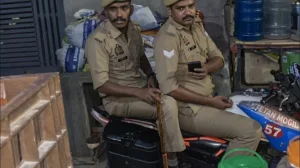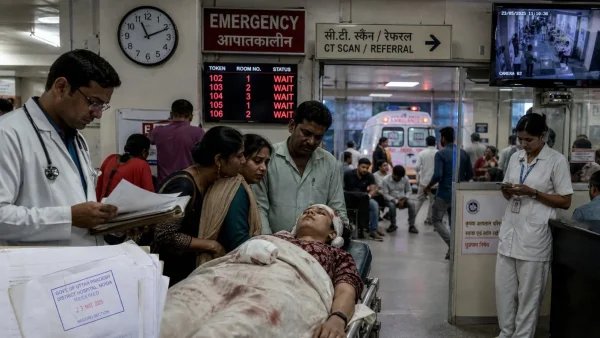
A video reportedly showing a police constable slapping a man repeatedly inside the medical emergency area of a hospital in Lalitpur, Uttar Pradesh, has triggered questions over police conduct, use of force and the limits of official authority.
According to the claims accompanying the viral footage, the constable, identified as Rohit, had arrived at the hospital to get someone medically examined. During the episode, he allegedly slapped a man several times and also behaved rudely with doctors.
The footage is being described on social media as showing four slaps within roughly six seconds, although the complete circumstances and the exact number of blows should be established through the original video and an official inquiry.
I could not independently verify from reliable news reporting the identity of the constable, the full context of the confrontation or whether departmental action has been taken. Those details should therefore be treated as allegations pending official confirmation.
The Bigger Question: Why Use Force Inside a Hospital?
A hospital emergency department is supposed to be a place where medical care takes priority.
Arguments can happen. Police may need to escort accused persons or facilitate medical examinations. Doctors may refuse requests that conflict with medical procedure or hospital rules.
But there is an important line between maintaining order and using unnecessary physical force.
If the man posed an immediate threat, authorities should explain what threat existed and why the force shown in the video was necessary.
If there was no immediate threat, repeated slapping raises a much more troubling question:
Was the badge being used to resolve a problem—or to intimidate someone?
Police Have Power. The Law Also Puts Limits on That Power
Police officers are given significant authority because maintaining public safety sometimes requires lawful restraint or force.
But that authority comes with responsibility.
The Supreme Court has repeatedly emphasised safeguards concerning arrest, detention and treatment of people in police custody. The broader principle is straightforward: police power must operate within law and constitutional protections, not personal anger or humiliation.
A uniform isn’t a licence to slap.
A police station isn’t a courtroom.
And a hospital emergency ward certainly shouldn’t become a place where disagreements are settled through blows.
What About the Doctors?
The allegation that the constable also behaved rudely with doctors adds another dimension.
Hospitals require doctors, nurses and police to cooperate—particularly when a person in custody or involved in a criminal investigation requires medical examination.
If police personnel intimidate medical staff, it can interfere with the independence and functioning of healthcare services.
At the same time, doctors and hospital employees must also follow lawful procedures and cooperate with police where required.
The solution to disagreement should be protocol, documentation and senior intervention—not confrontation.
Could the Slapping Be Justified?
This is where facts matter.
A viral clip rarely captures what happened before the camera started recording.
An investigation should establish:
What led to the confrontation?
Who was the person being slapped?
Was he under arrest or merely present at the hospital?
Was he resisting police instructions?
Did he threaten or assault anyone?
Was there an immediate safety risk?
Who ordered the medical examination?
Was the constable acting within his assigned duties?
Did the use of force comply with departmental rules?
Were doctors or other witnesses present?
If there was a genuine threat, the officer’s actions need to be assessed in that context.
If there wasn’t, repeated blows would be extremely difficult to justify as ordinary crowd control or professional policing.
The Real Problem: “Because I Am Police”
The most dangerous mindset in law enforcement is not necessarily physical strength.
It is the belief that:
“I am the police, so I don’t have to explain myself.”
Citizens often hesitate to challenge officers because they fear further trouble.
That makes accountability even more important.
A person facing a police officer is not standing before an ordinary private individual. The officer represents the state.
When the state uses force, the standard of accountability must be higher—not lower.
Hospital + Police + Physical Force = A Serious Accountability Issue
There have been other incidents in which alleged misconduct by officials at hospitals has triggered disciplinary action after videos became public. For example, in a 2025 Madhya Pradesh case, a doctor was dismissed and an FIR registered after a video allegedly showed an elderly man being assaulted at a district hospital.
Similarly, allegations involving police personnel and doctors in Uttar Pradesh have previously resulted in public controversy, including a 2025 case in Etawah where a doctor alleged that police forcibly took him from a hospital to treat a senior police officer’s mother.
These incidents point toward a broader issue:
Hospitals must remain professional spaces even when police, patients and families are involved in disputes.
“Four Slaps in Six Seconds”—But Who Counts the Accountability?
The viral caption is dramatic:
Four slaps in six seconds.
But perhaps the more important question is:
How many minutes will it take for accountability? Because viral videos often produce immediate outrage.
Then comes:
“Inquiry ordered.”
Then:
“Report sought.”
And sometimes, eventually:
Silence.
If misconduct is established, action should be visible and proportionate.
What Should the Uttar Pradesh Government Do?
1. Order an Independent Departmental Inquiry
The investigation should not simply rely on the officer’s version.
Statements from doctors, hospital staff, witnesses and the person allegedly assaulted should be recorded.
2. Preserve CCTV Footage
Hospital CCTV should be secured immediately so that the complete sequence—not merely the viral clip—is available.
3. Examine the Original Video
Authorities should verify the complete recording and establish exactly how the confrontation began.
4. Determine Whether Force Was Necessary
The central question should be necessity and proportionality.
5. Take Disciplinary Action If Misconduct Is Proven
If an officer used unjustified force, departmental proceedings should follow.
6. Consider Criminal Proceedings Where Appropriate
If the evidence establishes an offence, the matter should not end with an internal warning.
7. Strengthen Police Training
Officers need training in:
De-escalation
Communication
Conflict management
Human rights
Hospital protocols
Proportionate use of force
What About the Constable’s Right to Defend Himself?
Accountability must work both ways.
Police officers should not be expected to tolerate assault.
If someone attacked or threatened the constable, that must be investigated too.
But self-defence and punishment are not the same thing.
The police can use lawful force when necessary to protect themselves or others.
Repeatedly hitting someone because an argument became heated is an entirely different proposition.
Force should stop when the threat stops.
Sarcasm: New Police Training Module?
Perhaps the syllabus should be updated:
Step 1: Talk to the person.
Step 2: Explain the law.
Step 3: De-escalate the situation.
Step 4: Call a senior officer if necessary.
Step 5: Follow procedure.
And the unofficial alternative:
Step 1: Slap.
Step 2: Slap again.
Step 3: Explain later.
Obviously, the second version isn’t policing.
It’s an abuse of authority if the force was unnecessary or unlawful.
Citizens Need to Know One Important Thing
Being stopped, questioned, detained or medically examined by police does not mean a person loses all rights.
Likewise, being a police officer does not mean an officer loses the obligation to behave lawfully.
The relationship should be:
Authority + accountability. Not:
Authority − accountability.
Final Take
The Lalitpur video, if accurately represented, raises a serious question about whether police authority is sometimes being exercised as power rather than responsibility.
But the complete facts must be established before declaring the constable guilty of misconduct.
The answer should not be another social-media argument.
It should be an evidence-based investigation.
Check the CCTV.
Hear the doctors.
Hear the victim.
Hear the officer.
Examine the complete video.
Determine whether force was necessary.
And if it wasn’t, act.
Because citizens should never have to wonder whether walking into a government hospital means entering a place where medical care and police power can collide—and the uniform automatically wins.