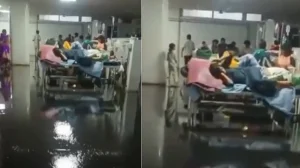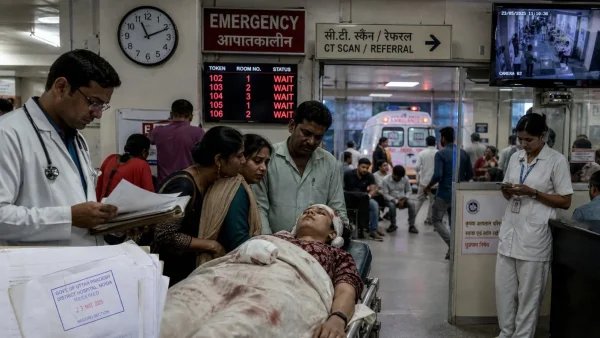
A disturbing video allegedly showing an injured woman waiting for treatment at a government hospital in Noida has triggered questions about the functioning of public healthcare in Uttar Pradesh.
According to the claims accompanying the video, the woman reportedly suffered serious injuries after falling from a multi-storey building and was brought to Noida’s Government District Combined Hospital.
Instead of receiving immediate and adequate emergency care, the woman is alleged to have been left waiting at the hospital.
If the circumstances shown in the video are accurately represented, the incident raises a fundamental question:
When a seriously injured patient reaches a government hospital, how long should she have to wait before receiving emergency medical attention?
What Is Being Alleged?
The video circulating on social media has been presented as showing the injured woman at Noida’s district hospital.
The accompanying allegations claim that despite her serious injuries, she was allegedly left waiting without timely treatment.
The claims also suggest that patients are frequently referred elsewhere, including to hospitals in Delhi, because of limitations in treatment facilities.
These claims require an official response and case-specific verification.
It is important not to conclude from a video alone that doctors or hospital staff were negligent. In trauma cases, treatment can depend on the severity of injuries, availability of specialists, diagnostic facilities, the patient’s condition and whether a higher-level referral is medically necessary.
But if the woman was left without appropriate emergency assessment or treatment, that would be a serious patient-safety concern.
This Is a Government Hospital—So What Is Its Responsibility?
The official Gautam Buddh Nagar district website lists the Government District Hospital in Noida, while the hospital’s own website describes it as a 240-bed multispeciality government facility with emergency services and facilities including CT scan, ultrasound, medical-gas infrastructure and telemedicine.
That makes the allegations particularly important.
A government hospital is expected to provide accessible healthcare to citizens, particularly those who cannot afford expensive private treatment.
For a trauma patient, the first priority should be appropriate emergency assessment, stabilisation and treatment or medically justified referral.
The question therefore isn’t simply whether the hospital eventually treated the patient.
It is:
Was the patient assessed promptly and was the appropriate emergency care provided?
Referral Is Not Automatically Negligence
There is an important distinction that should not be lost in the controversy.
A district hospital cannot necessarily provide every specialised treatment.
A severely injured patient may genuinely require:
Neurosurgery
Advanced orthopaedic surgery
Intensive care
Specialist trauma intervention
Vascular surgery
Other tertiary-care facilities
In such circumstances, referring a patient to a higher-level centre can be medically appropriate.
The problem arises if a patient is referred without first being stabilised when stabilisation is possible and necessary, or if a medically necessary referral is delayed because of administrative failures.
Therefore, an investigation should determine exactly what happened in this particular case.
The Most Important Question: What Happened During the First Hour?
In serious trauma cases, time can matter enormously.
Authorities should establish:
When did the woman arrive?
When was she examined by a doctor?
What injuries were recorded?
What treatment was provided immediately?
Were diagnostic tests conducted?
Was the emergency department adequately staffed?
Was a specialist available?
If she was referred, why was the referral necessary?
How long did the referral take?
Was an ambulance provided?
These are questions that can be answered through the hospital’s records.
Health Minister Brajesh Pathak Should Seek a Report
The allegations have also put the spotlight on Uttar Pradesh Deputy Chief Minister and Health Minister Brajesh Pathak.
Rather than allowing the matter to remain a social-media controversy, the health department should obtain a factual report from the hospital.
The district administration states that the Chief Medical Officer is responsible for medical-health activities at the district level and is in charge of the district hospital.
That provides a clear administrative route for investigating the incident.
A proper inquiry should examine the patient’s medical records, CCTV footage, emergency register, duty roster and referral documents.
If the Hospital Did Nothing Wrong, Show the Records
There is a simple way to settle the controversy.
Publish the facts.
If the woman received immediate emergency treatment, explain what treatment was provided.
If she was referred, explain why.
If the hospital lacked a particular specialist, say so.
If there was no delay, establish the timeline.
And if there was negligence, identify those responsible and take action.
Transparency is more convincing than a denial.
The Bigger Problem: Can Citizens Trust Government Hospitals?
For many families, a government hospital is not a second choice.
It is the only choice.
Private hospitals can be prohibitively expensive, particularly when a patient requires surgery, ICU care or prolonged treatment.
That is why government hospitals carry an enormous responsibility.
A patient arriving with a serious injury should not have to wonder:
“Will someone treat me here, or will I be sent somewhere else?”
And families should not have to believe that survival depends on how much money they have in their bank account.
But One Viral Video Cannot Define an Entire Hospital
This point is equally important.
Noida’s district hospital treats a large number of patients, and one incident—however disturbing—cannot by itself establish that the entire hospital routinely neglects patients.
The hospital’s official website describes emergency services and a range of diagnostic and medical facilities.
The correct response is therefore neither blind defence nor instant condemnation.
It is independent verification.
What Should the Government Do Now?
1. Order an Immediate Inquiry
The Health Department should investigate the woman’s treatment and establish a minute-by-minute timeline.
2. Examine CCTV Footage
Hospital CCTV can establish when the woman arrived, where she was taken and how long she waited.
3. Review Medical Records
Doctors’ notes, emergency registers, diagnostic reports and referral documents should be examined.
4. Check Emergency Staffing
Officials should determine whether doctors, nurses, technicians and essential specialists were available when the patient arrived.
5. Examine the Referral Decision
If she was referred to another hospital, authorities should establish whether the referral was medically necessary and whether it happened without avoidable delay.
6. Fix Responsibility If Negligence Is Proven
If an investigation establishes negligence, disciplinary action should follow.
7. Strengthen Trauma Care
Government hospitals in rapidly growing cities such as Noida need adequate emergency staffing, equipment, specialists and referral networks.
The Sarcasm Writes Itself
We keep telling citizens:
“Government healthcare is there for everyone.”
But imagine arriving after falling from a multi-storey building and finding yourself waiting for someone to decide what happens next.
Perhaps the next government health scheme should include one more facility:
“Please wait while your emergency becomes more urgent.” It sounds sarcastic.
But for a seriously injured patient, a delay isn’t a punchline.
It can be the difference between recovery, permanent disability and something far worse.
The Real Test of a Health System
Healthcare isn’t tested when everything is running smoothly.
It is tested when an injured person arrives at the emergency department.
The real questions are:
Was she seen?
Was she stabilised?
Was she diagnosed?
Was she treated?
If referral was necessary, was it done quickly and safely?
If the answer to these questions is yes, the government should present the evidence and put the controversy to rest.
If the answer is no, then someone must be held accountable.
Final Take: A Woman’s Pain Deserves More Than a Viral Video
The allegations surrounding the injured woman at Noida’s government hospital deserve a transparent investigation.
The government should not wait for public outrage to disappear.
It should establish the facts, release the relevant findings and take corrective action wherever necessary.
Because the ultimate question isn’t about politics.
It is about a basic promise of public healthcare:
When an injured citizen reaches a government hospital, will the system stand beside her when she needs it most? For this woman, and for every patient who walks through the doors of a government hospital, that answer cannot be “we’ll see.”