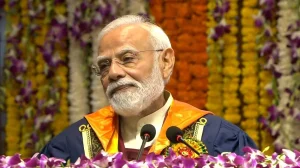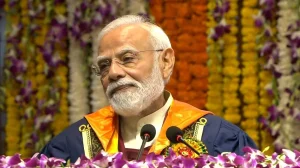
A fresh controversy has emerged around Prime Minister Narendra Modi’s appearance at the 2026 convocation of IIT Delhi, with social-media users mocking the event as an attempt to project political popularity inside one of India’s most prestigious academic institutions.
IIT Delhi’s official convocation website confirms that its 2026 convocation was held on August 8, 2026. (IIT Delhi Convo)
Online posts have since used the nickname “Duggal Sahab” for Modi and portrayed his presence at IIT Delhi as an unnecessary attempt to insert himself into an academic event.
However, there is an important distinction between satire and fact.
There is no verified evidence that Modi “forced himself” into the IIT Delhi convocation or that students formally exposed an attempt by him to manufacture popularity.
So, What Actually Happened at IIT Delhi?
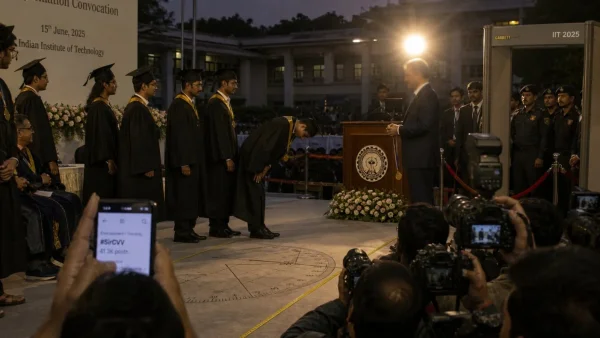
The controversy follows reports that students faced extensive security arrangements and ceremonial instructions surrounding the Prime Minister’s visit.
Social-media discussions alleged repeated identity checks, metal-detector screening and instructions concerning how medal recipients should approach and bow before the chief guest.
Some students reportedly described the arrangements as inconvenient or excessive.
Others, however, pointed out that high-profile constitutional dignitaries routinely come with elaborate security protocols and that ceremonial instructions at convocations are not necessarily unique to Modi.
That distinction matters.
Security protocol is not the same thing as political propaganda.
Why Is “Duggal Sahab” Trending?
The nickname has become part of the internet’s political satire surrounding Modi’s IIT Delhi appearance.
The joke essentially asks:
How did someone who was not graduating suddenly become one of the most prominent figures on graduation day?
The humour works because IIT students spend years preparing for one of the country’s toughest academic journeys.
And then, on the big day, the political guest can dominate the visual narrative.
Students earn the degree. The chief guest gets the spotlight. That is the irony critics are playing with.
But Was Modi Really “Forced” Into IIT Delhi?
There is no evidence currently available establishing that claim.
In fact, IIT Delhi has a long history of inviting senior national leaders to its convocations.
The institute’s own alumni material notes that more than seven Presidents of India and five Prime Ministers, including Narendra Modi, have addressed graduating classes over the decades. (IIT Delhi Alumni)
The institute’s historical convocation records also show prominent constitutional and political figures participating in previous ceremonies.
Therefore, the claim that a Prime Minister’s presence at IIT Delhi is itself unprecedented would be misleading.
The legitimate question is not “Why was Modi invited?” It is:
“Did the political presence overshadow the students and their academic achievement?” That is a debate worth having.
IIT Delhi Is Not a Political Rally
This is where the criticism has some force.
A convocation is fundamentally about:
Students.
Degrees.
Research.
Academic achievement.
Parents.
Teachers.
Years of hard work.
The chief guest is important, but the institution should remain the centre of attention.
If security restrictions, ceremonial rehearsals or political messaging become so elaborate that students feel their own graduation has become secondary, the institute should examine whether the balance is right.
What About the “Bowing” Controversy?
This is perhaps the most discussed part of the episode.
Reports circulating online said medal recipients were instructed about how low to bow when receiving medals from the Prime Minister.
But there is a counterargument.
Some IIT alumni and students online said that rehearsing stage movements and formal gestures is common during convocations. Others suggested that security protocols can restrict sudden or exaggerated movements when a high-security dignitary is present.
Therefore, describing the instruction as proof that students were being forced to “bow before Modi” goes beyond what has been independently established.
Protocol may be routine. The political interpretation is what’s controversial.
The Real Question: Why Does Political Image-Building Matter So Much?
This controversy points toward a broader phenomenon in modern politics.
Political leaders increasingly appear at:
Universities
IITs
Sports events
Start-up events
Convocations
Cultural programmes
Youth conferences
There is nothing inherently wrong with this.
Leaders should interact with students.
But the concern arises when academic events become opportunities for personal branding rather than substantive engagement.
A university should not become merely another backdrop for political imagery.
Could Modi’s IIT Presence Actually Be Useful?
Absolutely.
A Prime Minister speaking to engineering graduates can discuss:
Artificial intelligence
Semiconductor manufacturing
Climate technology
Space research
Start-ups
Defence technology
India’s research ecosystem
Employment
Innovation
Those are legitimate subjects.
The question is whether students received substantive engagement or simply participated in an elaborate ceremonial spectacle.
And Here’s the Delicious Irony
IIT students spend years learning:
Mathematics.
Physics.
Computer science.
Engineering.
Algorithms.
Then, apparently, someone thought:
“Before you receive your medal, let’s calculate the correct angle of your bow.” The engineers have finally encountered a new branch of applied mathematics:
Political Protocol Engineering.
But Let’s Not Turn Students Into Political
Props Either
There is another side to this debate.
Students should not be automatically portrayed as being collectively angry with Modi merely because some students criticised the arrangements.
The available social-media material represents individual reactions and online discussions, not necessarily the official position of the IIT Delhi student body.
Similarly, people who enjoyed Modi’s presence should not be dismissed as political followers.
IIT students are individuals—not a political chorus.
What Should IIT Delhi Do?
If students genuinely felt inconvenienced, the institute should consider:
1. Publish the Protocol
Explain which restrictions were imposed and why.
2. Distinguish Security From Ceremony
Necessary security measures are understandable. Unnecessary ceremonial demands should be reviewed.
3. Keep Students at the Centre
The graduate, not the dignitary, should remain the principal figure at a convocation.
4. Invite Diverse Voices
Universities should expose students to political leaders, scientists, entrepreneurs, academics and critics from across perspectives.
5. Avoid Political Spectacle
Academic institutions should remain spaces where intellectual achievement matters more than political optics.
The “Popularity” Question
The original criticism essentially asks:
Why would a powerful political leader need an IIT convocation to demonstrate popularity? That’s a political opinion, not an established fact.
A Prime Minister does not need to “prove” popularity by attending a university event.
Conversely, there is nothing wrong with a Prime Minister attending one.
The real measure should be what happened during the interaction.
Did students get meaningful engagement?
Did the Prime Minister discuss their concerns?
Did the event celebrate their achievements?
Did the academic institution maintain its independence?
Those are much more meaningful questions than counting how many cameras were present.
Final Take
The IIT Delhi controversy is bigger than one Prime Minister, one convocation or one viral nickname.
It raises an important question about the relationship between political power and academic institutions.
Universities should welcome public leaders—but they should never become stages where students are reduced to background characters.
And politicians should certainly visit campuses—but the campus should not become a backdrop for personality politics.
As for “Duggal Sahab”?
That’s internet satire.
The verified fact is much simpler:
Narendra Modi attended IIT Delhi's 2026 convocation, held on August 8, and the event generated controversy over security arrangements and ceremonial instructions. (IIT Delhi Convo) Whether that amounts to ordinary protocol, excessive VIP culture, or political image-building is the debate.
But perhaps the most important question should remain:
When India’s brightest students finally receive their degrees, shouldn’t the spotlight belong primarily to them?