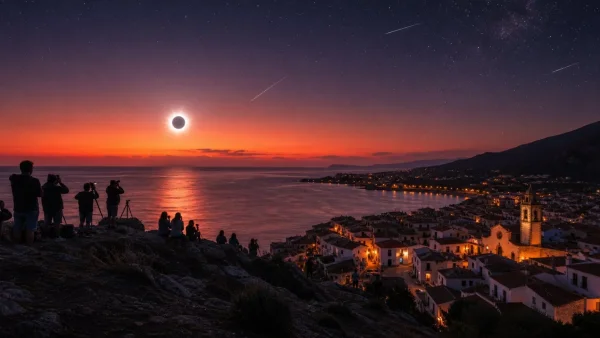
It has been decades since Europe has put on a twilight display like this. Come August 12, 2026, a total eclipse will make its way over the continent and, as the first in 27 years, it has already put it on the itinerary for some in the US.
The hard part is not to be drawn in by the timing and where you are. The Sun will be close to the horizon for a good portion of Europe, so totality will be something of a sunset affair. In the case of northern Spain, the dark may well set in with the setting of the Sun.
That is what you can expect: bold colours, long shadows and the sort of photos one does not soon forget. Toss in the fact that there are no-fuss vantage points in Spain and Iceland, and you can see why the word is getting out well before the date arrives.
Why this eclipse is different
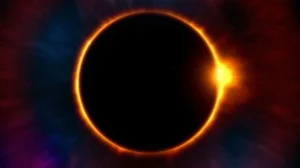
For a matter of minutes, totality rewrites the day. The Moon puts an exact cap on the Sun, the light fades, the temperature can drop and you are left with the corona, a kind of pale halo. It has an otherworldly quality to it until it is over.
You do not come by such an alignment often. The last time mainland Europe was in the path was August 11, 1999. For Spain it has been a longer story; the country has not had to endure total darkness since 1905, so 2026 is something of a once-in-a-lifetime occasion.
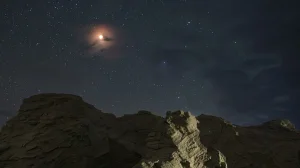
Then there is the matter of the hour. Most eclipses have the Sun right above you, but this one is late in the day. Up in parts of northern Spain the Sun might be gone just as it is on the horizon, and the result is a very cinematic kind of view.
Where and when for totality
Put August 12, 2026 in the diary. The corridor of totality, where the Sun is fully obscured, will start in the north of Russia, go over Greenland and the west of Iceland, then put in a run across the Atlantic to get to northern Spain.
After that it will make a brief pass through the northeast of Portugal and head for the Mediterranean in the vicinity of the Balearics. You could be in the deep shadow for a little more than two minutes in some spots. Anywhere else and it is still a show, if only a partial one.
Spain is the sensible choice for a lot of people. There are decent roads, things are easy to put in place and the western horizons are unobstructed. You have Bilbao, Zaragoza, Burgos, Leon, Palencia, Logrono and A Coruna to name a few, so there is no shortage of a city to put down roots near the action.
Who else can look up
Even for those who will not be in for the full experience, most of the continent will have a partial eclipse to put on display. The list of affected countries is long: the UK, Ireland, France, Germany, Italy and Portugal are in, along with some of North Africa where the Sun will be 90% or more in shadow.
Here is what to keep in mind for a quick plan:
– The date for totality is August 12, 2026
– It is the first in Europe since 1999
– The last time Spain’s mainland was in the path was 1905
– Northern Spain has the most to offer
– You can expect as much as 90% partial coverage outside the direct line
– Make sure to have ISO 12312-2 glasses on hand
You won’t be able to see it from the U.S. mainland, which is what has American astronomers and photographers of all kinds already charting a course for Spain and Iceland. For those not making the trip, there are good live feeds from observatories to be had.
In India, the story is different. With the exception of the far north like Ladakh, where conditions might be right, most of the country is out of luck and will have to rely on an online broadcast.
How to do it safely
It is not worth the risk to look at the Sun unshielded. Don’t be tempted by regular shades or any kind of DIY filter; they won’t do the job. Stick to a pair of eclipse glasses or a solar viewer from a reputable maker that is up to the ISO 12312-2 mark.
There is a time to put them down, though. When you are in the heart of totality and the Sun is fully obscured, your eyes are fine. But as soon as the light comes back, the glasses go on to prevent any harm.
For the best of it, get to a spot with a good view to the west and don’t be late. A low-hanging Sun means you need an open horizon. Then there is the matter of the weather. Clouds are the one thing that can ruin an otherwise ideal eclipse.
And then the Perseids
Once the shadow has passed, the night is not over. The Perseid meteor shower is at its height, and with the Moon out of the way, you are in for a fine display.
Some will be in for a double header. See the day go quiet and dark, let the Sun reappear, and then you can turn your attention up to the sky for some meteors. It doesn’t happen often.
You can find a total solar eclipse somewhere on the planet every year or so, but they are not known for coming back to the same spot in a person’s lifetime. This is as good as it gets for a lot of Europe in a very long time. An eclipse at sunset, a return to totality in Spain and the Perseids to top it off.