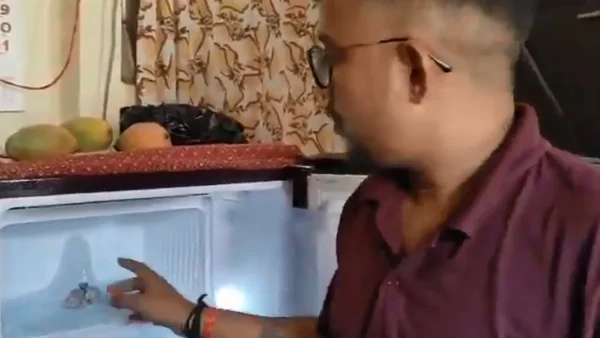
A few decades ago, if someone claimed that a sacred symbol had appeared inside a household freezer, the story would likely have remained within the neighborhood.
Today, a single smartphone video can reach millions of people within hours.
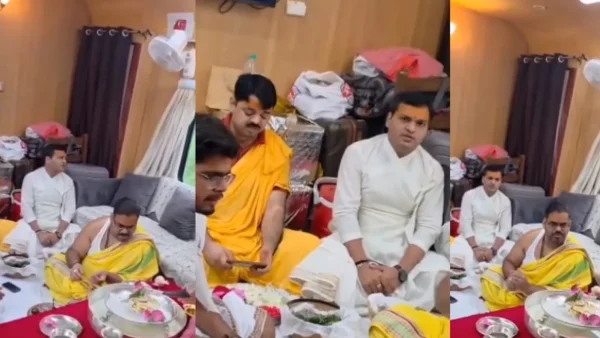
Recently, social media users widely shared posts claiming that an ice formation inside a freezer in Agra resembled a Shivling, with some posts further claiming that people gathered to pray and offer donations. While these claims circulated widely online, the details have not been independently verified.
Whether this specific claim proves accurate or not, it raises fascinating questions.
Why do people see miracles in ordinary objects?
Why do thousands travel to places associated with extraordinary claims?
And how does social media transform a private household into a national talking point overnight? Faith Is Older Than the Internet Faith is one of humanity’s oldest companions.
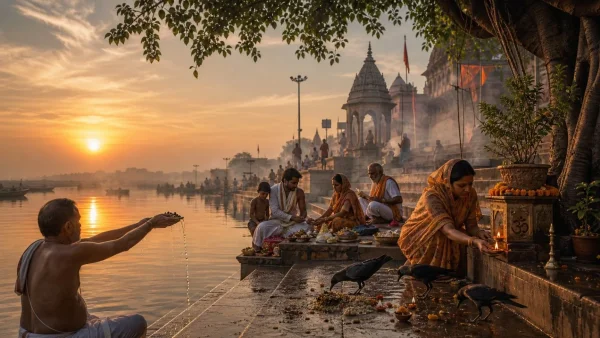
Long before smartphones, people believed that divine signs appeared in rivers, caves, mountains, trees, temples, and even everyday objects.
Across civilizations, unusual natural events have often been interpreted as messages from a higher power.
For believers, these moments provide hope.
For historians, they reflect cultural traditions.
For psychologists, they reveal how the human mind searches for meaning. From the Milk Miracle to Viral Freezers India has witnessed several widely discussed religious phenomena over the years.
The 1995 Milk Miracle
One of the most famous examples occurred in September 1995, when reports spread that statues of Hindu deities were drinking milk offered by devotees.
Within hours, temples across India—and in several other countries—were filled with worshippers.
Scientists later explained that the apparent disappearance of the milk could be attributed to capillary action and surface tension, although many believers continued to view the event as miraculous.
The incident demonstrated how rapidly extraordinary claims could spread even before the age of smartphones.
Similar Stories Around the World
Such reports are not unique to India or to Hinduism.
Around the world, people have reported seeing:
Faces of Jesus on toast or grilled sandwiches.
Religious figures on windows and walls.
Sacred symbols in tree bark.
Images in clouds, rocks, and ice formations.
These incidents occur across different religions and cultures, reminding us that the search for meaning is a deeply human trait. Why Our Brain Loves Miracles Psychologists use the term pareidolia to describe the tendency to recognize meaningful images in random patterns.
It’s why people see:
Animals in clouds.
Faces on the Moon.
Shapes in marble.
Figures in smoke.
Religious symbols in natural formations.
This ability has evolutionary advantages—it helps humans recognize faces and patterns quickly.
Sometimes, however, it also leads us to interpret random shapes as something deeply significant.
Recognizing this psychological phenomenon does not invalidate personal faith; it simply explains one way our brains process visual information. Trust: The Foundation of Every Belief Every society functions because of trust.
We trust doctors with our health.
Teachers with our education.
Scientists with research.
Religious leaders with spiritual guidance.
When extraordinary claims emerge, many people naturally place trust in family members, community leaders, or those who shared the information.
The challenge arises when trust replaces verification.
Extraordinary claims deserve careful examination—not because faith is wrong, but because facts matter.
Respecting belief and asking questions are not mutually exclusive. Worship, Devotion and Community Places of worship are not only about miracles.
They are also about belonging.
People gather to:
Pray.
Seek comfort.
Express gratitude.
Find emotional support.
Build community.
If people assemble around an unusual event, the experience may be meaningful regardless of whether the event has a natural explanation.
For many, devotion is less about proving a miracle and more about expressing hope. Social Media: The Fastest Pilgrim in History Centuries ago, stories of miracles travelled by word of mouth.
Today, algorithms carry them across the world in minutes.
Platforms often promote content that evokes strong emotions:
Wonder.
Curiosity.
Anger.
Surprise.
Inspiration.
As more people react, comment, and share, the content reaches even larger audiences.
The result is that a local story can become a national or global conversation almost instantly.
Popularity, however, should not be confused with proof. Humour: Imagine the Kitchen Conversation Let’s imagine the appliances talking.
Freezer: “I was manufactured to preserve ice cream.”
Refrigerator: “I keep vegetables fresh.”
Microwave: “Please don’t let me trend next.”
Ceiling Fan: “I’ve been spinning for twenty years. Surely I’m due for a miracle too?”
Humour aside, these moments remind us how quickly ordinary household objects can become the centre of extraordinary public attention. Superstition or Spirituality? This question has no universal answer.
For one person, an unusual event is divine.
For another, it is coincidence.
For a scientist, it may be a natural phenomenon.
For a philosopher, it may reveal humanity’s search for meaning.
A healthy society allows these conversations while encouraging respectful dialogue and evidence-based inquiry when factual claims are made. When Faith Meets Commerce History shows that places associated with reported miracles sometimes attract visitors, donations, and local businesses.
That does not automatically imply wrongdoing.
Many genuine places of worship support surrounding communities through tourism and pilgrimage.
At the same time, if financial contributions are sought based on extraordinary factual claims, transparency and accountability become important.
Faith is personal.
Financial transactions are matters of public trust. The Importance of Verification In the age of instant sharing, every smartphone user has become a publisher.
Before forwarding or posting extraordinary claims, consider asking:
Has the event been independently verified?
Is the video authentic and recent?
Are reliable news sources reporting the same facts?
Is there another explanation?
These questions do not diminish faith.
They strengthen public understanding. The Bigger Lesson The reported freezer incident—whether ultimately verified in every detail or not—illustrates something larger than itself.
It shows how deeply humans seek hope, meaning, and connection.
It also demonstrates the immense influence of digital platforms in shaping public conversations.
Faith has comforted people for thousands of years.
Science has helped explain the natural world.
Journalism seeks verified facts.
These three perspectives need not be enemies.
They can coexist when approached with humility, curiosity, and respect. Conclusion: Believe, But Also Ask Every generation has its miracle stories.
Yesterday it was statues, trees, walls, and springs.
Today it may be a freezer captured on a smartphone.
Tomorrow it could be something entirely different.
The real question is not whether people should have faith.
It is whether we can preserve both faith and critical thinking in an age where information travels faster than verification.
Perhaps the greatest miracle is not that an ordinary object becomes extraordinary.
It is that millions of people, from different backgrounds and beliefs, continue to search for hope, meaning, and connection—even in the most unexpected places.