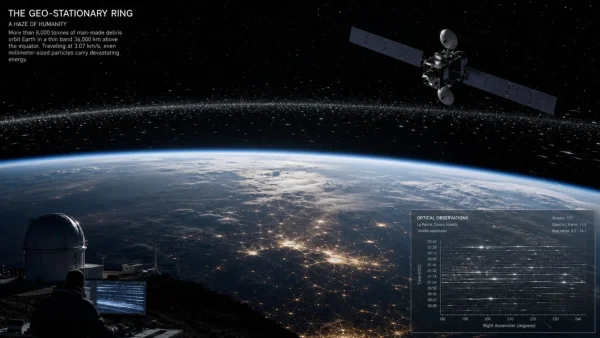
There is a cloud of space junk hiding in geostationary orbit, and it is giving us reason to be concerned about collisions with some of Earth’s most prized hardware. According to the Warwick team, there are small, hard-to-see pieces up there that can put a damper on everything from a live broadcast to an online connection. The findings have made for some pointed discussion on the subject of space safety.
Why this matters for everyday connectivity
You will find the geostationary orbit roughly 36,000 kilometres up, a vantage point where a satellite can hold its position over a single location. It is what makes possible our television, the internet, and the kind of Earth observation and forecasting we take for granted.
The problem is, you don’t get the same atmospheric drag here as in low Earth orbit. So when something is left behind, it is there for the long haul – decades or even centuries. We are talking about some of the more expensive, high-end spacecraft in GEO, with solar wings 30 metres across and 15-year life expectancies.
An accident in such a strategic area is not cheap. A miscalculation or an object you didn’t see can put out of commission the very services that broadcasters and emergency teams count on. That is what has the industry looking at this new inventory of debris with some interest.
What the researchers uncovered
In a paper for the Journal of Astronautical Sciences, the study team went back to some old sky photos and found a number of small things that had been overlooked. They were able to pick out debris no bigger than 5 centimetres.
They put 25 new tracks on the record, and for the most part, 80 per cent of them were objects we had not been aware of. It would seem the GEO environment is a bit more of a crowded place than the usual numbers show.
How a clever imaging trick exposed faint trails
Rather than go out and collect fresh data, they put some advanced processing to work on what was already in the archives. With a technique known as blind stacking, they were able to make visible the kind of quick, faint streaks that a normal scan would let pass by.
The source material came from the Isaac Newton Telescope in La Palma. By running those images through some updated algorithms, the scientists could tell the difference between a weak trail from a piece of junk and the rest of the background.
The collision threat in plain terms
When you are moving at a few kilometres a second, size is relative. A fragment only a couple of centimetres can put an end to a satellite that has cost hundreds of millions to build.
And the more congested the orbit, the higher the stakes. One thing breaking up creates more of the same, which in turn makes it harder to steer clear of trouble down the line.
For anyone with a GEO mission in the works, the bottom line is this:
– We can now spot debris as small as 5 centimetres
– There are hidden variables to factor into mission plans
– Upgraded tracking is a must before you put a new satellite up
Why the discovery changes the risk picture
Older catalogues have a way of focusing on the big, easy-to-follow items. This is evidence of a whole other stratum of smaller debris in the orbit that has not been well documented. And it is enough to put a hole in a radiator or a fuel line, or ruin a solar panel.
Larger GEO units are in the line of fire. With their broad profiles and the length of time they are in service, the odds of running into something you haven’t noticed add up. What is a minor blip on a screen today can be an operational headache later on.
What comes next for monitoring and mitigation
Before any more satellites are sent to GEO, the researchers would like to see some better oversight. They are set to look at data from a host of other telescopes to get a fuller view of what is out there.
With a more detailed map, one can be more judicious about where to put a satellite and when to make an avoidance burn. As reliance on GEO grows, knowing what is in your way is just as important as the capacity you are putting in.
It is a case of being realistic. If you have a good headcount of the small stuff, there is room to make some adjustments in design and in how you handle a satellite at the end of its run. The orbit is not going anywhere, but it does call for a watchful eye.