A Complete Guide to the Divine Presence of Vighnaharta
|| Om Gam Ganapataye Namah ||
1. Introduction
In the busy centre of Mumbai, amid the sounds and disorder of one of the world’s biggest cities, is a temple which offers a quietness beyond description – the Shree Siddhivinayak Ganapati Mandir at Prabhadevi. This holy place of Lord Ganesha isn’t simply a building of stone and cement; it’s a truly alive, breathing place of belief, worship, and heavenly kindness, which has touched the hearts of millions for more than two hundred years.
Shree Siddhivinayak – the name itself is a promise. ‘Siddhi’ denotes success, achievement, and being satisfied. ‘Vinayak’ is one of the most honoured names of Lord Ganesha, the elephant-headed god who is the son of Lord Shiva and Goddess Parvati, and who is worshipped as the remover of difficulties (Vighnaharta) and the giver of wisdom and wealth. Put together, Siddhivinayak means ‘the Lord who grants all desires and achieves all aims’ – a god whose help is asked for before any lucky action, work, or trip starts.
Each year the temple gets millions of people who worship, from ordinary, humble workers to the most famous people in Bollywood, sport, business and politics. People of every kind, no matter what their caste, faith, religion or area, come together under the same roof, joined by one feeling – complete, firm belief in Lord Siddhivinayak.
Lately, the temple has used new technology to spread the holy experience beyond its walls. Through Live Darshan – the real-time online broadcasting of the temple’s services, prayers, and aarti – people who worship from all over India and the world can take part in the holy feeling of Siddhivinayak from their houses, workplaces, or wherever they are. This article is a full, detailed guide to all you need to know about Shree Siddhivinayak Ganapati – his story, importance, mantras, aarti, and how to get his blessings through Live Darshan.
2. History of Shree Siddhivinayak Temple
2.1 The Origin Story
The story of the Shree Siddhivinayak Ganapati Mandir goes back to November 19th, 1801. It was on this lucky day that the temple was made holy and the image of Lord Siddhivinayak was properly put in place. The temple was built by the generous giving and worship of Deubai Patil, a woman without children who prayed deeply to Lord Ganesha for a child. She asked a local builder and devoted Ganesha worshipper, Laxman Vithu Patil, to build the temple.
Deubai Patil’s wish was simple and truly human – she wanted a child. It is said that she prayed to Lord Ganesha with so much power that her wish was given to her. In thankfulness, she paid for the building of the temple and gave it to Lord Siddhivinayak. This beginning gives the temple a special meaning for people who pray for the blessing of children, and thousands of childless couples from all over the country visit the temple for this very reason.
The first building was a modest one – a small, simple shrine about 3.6 square metres. The image put inside was a swayambhu murti (a self-made image), meaning it wasn’t carved or made by any human hand but came into being naturally. This is one of the most important parts of the temple’s holy power, as swayambhu images are thought to have much more divine energy than made ones.
2.2 Growth and Renovation Over the Centuries
For many years, the temple stayed a fairly modest building, known mostly among the local people of Prabhadevi and nearby areas. But as its fame spread by word of mouth and through the wonderful experiences of people who worshipped, more and more people began to visit, and the need to make the temple bigger became clear.
The most important change to the temple took place in the late 20th century. The Shree Siddhivinayak Ganapati Mandir Trust was set up to control the management, keeping and development of the temple. Under the trust’s control, the temple went through a huge rebuilding and expansion project. The new temple building, which was opened in the early 1990s, has a wonderful five-story structure built in the Nagara style of Hindu temple building. The outside of the dome is covered in pure gold plating, which shines brilliantly in the sunlight and can be seen from a long way off, showing the divine brightness of Lord Ganesha.
Now, the temple building includes the main most holy of holies (garbhagriha), large prayer halls, places for thinking, trust offices, a prasad giving centre, and facilities for thousands of daily visitors. The whole structure is a wonderful mix of traditional Hindu building ideas and modern building methods.
2.3 Location
The temple is at Prabhadevi, in the S.K. Bole Road area of Mumbai, Maharashtra. It’s easily got to from all parts of Mumbai and is a sign of the city. The nearest railway station is Dadar, from which the temple is about a 10-minute walk or a short auto-rickshaw trip.
3. About the Sacred Idol (Murti)
3.1 The Swayambhu Murti
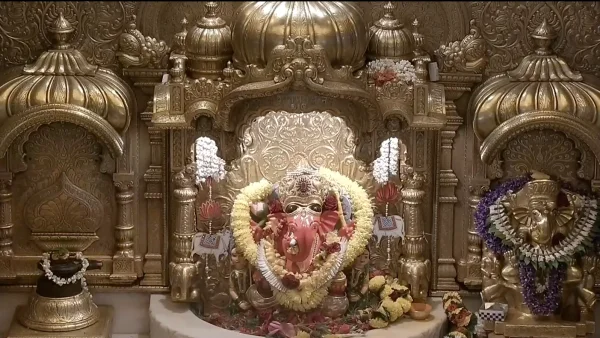
At the holy centre of the Shree Siddhivinayak Temple is the divine image of Lord Siddhivinayak – a swayambhu (self-made) murti which is thought to be several hundred years old. The image is fairly small, about two and a half feet high, but the power and presence it gives off is thought to be endless by millions of faithful people who worship.
3.2 The Right-Turned Trunk — A Rare and Powerful Symbol
One of the most special and holy things about the Siddhivinayak image is that the trunk of Lord Ganesha is turned to the right side. This is a very rare and lucky feature. In most Ganesha images, the trunk curves to the left, showing ease, comfort, and the flow of everyday life. A trunk turned to the right – Dakshinabhimukhi – is linked to the power of Surya, the Sun, and so is linked to success, being satisfied, strength, and doing what seems impossible.
Siddhivinayak images with right-turned trunks are thought to be much, much stronger and are given worship with strict rules and deep respect. People believe that someone who truly prays to this kind of Ganesha will get their most heartfelt, hardest wishes met – which is the main reason so many people come from far away to get Shree Siddhivinayak’s blessing.
3.3 The Four Arms and What They Mean
Lord Siddhivinayak is shown with four arms, and each one holds something holy that is full of what it stands for:
Pasha (Noose) – In his upper right hand, Lord Ganesha is holding a noose called Pasha. This shows his power to catch and tie up all the trouble, blocks, and bad things in a follower’s life. It is a sign of his control of Maya – what seems real but isn’t – and his power to free followers from the chains of pain in the world.
Ankusha (Goad/Hook) – In his upper left hand, Lord Ganesha has an ankusha, a goad used to lead elephants. It stands for the strength of knowing and telling right from wrong – the power to lead a follower’s mind from not knowing to the path of wisdom, being right, and growing in spirit.
Modak (Sweet Dumpling) – In his lower right hand, Lord Ganesha holds a modak, a sweet dumpling of rice flour that is his favorite thing to be given. The modak shows the sweetness of the spiritual trip – the inner joy and bliss that comes with being enlightened and knowing what you are.
Broken Tusk – In his lower left hand, Lord Ganesha is holding his own broken tusk. Stories say Ganesha broke off his own tusk to use as a pen when writing the great story Mahabharata, as the wise man Vyasa told him what to write. This shows a spirit of giving up something precious for something better. It also means even being not perfect and broken can be made into tools for being great.
3.4 Riddhi and Siddhi
On both sides of the image of Lord Siddhivinayak are the lovely shapes of his two wives – Riddhi (the goddess of having enough and wealth) and Siddhi (the goddess of spiritual success and powers that are not normal). Their being with Lord Ganesha makes clear the message that those who get his blessing will get both enough in the world and success in spirit.
3.5 The Decorations
The image of Shree Siddhivinayak is richly decorated with jewels, gold things, and flower designs that are changed every day. On special times and festivals, the god is dressed in royal clothes of silk and gold, and the most holy place is full of the smell of new flowers. The beautiful sight of the decorated image is one of the most moving and remembered things for any follower.
4. Mantras of Shree Siddhivinayak
Mantras are holy sound waves that have divine power. Saying them with love and the right sound is thought to make the mind pure, draw in good power, and link the follower with the divine mind of the god. The mantras linked to Lord Siddhivinayak are among the most powerful in the Shaiva-Shakta and Ganapatya parts of Hinduism.
4.1 Ganesh Beej Mantra
|| Om Gam Ganapataye Namah ||
This is the seed (beej) mantra of Lord Ganesha. It is seen as the most strong and focused way of worshipping Ganesha. ‘Gam’ is the beej (seed) sound of Lord Ganesha – one sound that has all his holy being and power. Saying this mantra 108 times a day is seen as very lucky. It is usually said before starting any new work, trip, or prayer.
4.2 Siddhivinayak Mantra
|| Om Namo Siddhivinayakaya Sarva Karyasiddhikaro
Sarva Vighnashmanaya Sarvarajyavashyakaraya
Sarvajanapriyaya Sarvardhasadhakaya
Ashtadashabhujaaya Ashtadasha Vidhyasampradeepaya
Ashta Mahasiddhaye Namah ||
Translation: ‘I bow to Lord Siddhivinayak, who gets all tasks done, takes away all blocks, who is loved by all, who meets all wishes, who has eighteen arms, who lights up eighteen parts of learning, and who is the master of the eight great powers that are not normal.’
This is the special mantra for the Siddhivinayak form of Lord Ganesha. It is a strong call that talks about all the holy qualities of this form and is thought to have the power to clear the hardest of blocks when said with full belief.
4.3 Vakratunda Mahakaya Shloka
|| Vakratunda Mahakaya Suryakoti Samaprabha
Nirvighnam Kuru Me Deva Sarva Karyeshu Sarvada ||
Translation: ‘O Lord with the bent trunk and a huge body, who has the shine of a million suns, please make all my efforts free from blocks, always and in all ways.’
This is maybe the most often said Ganesha shloka. It is said at the start of every lucky event, prayer, wedding, business, or test. Its message is simple and lovely – a low prayer to the strong Lord to take away all blocks from every path in life.
4.4 Ganesha Gayatri Mantra
|| Om Ekadantaya Vidmahe
Vakratundaya Dhimahi
Tanno Dantih Prachodayat ||
Translation: ‘We think on the one-tusked Lord; let the one with the bent trunk wake up and light up our minds.’
The Gayatri form of any god is seen as a very high prayer – a prayer not just for help for yourself but for the lighting up of the mind. The Ganesha Gayatri prays for wisdom, telling right from wrong, and clear thinking, which are all things linked to Lord Ganesha as the god of learning and knowing.
4.5 Ganesha Mool Mantra
|| Om Shreem Hreem Kleem Glaum Gam Ganapataye
Vara Varada Sarvajanam Me Vashmanaya Swaha ||
This is the Mool (root) mantra of Lord Ganesha. It puts together many beej (seed) sounds – Shreem (calling Lakshmi, goddess of wealth), Hreem (calling the holy woman/Shakti), Kleem (calling holy love and wanting), and Glaum (a special Ganesha beej). Together, they make a very strong wave field. This mantra is usually said 108 times or 1008 times for special wants, very much when wanting great blessing in work, links, health, or growth in spirit.
4.6 How and When to Chant
The best time to say Ganesha mantras is in the early morning – Brahma Muhurta – which is around 4:00 AM to 6:00 AM.
Before chanting, you should have a bath, put on neat clothes, sit on a clean mat or wooden seat looking east or north, and light a lamp; a ghee lamp is best.
It’s good to use Rudraksha or sandalwood (Chandan) malas – strings of 108 beads – to keep track.
Tuesdays, the 4th day of each half of the month (Chaturthi), and Angarki Chaturthi are the most effective days to worship Ganesha.
Offering red flowers – especially red hibiscus – Durva grass (a holy grass), modak (sweet dumplings), and a coconut to Lord Ganesha when chanting makes the mantras work even better.
5. Aarti of Shree Siddhivinayak
5.1 What is Aarti?
Aarti is one of the most lovely and important ceremonies in Hindu worship. It comes from the Sanskrit word ‘Aratrika’ – meaning ‘that which takes away darkness’ – and is the act of waving a lit lamp around the god, whilst singing religious songs. The lamp stands for the light of divine knowledge, which gets rid of ignorance from the worshipper’s mind and heart.
At Shree Siddhivinayak Temple, aarti is done several times a day, and draws thousands of worshippers who come to see and be part of this very touching service. Seeing so many worshippers standing with their hands together, eyes shut, their voices getting louder in religious song as the smell of incense fills the air, is a shared spiritual experience which really changes people.
5.2 Sukhakarta Dukhaharta – The Main Aarti
The aarti most loved and most often sung to Lord Ganesha is ‘Sukhakarta Dukhaharta’, written by the great Marathi saint-poet Sant Ramdas Swami in the 17th century. This aarti is sung in every Ganesha temple in Maharashtra and further afield, and its words are deep in the hearts of millions who worship Ganesha.
|| Sukhakarta Dukhaharta Varta Vighnachi ||
Nurvi Purvi Prem Krupa Jayachi ||
Sarvangi Sundar Uti Shendurachi ||
Kanti Jhalachal Tarajanchi ||
|| Jai Dev Jai Dev Jai Mangalmurti ||
Darshan Matre Man Kamna Purti || (Dhrupad)
Ratnakhadak Chalke Pudhati Paavle ||
Navratna Mekhal Shobhata Ghavle ||
Shirsna Balachandra Bahumol Divale ||
Mukh Manivadhan Kundalat Ghavle ||
|| Jai Dev Jai Dev… ||
Kanda Moola Bhakshaya Vasai Ranat ||
Chandrashekharatmaj Sukhada Sattat ||
Kinari Swami Raya Dutta Varadat ||
Rakshe Suravar Vandan Bhavatat ||
|| Jai Dev Jai Dev… ||
5.3 Meaning and Verse-by-Verse Explanation
Verse 1 — ‘Sukhakarta Dukhaharta’: ‘You make happiness and end sorrow; you remove all problems. You are always full of love and kindness. All of your body is covered in sandalwood paste. Chains of light shine around your neck.’
Refrain — ‘Jai Dev Jai Dev’: ‘Victory to the God! Victory to the lucky one! Just seeing you fills all the wishes of the mind.’
Verse 2 — ‘Ratnakhadak Chalke’: ‘Your feet, with jeweled anklets, move gracefully. A belt of nine gems (Navratna) looks lovely at your waist. On your head shines a crescent moon of great worth. Jeweled earrings (kundalas) adorn your face.’
Verse 3 — ‘Kanda Moola Bhakshaya’: ‘You live in the forest, eating roots and tubers. You are the son of the one who wears a crescent moon on his head (Shiva). You give joy to those who are faithful. Even the gods bow at your feet in respect.’
5.4 Daily Aarti Schedule at Siddhivinayak Temple
Kakad Aarti (Morning Aarti): 5:30 AM — The first aarti of the day, done at sunrise when the temple doors open. This is thought to be the most spiritually powerful aarti.
Madhyan Aarti (Noon Aarti): 12:00 PM — Done at midday, marking the time of day changing and giving the god worship at the middle of the day.
Sandhya Aarti (Evening Aarti): 7:20 PM — As it gets dark, the temple is lit up and the evening aarti is done. This is the most popular and most crowded aarti of the day.
Shej Aarti (Night Aarti): 9:50 PM — The last aarti of the day, done as a lullaby to send the god to sleep for the night. It is a very close and touching ceremony.
5.5 Instruments Used
The aartis at Siddhivinayak have traditional Maharashtrian musical instruments with them, which make a sound which touches the soul. These include the Tutari (a traditional wind instrument), Dhol (drum), Lezim (a small cymbals-and-chain instrument used in Maharashtrian folk music), and Shankhya (conch shells). The sound of these instruments, and the singing of hundreds of worshippers, makes a strong vibration which is both giving energy and very calming.
6. Shree Siddhivinayak Ganapati Live Darshan
6.1 What is Live Darshan?
Live Darshan is the real-time online video showing of the temple’s god, ceremonies and surroundings, letting worshippers everywhere in the world see and be part of the holy experience of Shree Siddhivinayak without being at the temple in person. Through a safe, high-quality video, viewers can see the decorated form of Lord Siddhivinayak, watch the priests do the puja and aarti, and feel linked to the spiritual power of the temple from wherever they are.
The idea of Live Darshan came about as temple trusts across India began to see that millions of worshippers, for reasons of distance, health, age, money problems, or being unable to move, could not make the journey to important temples. By giving live streaming, the temple has given its blessings to the world-wide group of worshippers – from those in the most distant villages of country India to those in cities like New York, London, Sydney, or Singapore.
6.2 How to Access Live Darshan
It is very easy – and free – to view the Live Darshan of Shree Siddhivinayak:
You can bookmark this page and visit it whenever you want to live darshan of “Shree Siddhivinayak”.
You can also use other methods for live darshan listed below:
The official Shree Siddhivinayak Ganapati Mandir Trust website has a Live Darshan link. Go to the site and select ‘Live Darshan’ to see the stream in real time.
The temple also has an official YouTube channel which shows the Live Darshan. Just search ‘Siddhivinayak Live Darshan’ on YouTube, and subscribe to the official channel.
A mobile app – for Android and iOS – has been made by the temple trust. As well as Live Darshan, the app includes mantra audio, aarti times, temple details, and the chance to order prasad or give donations online.
During important festivals and aartis, Live Darshan is also broadcast on Facebook Live and Instagram Live.
6.3 Best Times to Watch Live Darshan
5:30 AM: Kakad Aarti – the day’s most spiritually powerful time, when the energy is thought to be at its purest.
Tuesday Mornings: Tuesdays are the luckiest day for Lord Ganesha and the busiest at the temple. Watching Live Darshan on a Tuesday – particularly at Kakad Aarti time – is thought to greatly increase blessings.
7:20 PM: Sandhya Aarti – the evening aarti, and the most visually impressive, with the temple brightly lit and many worshippers present.
Ganesh Chaturthi: The 10-day Ganesh Chaturthi festival is the finest time to watch Live Darshan, when the temple is wonderfully decorated and thousands of devotees come from all over India.
Angarki Chaturthi: When Chaturthi is on a Tuesday (Angarki), it is particularly lucky. These days see the Live Darshan attract hundreds of thousands of viewers.
6.4 Spiritual Benefits of Live Darshan
A lot of people ask if Live Darshan has the same spiritual value as visiting the temple in person. While the actual experience of going to the temple and being in the holy area is special and cannot be matched, Hindu belief has it that the divine is everywhere and not in only one place. Darshan – meaning ‘to see’ or ‘to be with’ – is at heart an exchange of energy between the worshipper and the divine – and this can happen via any way the devotee’s mind joins with the god.
The Live Darshan of Shree Siddhivinayak is, so, a real and strong spiritual activity for millions of worshippers. Many have told of feeling a deep peace, clarity and joy while watching, as well as their issues being solved and their sincere prayers answered. As with all spiritual things, the main thing is the quality and honesty of the devotee’s aim and focus.
6.5 Tips for the Best Live Darshan Experience
Before viewing, set up a small worship area at home – put a photo or statue of Lord Ganesha, light a ghee lamp or diya, and offer flowers and incense.
Have a wash and put on clean clothes, as you would before going to a temple.
Cut out distractions – turn off your phone alerts and sit in a quiet, calm place.
Say ‘Om Gam Ganapataye Namah’ at the start and end of the darshan.
Be ready to receive, thankful, and open in your mind.
If watching during aarti, sing along or at least listen closely – allow the sounds and vibrations to go into your heart.
Use a firm, quick internet connection to watch without breaks. For the best picture, use a device that can show HD – such as a smart TV, laptop or tablet.
7. Visiting the Temple – A Devotee’s Guide
7.1 Temple Location and Address
Shree Siddhivinayak Ganapati Mandir, S.K. Bole Road, Prabhadevi, Mumbai – 400 028, Maharashtra, India.
7.2 How to Reach
By Train: Dadar Railway Station (Central and Western lines) is the closest station – about 1km from the temple. Auto-rickshaws and taxis are easily found at the station.
By Bus: Many BEST (Brihanmumbai Electric Supply and Transport) bus routes go through Prabhadevi. Buses 68, 70, 83 and others stop near the temple.
By Road: The temple is on S.K. Bole Road, and has good links to all the main roads in Mumbai. Use any GPS app to find ‘Siddhivinayak Temple’ for the right directions.
By Metro: The Mumbai Metro is growing, and new lines will soon bring the area closer to the metro network.
7.3 Darshan Timings
Monday to Friday: 5:30 AM to 12:00 PM and 5:30 PM to 9:50 PM
Saturday and Sunday: 5:30 AM to 10:00 PM (continuous darshan at the weekend)
Tuesday: Special longer hours with large crowds – especially during Chaturthi
Main Festivals (Ganesh Chaturthi, Angarki): The temple may be open for 24 hours
7.4 Dress Code and Temple Rules
You must wear modest clothes. Do not wear tops without sleeves, shorts, or anything too revealing.
Take your shoes off at the area set aside before going into the temple area.
Taking photos and using mobile phones is not usually allowed in the main holy area.
Be quiet and respectful inside the temple.
Follow the queues with patience and respect.
7.5 Prasad
The most loved prasad at Siddhivinayak is the Modak – a sweet, steamed dumpling with coconut and jaggery inside, and Lord Ganesha’s favourite. The temple sells nicely packed boxes of modak as prasad, available at the prasad sales areas. Getting and eating the prasad after darshan is thought to be the god’s blessing passing to you, and many worshippers take these boxes home as gifts of holy grace for family and friends.
8. Festivals and Special Celebrations
8.1 Ganesh Chaturthi — The Grand Celebration
Ganesh Chaturthi is the festival for the birthday of Lord Ganesha, and the most significant yearly festival at Shree Siddhivinayak Temple. It happens on the fourth day of the bright half of the Hindu month of Bhadrapada – generally August or September – and the temple has ten days of it with great show.
During those ten days, the temple gets decorated with loads of flowers, lights and jewellery. Special prayers are said many times a day. They put on cultural shows, devotional singing, and religious talks. The number of people who come goes up from the everyday 25,000 to 50,000, to several hundred thousand during the festival. The Live Viewing of the deity during Ganesh Chaturthi gets millions of people to watch from all over the world.
On the last day – Anant Chaturdashi – a big parade and immersion ceremony ends the festival, although the main statue at Siddhivinayak, as a permanent self-born image, is never put in the water. The events show the amazing affection Mumbai and Maharashtra have for Lord Ganesha.
8.2 Angarki Chaturthi
Angarki Chaturthi is when Sankashti Chaturthi – the fourth day of the dark fortnight – is on a Tuesday; Angarki means lucky. The combination of the strongest day for Ganesha (Chaturthi) and the strongest day of the week for Ganesha worship (Tuesday) makes a very powerful religious event. On Angarki days, the line of people at Siddhivinayak Temple can go on for miles, and people often have to wait eight to twelve hours, which worshippers see as devotion in itself.
8.3 Sankashti Chaturthi
Sankashti Chaturthi is observed monthly on the fourth day of the dark Krishna fortnight of the Hindu calendar. Worshippers fast from sunrise to moonrise, when they pray to Lord Ganesha, do puja, and end their fast. Each Sankashti brings thousands of faithful worshippers to Siddhivinayak Temple. The monthly Sankashti fast is one of the best religious practices for people who want Lord Ganesha’s blessing.
8.4 Ganesh Jayanti
Ganesh Jayanti, also called Magha Shukla Chaturthi, marks the anniversary of Lord Ganesha’s birth according to the lunar calendar. It is in the Hindu month of Magha – generally January to February. It is a quieter, more spiritual event than the big public events of Ganesh Chaturthi, and is greatly loved by devoted Ganesha worshippers.
9. Miracles, Famous Devotees, and Inspiring Stories
9.1 The Power of Faith
The history of Siddhivinayak Temple is full of stories of wonderful grace – stories of people whose lives were changed by the deity’s blessing. From couples who could not have children who were given children after years of earnest prayer, to patients who got well from illnesses they could not survive, to people who found success and peace after years of trouble – the temple’s history has many reports of divine help. These are not just one-off stories, but a constant, active tradition of miracles that has been building since the temple was founded in 1801.
9.2 The Celebrity Devotees
Among the millions who have asked for the blessing of Shree Siddhivinayak, some are among India’s most famous public people. The famous actor Amitabh Bachchan is one of the temple’s most faithful visitors, and it’s well-known he goes to Siddhivinayak before and after big events in his career. The cricket hero Sachin Tendulkar is another very faithful worshipper who has visited the temple many times during his great career. Lata Mangeshkar, the Nightingale of India, worshipped Ganesha all her life. Apart from Bollywood and cricket, prime ministers, state chief ministers, leading business people, athletes, and all kinds of public figures have come to the temple. What these very different people all have in common is a straightforward, deep understanding: that, whatever people do or succeed at, a divine favour steers, safeguards and completes – and at Siddhivinayak, this favour is felt as something real and alive.
9.3 The Story of Deubai Patil
Probably the most touching and telling miracle in the temple’s story is how it began. Deubai Patil – a simple woman with no children, in Mumbai in the early 1800s – put all her greatest wish into a religious act. She didn’t just pray, she built a temple; she made her own prayer a present to the people of the area. And, as the story goes, her wish came true. This tale shows what Siddhivinayak worship is about – that the strongest prayer is one which goes past what is personal and aims at what is universal.
10. Shree Siddhivinayak Ganapati Mandir Trust
10.1 Overview
The Shree Siddhivinayak Ganapati Mandir Trust is the group in charge of running, looking after and doing the charitable work of the temple. The trust is one of the richest religious trusts in India and takes in a yearly income of many hundred crore rupees, mostly from gifts by people who worship there.
10.2 Charitable and Social Activities
The trust spends a large amount of its money on doing good and helping people socially. This includes running hospitals and giving poor people free or cheap medical help, running schools and giving students from poor backgrounds scholarships, giving money to homes for orphans, old people and people with disabilities, and giving help and support during natural disasters. The temple’s work to help people is a straight result of Lord Ganesha being the protector of the poor and a giver of good things to all.
10.3 Online Services
Online Donation: Those who worship can give money to the temple trust on the internet through the official website.
Seva Booking: Different sevas (religious services) like Abhishek, Shodu Mahapuja, Panchamrit Puja, and others can be booked on the internet.
Prasad Booking and Delivery: In a lot of cases, prasad can be ordered on the internet and sent to the homes of those who worship – a great service for those who can’t come to the temple themselves.
11. Conclusion — The Eternal Grace of Vighnaharta
Shree Siddhivinayak Ganapati is not just a god – he is a principle which is alive, a divine model of knowledge, favour, and getting rid of anything which stops life from growing. His temple in Prabhadevi, Mumbai, is a place where people’s desire for the divine gets a reply which is instant, you can feel it, and changes you. For more than 225 years, millions and millions of people have gone to its doors with their problems, their hopes, their thanks and their sorrow – and have left changed.
In the world today, with everything moving so fast, Live Darshan has made sure that no one who worships, wherever they are, needs to feel cut off from this source of favour. Whether you are watching the Kakad Aarti on a peaceful morning from your home in Mumbai, or joining the Sandhya Aarti on the internet from a city thousands of miles away, the look of Shree Siddhivinayak reaches you. The divine doesn’t need you to travel far – it only needs the truth in your heart.
Sit quietly. Light a lamp. Put your hands together. Watch the soft light of the inner shrine on your screen and let the words of the aarti go through you. In that moment, distance doesn’t matter, and the old, always-there favour of Lord Siddhivinayak covers you completely.
12. Frequently Asked Questions
12.1 How can I watch Siddhivinayak Live Darshan online?
You can save this page – and come back to it to see Shree Siddhivinayak whenever you like. You can also see the Live Darshan on the Siddhivinayak Temple’s official website (siddhivinayak.org), their official YouTube channel, and using the temple’s app for Android and iOS.
12.2 What are the Live Darshan timings for Siddhivinayak Temple?
From Monday through Friday, the temple is open from 5:30 in the morning to 9:50 at night; Saturday and Sunday it is open 5:30 AM to 10:00 PM. The aarti times are: Kakad Aarti at 5:30 AM, Madhyan Aarti at twelve noon, Sandhya Aarti at 7:20 PM, and Shej Aarti at 9:50 PM.
12.3 What is the significance of the right-turned trunk of Siddhivinayak?
A trunk turned to the right – that is, Dakshinabhimukhi – is very unusual and thought to be really strong. It has to do with the sun’s energy, and people think it can make even very hard wishes come true for people who truly believe.
12.4 Which mantra should be chanted during Siddhivinayak Live Darshan?
‘Om Gam Ganapataye Namah’ is the mantra most often suggested. During Live Darshan, you could also say the Vakratunda Mahakaya shloka, or the complete Siddhivinayak mantra, to get the most out of it.
12.5 Is Live Darshan of Siddhivinayak spiritually the same as a physical visit?
In Hindu belief, the divine is everywhere. Live Darshan is a proper and strong way to worship for people unable to come to the temple, so long as it is done with real devotion and attention.
12.6 When is the best day and time to have Siddhivinayak darshan?
Tuesday is the most lucky day for Lord Ganesha. Kakad Aarti – at 5:30 AM – is the most spiritually strong time. Angarki Chaturthi – when Chaturthi happens to be on a Tuesday – is thought to be the most blessed day of all.
|| Jai Siddhivinayak! ||
|| Om Gam Ganapataye Namah ||
|| Mangalmurti Moraya! ||
May Siddhivinayak Lord give health, happiness, wisdom and all good wishes to all who worship.