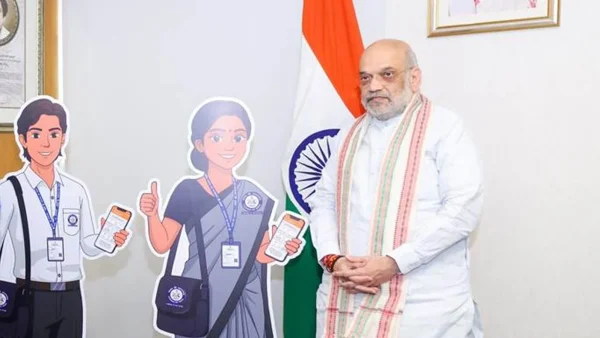
The next national count for India is getting a digital change. The Union Home Minister, Amit Shah, has begun to use four new tech platforms and showed the Census 2027 mascots, Pragati and Vikas, which shows a move to a completely digital census that’s safe with data and easy for people to use. This start gets things ready for the world’s biggest count to be done with modern tools on a very large scale.
Pragati – a woman – and Vikas – a man – have been brought in as the people can relate to faces of the Census 2027. More than just branding, they show the main idea: that women and men must both take part equally in making India’s future.
The mascots will be in the public to help explain how things work, when things will happen, and how the data will be kept safe. You can expect to see them in work with communities and on digital channels, to help people know how to take part easily.
The meaning is on purpose. The government has made this work with the goal of making India a developed country by 2047, showing that it includes everyone, people can trust it, and it’s easy to get to.
When the Census 2027 will happen, what it will be in phases of, and how big it will be
The census will happen in two parts. The first part, listing houses and the housing census, is set for April to September 2026. The second part, counting people, is planned for February 2027.
People in charge expect the work to be mostly done by March 1, 2027. This will be India’s 16th national census since it became independent and its first completely digital count.
The census which happens every ten years, was at first planned for 2021, but was put off because of the COVID-19 pandemic. The 2027 cycle will also include counting caste, which will add a big part about policy to the data.
Four digital tools to power the first completely digital census
The Centre for Development of Advanced Computing (C-DAC) has made a group of platforms to plan, watch, and do work across the country. Together, they are meant to make things more exact, lower the amount of paper, and make the time from getting data to getting information shorter.
HLBC: Digital mapping backed by satellites
The Houselisting Block Creator (HLBC) is a web map that uses pictures from satellites to make standard blocks for listing houses. This layer of space information helps make sure all areas are covered, the lines between areas are the same, and the work is planned better for people who count in cities and the countryside.
HLO mobile app: Field work collection which is safe and works first without being online
The Houselisting Operations (HLO) mobile app changes clipboards to handheld devices. Only people who count, who are on the Census Management and Monitoring System (CMMS), can get to it, and it works on registered mobile numbers.
The app works safely when not online and supports Android and iOS. It lets data go straight from the field to the server and can be used in 16 languages to meet local needs.
Self-enumeration portal: A first for people
For the first time, homes will be able to count themselves online before people visit doors. People who are allowed to answer can send in information through a safe web site during a 15-day time before the 30-day time for listing houses. When a person gets a unique Self-Enumeration ID – or SE ID – after submitting information online, sharing that ID with the person who comes to their door to do a census will help to check the information, speed up the visit, and make fewer mistakes.
CMMS: Planning and watching progress as it happens
The CMMS portal is at the core of everything; it’s a single place to plan, deal with, carry out, and watch activities on all levels of administration. Dashboards that work together will let people at the sub-district, district, and state levels see how things are going and how well people in the field are doing, almost as it happens.
The CMMS controls the movement of data from a lot of devices – millions, in fact – so data can be quickly brought together and checked. This makes quality control better, and reduces the time spent putting things together and correcting mistakes.
Census 2027 will use over 3.2 million people in the field all over the country. People doing the census and their supervisors will use handheld devices, standard maps, and safe apps to get data on people’s backgrounds, social conditions, and money situations from hundreds of millions of homes.
Improvements in how far the census reaches, how safe the data is, and the quality of the data
The new system is made to be both wide-reaching and careful. Watching progress nearly as it happens helps find gaps quickly, and checks built into the system make the data more correct. Going door-to-door still happens, but with better tools, clearer ways of doing things, and more people being held responsible.
Ways to protect data include only letting people into the app if they’ve signed up through the CMMS, using phone numbers that have been confirmed, and sending information using encryption. These protections are meant to build trust while still making sure everyone is counted.
What’s new this time, and why it’s important
This census is different in a number of ways: it’s fully digital from start to finish, lets people count themselves, brings using maps to making lists of homes, and introduces watching progress almost as it happens for quicker, more accurate data.
The census also covers more ground – it will record caste, giving more useful information for social policies and planning welfare. A budget of about Rs 11,718 crore shows how large and technically ambitious the effort is.
The census will happen in two steps: first, it will get data on homes – what they’re like, what people own, and what they have. The second step will get data on people’s backgrounds, social and economic conditions, and cultural details. Together, the data can help with planning infrastructure, how much health care there is, access to education, labour policies, and market strategies.
The role of C-DAC as the technology that everything depends on should also reduce things being split up, making sure everything works together across devices, languages, and regions, and improving training and support for the people doing the census.
How people can take part and get ready
People in homes should watch for official announcements about when they can count themselves and only use the official website. Keep the SE ID after submitting information online and have it ready for when the person doing the census comes to visit.
During the field work, ask to see official ID. Give correct, complete information about homes and people in the home. If you’ve moved recently, be ready with your current address so you aren’t counted twice.
For people who aren’t as comfortable with digital tools, visits to homes will still be the main way of doing things. The system balances new ideas with making sure everyone is included, making sure everyone is counted, safely and correctly.
Census 2027 combines technology, scale, and getting the public involved to give quicker, better data. With Pragati and Vikas in charge of communications, and a strong digital system behind the scenes, India’s first fully digital census is set to change how national statistics are gathered and used.