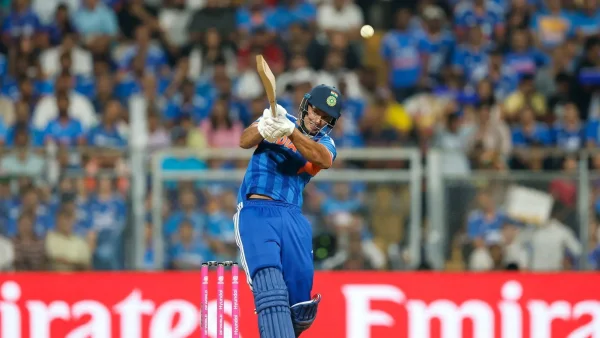
India’s batting was truly amazing in the ICC Men’s T20 World Cup 2026 semi-final at Wankhede Stadium, getting 253/7 in 20 overs versus England. This included nineteen sixes and thirty-seven boundaries, and a partnership between Sanju Samson and Ishan Kishan which really changed the match. This innings showed how seriously India intended to play in the shortest form of the game.
Samson and Kishan make a historic total
Sanju Samson started things off with a really strong 89 from 42 balls – eight fours and seven sixes. He kept India going after a poor start, and got faster whenever the bowlers tried to slow him down. The way he timed the ball and where he placed it caused the score to go up very fast.
Ishan Kishan quickly helped, getting 39 from 18 balls with four fours and two sixes. The 97 runs Samson and Kishan got together for the second wicket was the highest partnership India had ever had in a T20 World Cup knockout match, and a very important part of the game.
Shivam Dube also made things happen with 43 from 25, using both power and placement to keep the scoring rate up. Late contributions from Hardik Pandya (27* off 12) and Tilak Varma (21 off 7) made the total even higher in the last overs, showing how much depth and ability India had to finish well.
Lots of boundaries and sixes
India’s nineteen sixes matched the record for the most sixes in a T20 World Cup innings, the same as the Netherlands’ nineteen in 2014 and the West Indies’ nineteen earlier in this tournament. The team also hit eighteen fours, making a total of thirty-seven boundaries – the second highest number in T20 World Cup history.
Throughout the 2026 tournament India had hit the rope eighty-eight times, the most of any team, ahead of the West Indies (76) and South Africa (72). This is a large increase from the sixty-one sixes in the 2024 tournament, and shows a big increase in hitting power.
India’s place in T20 records and totals over 250
The 253/7 puts India among the best, as it is their sixth team total of over 250 in men’s T20 cricket. This is the highest number, with a team in a league just behind with five. The number of scores over 250 shows how much more power India has, and how able the team is to keep scoring high throughout an innings.
This performance is also one of the highest totals in T20 World Cup history, and shows that the level of scoring in modern T20 keeps going up. Bowlers now have to face constant hitting at all times, forcing them to change their plans and think of new ways to defend.
What chasing this total means for the game, and what England has to do
England won the toss and chose to field, setting India a target of 254. To get to the final and play New Zealand, they will have to chase a total which is higher than the most recent big chases. The highest successful chase in a T20 World Cup is still England’s 230 against South Africa in 2016 at Wankhede – a number England will need to go past by a lot.
In T20 internationals against India, the biggest successful chase was 225 by Australia in Guwahati in 2023. These numbers show how hard it will be for England; to match India’s speed they will need to hit very well and bowl well at the end of the innings.
What this means for strategy, and what is at stake in the semi-final
India’s innings showed a good balance between the top order hitting aggressively and the lower order finishing well, giving England strategic problems. They must fight the early fireworks with ways to get wickets, and stop boundaries in the last overs. Spin and different bowling at Wankhede could be very important when it gets dark.
For India, the innings is both a statement and a test. Although hitting has put them in a strong position, how well they do in the field and how well they bowl will decide if this advantage in batting turns into a place in the final. New Zealand are waiting for the winner, and the intensity of this semi-final has set the stage for a very exciting end to the tournament.