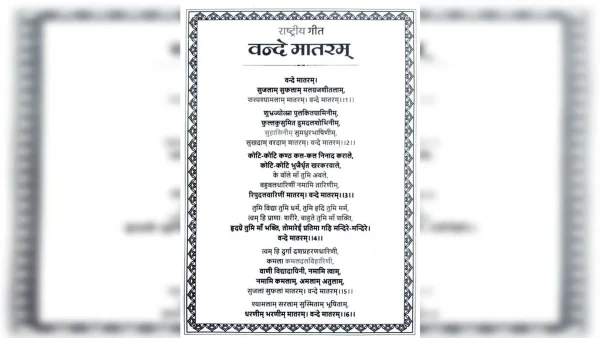
India is celebrating a grand occasion as the Vande Mataram song holds the honour of its 150th anniversary. Said national anthem represents unity, patriotism, and resistance through history-the soul-stirring tones crossing through countless generations. Vande Mataram was coined in the 1870s by the great Bengali poet and novelist Bankim Chandra Chatterjee, and the text was first printed on November 7, 1875; thereafter, it was incorporated in his novel Anandamath in 1882.
Historical Significance
The history of Vande Mataram is interspersed with the history of independence in India. As the British tightened their hold on the country, this song became the war cry of freedom fighters, expressing their love and dedication to the motherland. In 1896, Gurudev Rabindranath Tagore gave the first public rendition of this mellifluous poem during the session of the Indian National Congress at Kolkata, setting afire the spirit of the song as an emblem of the freedom movement of India.
Recognition as National Song
Vande Mataram stood for official recognition as the national song on January 24, 1950, by the Constituent Assembly of India. Dr. Rajendra Prasad had stood up at that time and declared that both Vande Mataram and the national anthem Jana Gana Mana should be treated equally and honored. This was an acknowledgment of the rare legacy of the song and its profound effect on the cultural-historical account of India.
Legacy and Relevance Today
As we celebrate 150 years of Vande Mataram, one thinks of all its aspects that have provided inspiration and continue to resonate in the hearts of the people in the Indian subcontinent. This devotional song to the country is much more than just a poem; it is a call to action, a reminder of dignity and strength, and an anchor linking the past struggle of freedom to current-day patriotism. Vande Mataram is indeed a time-honored symbol of pride and commitment for students studying in classrooms or for elders who recollect the struggle for independence and for fresh young citizens who discover an affinity for nationhood.
Renewing Our Pledge
In times when unity, purpose, and national identity are more vital than ever, the legacy of Vande Mataram invites a moment of reflection on common thoughts. Let every note and lyric of this hullabaloo transcend the stage and send shivers down every listener’s spine-the music should awaken pride within the listeners-their need to serve this motherland, instead. On the occasion of Vande Mataram’s anniversary, we should glorify the spirit it stands for-a spirit that serves as a reminder to all of us to work towards unity, dignity, and doing something for the country.
Conclusion
Let us remember and pay tribute to the impact that Vande Mataram carried into history and culture, particularly on this great and memorable occasion. On Vande Mataram’s 150th Anniversary, let the national song remind us of our shared obligation to live by the principles it stands for: Happy Anniversary, Vande Mataram. The ever-charming tribute to the landmother that continues to inspire and unite.