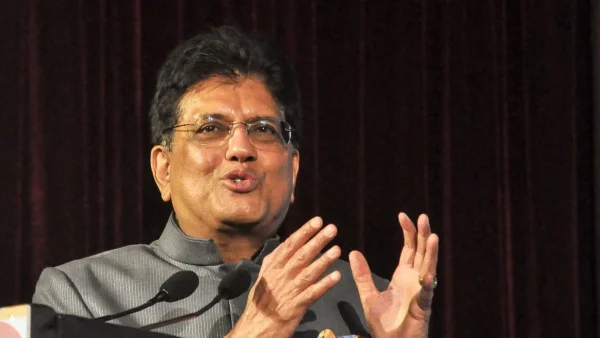
The bar is being put higher for trade. Piyush Goyal, the Commerce and Industry Minister, has put a $1 trillion figure on the table for this fiscal. He is counting on a pick-up in both ends of the market and a wave of new deals to make it happen. To the industry, his words were plain: you have to scale up or you will be left behind.
You can see the signs already. In the first quarter, Goyal put the numbers out there: 15% growth for merchandise and 11% for services. He is touting that as evidence the trillion-dollar mark is not so far off, provided we keep this up.
Why the push for a trillion now?
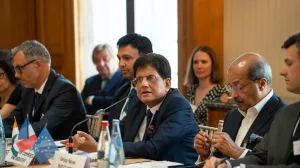
In the government’s view, India’s standing is what’s pulling in partners from around the world. Speaking to the Board of Trade, Goyal was blunt: “The world wants to work with us. We have to go out and capture those world markets.”
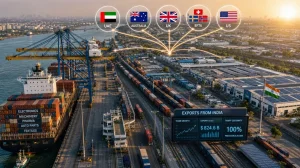
And the pacts are the means to an end. The one with Oman is in effect as of 1 June, the UAE is done, and the UK deal should be live by July 15. Goyal has been at the industry and the states to make use of these, along with the EFTA FTAs, to get into more markets.
The numbers at play
To get to $1 trillion you need to move on two tracks: more in the way of goods and strong showings in services. Goyal has mapped it out. He is looking for a 16-17% lift in goods to hit roughly $530 billion, and an 11-12% in services for close to $470 billion. You do the math: that is a step up from $440 and $421 billion respectively.
For perspective, last year we wrapped up at $863 billion in all. Or if you look at FY26, it was $860 billion – $441.78 billion in wares and $421 billion in services. Hitting the new number means both have to perform.
What is expected of the industry and the states
There is a call for an upgrade in three areas: capability, credibility and the ability to get to the customer. A low price tag won’t be enough to close a deal. Goyal has told exporters to put money into quality and to put in the work to build a name for themselves. Export Promotion Missions will be there to back them up in branding and to put down roots in other countries.
He is also on top of the red tape. The minister has made it known that testing costs will come down. For the smaller players, the missions will even cover the cost of getting the right approvals. The idea is to clear the path here so they can be more of a force out there.
Goyal has some things he wants to see put in motion:
– Put exports first in every sector
– Make the most of the FTAs with EFTA, Oman, the UAE and the UK
– Get some scale with the BHAVYA Scheme
– Find where you can replace imports to be more resilient
– Don’t skimp on quality and testing
– Put your brand in front of people overseas
– Have state policy in line with the Centre
He also had a word for the Directorate General of Trade Remedies to be on the lookout for dumping. If the states and the Centre are on the same page, he says, you can get to those export markets in a hurry.
Obstacles and what comes next
Then there is the matter of cost, and freight in particular. Goyal concedes shipping is pricey, but points out everyone is feeling it. The real danger is if you don’t have the capacity for it. “This will not happen sitting at home,” he said, and made it clear exporters need to get out and put in the effort.
The Board of Trade got together on Friday for the first time in a while, and it was a sign of a change in tone. “We must get to $1 trillion,” Goyal put it. “It is an ambitious target, but it can be done.” All eyes will be on the India-UK pact coming online in mid-July; it could be a big opening in a market where we are currently on the short end of the stick on imports.
Put the early gains together with the new access and some help from above, and you can see the way to a trillion. The message from the Centre is simple: take the opportunity, or let someone else with a swifter hand have it.