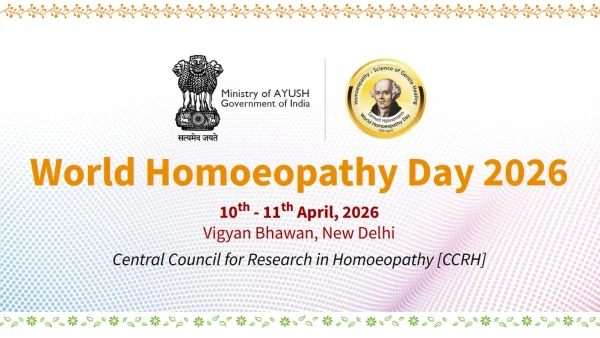
World Homoeopathy Day will be on April 10th, and again the focus is on lasting health and healthcare systems that are fair to everyone. This date is Dr. Samuel Hahnemann’s birthday (he started homeopathy), and it shows how significant India is to homeopathy around the world in how it’s used and researched. India has one of the largest numbers of homeopathy practitioners, and has two hundred years of actually treating patients, teaching it, making rules for it, and using it in public health.
World Homoeopathy Day 2026: Theme, event, and significance
This year’s main idea, “Homoeopathy for Sustainable Health”, puts stopping illness before it starts, being affordable, and protecting the environment at the heart of everything. The Ministry of Ayush will hold a two-day meeting at Vigyan Bhawan in New Delhi, with people who make laws, researchers, and doctors, to think about how homeopathy can help create healthcare systems that can recover and continue working.
Prataprao Jadhav, the Minister of State for Ayush, will officially open the event. Rajesh Kotecha and other high-ranking officials will be there with the experts to discuss how to build up proof of homeopathy’s effects, good professional behavior, and combining it with national health plans. The Central Council for Research in Homoeopathy (CCRH) is organizing the meeting and will be displaying new research and public health programs.
The meeting will look at what homeopathy can do for long-term illnesses, resistance to antibiotics, and keeping people healthy in the first place. They will also discuss environmentally sound ways of making medicines, protecting different kinds of plants and animals, and combining old traditional knowledge with current scientific methods to lessen the harm healthcare does to the environment.
Origins and principles: Hahnemann’s enduring framework
Samuel Hahnemann, a German doctor who lived from t755 to 1843, formally established homeopathy in 1796. His Organon of Medicine is still extremely important to those who practice homeopathy; it outlines the methods and principles of doing things, and encourages treating each person as an individual, with all their needs taken into account. The word “homeopathy” comes from Greek words that mean “similar suffering.”
The system is based on two important ideas. The first, often called “like cures like”, says that something that causes symptoms in a healthy person can, in very diluted form, treat those same symptoms when someone is sick. The second, the “law of minimum dose”, says to use very tiny, carefully prepared medicines to encourage the body to heal itself, and to have as few unwanted effects as possible.
Homeopathic medicines are made from plants, minerals, and animal substances, and are made by diluting them and shaking them. They’re typically given as pills, small sugar pellets, or liquid drops. Each patient is treated as a whole person – their emotional and physical state are considered, not just the name of their disease.
A two-century journey of homoeopathy in India
Homeopathy came to India around 1810 because of German missionaries who handed out the new medicines. John Martin Honigberger, a follower of Hahnemann, began practicing here and became well-known after successfully treating Maharaja Ranjit Singh in 1839. This success led to more people of importance and the public in general accepting it.
Soon after that, homeopathy became more established. One of the first homeopathy hospitals opened in Tanjore, Tamil Nadu in 1847. In Bengal, Rajendra Lal Dutta, a doctor and someone who gave to charity, improved how patients were treated, and Mahendra Lal Sircar, a famous doctor, gave homeopathy more respect as an idea. Clinics were soon in Calcutta, Banaras, and Allahabad, and it spread to other areas.
Now, India has about 345,000 homeopathy doctors who are registered, 8,593 clinics, 277 schools, and approximately 34 research centers just for homeopathy. This shows how it’s grown over a long time from being used by missionaries to being a normal part of preventing illness, managing long-term problems, and looking after the health of communities.
Institutional architecture after Independence
After India became independent, the government started to control how homeopathy was taught and practiced, and encouraged research. In 1973, the Central Council of Homoeopathy was formed to decide what should be taught, keep standards high, and give advice to schools. In 1978, the Central Council for Research in Homoeopathy was set up to improve scientific investigation and studies of patients.
A major change in how things were regulated came with the National Commission for Homoeopathy Act, 2020, which started on July 5, 2021. A newer commission has taken the place of previous organizations, is now in charge of the quality of homeopathy education, and keeps the official list of homeopathic doctors. It also works with state-level homeopathy groups, makes sure doctors act ethically, and checks that homeopathy schools and hospitals follow the rules.
The Pharmacopoeia Commission for Indian Medicine and Homoeopathy helps ensure the quality and safety of medicines. It creates official lists of ingredients and formulas and is also the main laboratory for testing drugs and hearing appeals about them. It was set up in 2010 and in 2014 began to include homeopathy, and it is central to standardizing and testing homeopathic medicines.
Government programs and public health integration
The Ministry of Ayush promotes homeopathy with programs that combine providing treatment, teaching, and doing research. The National AYUSH Mission supports having homeopathy services in the same locations as basic health centers and community health centers, and provides money for hospitals, clinics, and schools. Over 184,235 Ayushman Arogya Mandirs are operating throughout the country.
AYURSWASTHYA concentrates on improving the quality of homeopathy institutions and the excellence of their research, while AYURGYAN focuses on training and improving the skills of homeopathy professionals. The Extra Mural Research program provides funding for researchers to do their own projects; it offers up to 7 million rupees over two or three years to help prove homeopathy is effective scientifically.
The National Medicinal Plants Board supports all of this by encouraging the growing and protecting of medicinal plants. Because over 7,000 different plants are used to make medicines for AYUSH (Ayurveda, Yoga and Naturopathy, Unani, Siddha and Homeopathy), protecting these plants helps biodiversity, makes sure there’s a reliable supply of ingredients, and helps people in rural areas make a living, as well as helping the AYUSH industry as a whole.
Research, epidemics, and sustainable health goals
CCRH (the Central Council for Research in Homeopathy) does research through 33 of its own research centers and teams. They do research to determine how homeopathic medicines work, test them on people, keep records, and publish their findings. The council also gives money to people doing research outside of CCRH, and they work with experts in other areas of medicine to make sure homeopathy research fits with the country’s overall health objectives.
Being involved with the public’s health is a major part of what they are doing. CCRH and its partners have done research and provided help during epidemics, including during outbreaks of Japanese Encephalitis and Acute Encephalitis Syndrome in Uttar Pradesh. They have also worked on chikungunya in Kerala and programs to prevent dengue, and have held health camps for many illnesses such as malaria and typhoid.
During the COVID-19 pandemic, about 500,000 people received the homeopathic remedy Arsenicum album 30C at 136 centers run by the Ministry of Ayush. Scientists are still evaluating this, but it shows the government’s commitment to being ready for problems and reaching out to communities as part of a combined approach to public health.
The theme for 2026 is about the increasing costs of healthcare, the number of people with long-term illnesses, and the fact that germs are becoming resistant to antibiotics. People who support homeopathy say that because it treats each person as an individual and doesn’ may require a lot of resources, it can be an affordable way to get care and be better for the environment. Continuing to get good evidence, having strong ethical standards, and clearly defining how to properly combine homeopathy with mainstream medicine are still important goals.
How India observes World Homoeopathy Day
All over the country, people are holding meetings and events to mark the day. The National Commission for Homoeopathy has asked state-level homeopathy groups, schools, and doctors to have programs on April 10th. Seminars, discussions of cases, and talks between teachers and students help people share knowledge and improve their skills in treating patients.
At the same time, they are reaching out to the public. Awareness campaigns, free health checks, and clinics in the community show how homeopathy can help prevent illness and provide complete care. Fun activities like essay and poster contests and making short videos get more people to take part and introduce younger people to homeopathy and possible careers in the field.
This way of celebrating brings together science, providing care, and including the community. It shows how rules, research and education can work together with what the public needs for their health and what patients want, and it supports India’s approach to healthcare that uses many different types of medicine.
Looking ahead: A steady path for homoeopathy in India
Homeopathy in India has changed from being started by missionaries to a system with rules and research, and it is now part of the country’s health plans. Organizations such as the National Commission for Homoeopathy and CCRH keep improving standards by creating evidence, making sure ethical rules are followed, and changing how people are educated.
As World Homoeopathy Day 2026 focuses on health that lasts, India’s experience provides ideas about how to do things on a large scale, come up with new ideas, and combine different approaches. Having more solid data, being open and honest in evaluations, and working with people in other fields of medicine will be very important. If we do these things, homeopathy can continue to be a valuable part of India’s healthcare system that uses many different types of medicine.