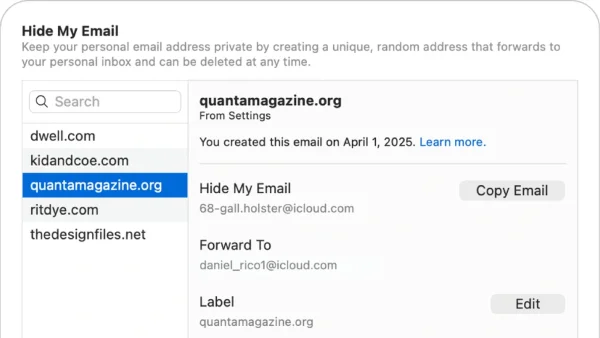
There is a bit of a reworking of the back end for Hide My Email, and in some ways it could put a new spin on how apps deal with you when you don’t want to be known. The new .icloud.com tag for fresh aliases means a website can more readily see you are using a private address and decide to block you. For Apple, the privacy angle is at stake.
Hide My Email is one of the perks of an iCloud+ plan. It makes up a random relay to send your mail to where you want it. You can put it down for a service and not have to give out your actual email, which is a good way to keep spam and oddball senders from your main inbox.
Why this is a big deal
Up to this point, the aliases were on the same .com as any other Apple account. That made it tough for a platform to know if you were being open or putting up a front. The .icloud.com label changes that; now they can tell with less effort.
We’ve been told by developers and providers to be on the lookout so as not to block a Hide My Email message by mistake. Apple is saying what you have will still work, so there won’t be much of a hiccup. But having a domain that stands out gives an app a moment to think twice when you’re making an account.
The promise of privacy and the rules of the road
Apple hasn’t come out and said why they are making the change. Over on Reddit, a few folks are of the opinion it takes away from the feature’s appeal: the ability to blend in. It’s simple enough – if they can see the alias, they can say no to it and you might as well hand over a personal one.
They aren’t taking the feature back, but the way it works in the wild is different. An app with a preference for a verified email can now screen you at the door.
What we have been told by Apple
A word to their developers was that in the next few weeks, any new addresses will be under the .icloud.com umbrella. They made it clear that old ones will do what they always have. The feature is still part of the iCloud+ package.
Here is the rundown of the details Apple has put out there:
– Any new alias will be on .icloud.com
– What you have already will go through as usual
– Providers are to fine-tune filters to prevent false blocks
– You can still use Hide My Email with iCloud+
Anonymity is under a microscope
It is no coincidence this comes at a time when being untraceable online is being questioned. We are hearing of legal moves to get tech to cough up on users, even those who are critical of the government. In one case, reports say Apple turned over info on a person who was accused of using the service to threaten the girlfriend of FBI Director Kash Patel.
You have to look at the bigger picture. There is a pull between what users want in terms of privacy and what platforms and the law want in the way of a clear identity. This is Apple’s way of walking that line.
What it means for you
For the average person, nothing will seem to have changed. But if you are the type to sign up for things without a trace, you may run into some pushback from an app that doesn’t like the .icloud.com name.
You don’t need to do anything with your current aliases. The only thing is, you might be denied access. If a site won’t have a private address, you can either show them your real one or walk away.
Where does this leave Apple?
Privacy has been a selling point for the company. By making it plain what a Hide My Email is at registration, they are putting the ball in the court of the developer to make a call. It’s no longer just about the inbox; it’s about whether you can make an account at all.
How hard apps press on this will be the test. Should they start to be firm on rejecting these, it could be a thorn for Apple’s brand. Not because the tool is off the table, but because now the gatekeepers have a way of knowing.