You could say India has ratcheted up its oversight of messaging by username. The IT ministry put the brakes on WhatsApp’s India launch for now and wanted an answer in three days; it has also put out notices for Telegram and Signal. It all comes down to privacy, the risk of being defrauded and how you build an identity when you’re serving half a billion people in India.
What the government is asking, and why it matters
If you ask a source in the government, the Ministry of Electronics and Information Technology has put to Telegram and Signal some hard questions on how their systems for usernames stand up to fraud and the like. With Telegram, they’ve even inquired as to why the feature should be there in the first place.
For WhatsApp, the bar is higher. The Centre has made it clear to Meta: hold off on the new feature in India until we’re done talking and let us have a write-up in three days. They’ve also posed the question of why they shouldn’t be moving on this under the IT Act and the rules that go with it.
They are kind of the same story, but not quite, one official will tell you. For one, Telegram has been doing this for a while; WhatsApp is just talking about it. Then there’s the matter of the user base – India is where the rubber meets the road for WhatsApp, with well over 500 million of them.
Key concerns flagged by the Centre
The way the officials see it, what WhatsApp is up to could ‘materially increase’ the chances of you running into a phishing attempt, a digital arrest scam or some other form of online fraud. The ministry has also put WhatsApp on notice about the due diligence expected of a major social media player here in India.
Regulators have been making a point of these to the platforms:
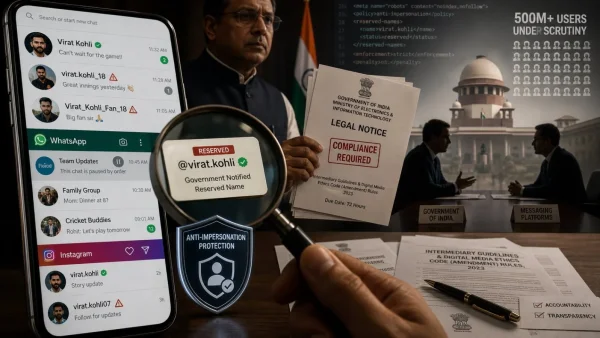
– How do you stop someone from making a copycat or lookalike handle?
– What is in place to keep scammers from hounding victims with messages?
– In what way can a user be sure they are talking to a real public figure?
– If you are the one being impersonated, where is your recourse?
What WhatsApp intends to change
The idea is to make it possible to get in touch with a username rather than having to hand over your phone number to a new contact. You’d still have to put in a number to set up the account, but after that you can be found by a handle of your own making.
WhatsApp is putting it out there as 'a more private way to connect‘, and in their view, it is a fix for the old problem of being reachable without giving out your number. “You can put in for a username of your choice right now, but you won’t be able to make use of it just yet,” a spokesperson put it. “That part is coming later this year and we’ll be phasing it in.”
WhatsApp has been fielding some pushback on the matter. The app’s makers are quick to point out they have put in place some guardrails to head off scams and the like. They’ve even put up an FAQ to set the record straight on how the new system and its security will work.
Reserved names and anti-abuse plans
To put a stop to anyone putting on a false face, WhatsApp says it is holding back the handles of well-known personalities, government bodies and any verified Meta accounts. It’s all part of their multi-pronged strategy to keep abuse at bay.
Why privacy advocates and creators are on edge
It comes down to the threat of copycats. A public figure or official could end up with a doppelgänger username reaching out to users who can’t be sure if it’s the real thing. “Close variants of a name can be used to pull in money by preying on brand recognition,” was the warning from entrepreneur Ankur Warikoo on X.
Warikoo made the case that without a phone number to verify, you’re losing a bit of safety. Vijay Shekhar Sharma, of Paytm, was of the same mind, noting the potential for confusion when you have a mix of the real deal and unverified imitators.
Then there’s Manish Sisodia, the AAP politician, who found he couldn’t get his top pick for a handle because “many versions” were already gone. He sees a real risk in having someone else put a claim on a name that’s tied to a public office.
Competitors feel the heat, and a homegrown app concedes
We haven’t heard back from Telegram or Signal as of yet. Telegram has had its share of trouble with regulators in India over fraud and the kind of content it allows; the service was even put on ice for a week at one point.
The message from the top is enough to alter course. Arattai, which is behind Zoho, has said it’s turning off its own username feature to stay in line with where things are heading. Sridhar Vembu, co-founder of Zoho, made as much on X.
The strategic calculus for platforms
This is more than a matter of what features you want in India. For WhatsApp, putting the brakes on in its biggest market makes for a hard sell on its privacy story and nixes the kind of user discovery you see with Telegram. As for the others, they have to figure out if their way of doing things can be made to fit with Indian rules.
Now it’s a matter of haggling. WhatsApp has put a hold on things in India while it talks with the authorities. The government wants to know why it shouldn’t be using the IT Act to put a stop to it. The onus is on the platforms to show that usernames can be a net positive for privacy and not a vector for new kinds of fraud.
In the end, it will come down to how much you can be reached without giving out your number. For the rest of the industry, it’s going to be a case study in how to handle identity and verification in India. How this is resolved may well dictate how other privacy tools are put together and put out there.