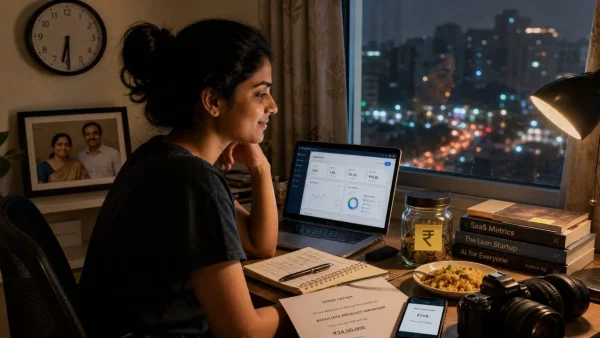
On paper she has taken a hit to her income, but the 24-year-old says she is putting away more than before. When her firm made it a point to have everyone in the office five days a week, she walked away from a Rs 10.5 LPA position for an all-remote one at Rs 8.5 LPA. For her, it was about getting back some time, energy and a sense of control.
It is a tale that has been making the rounds online, and it poses a question a lot of city-dwellers are mulling over: once you factor in the commute, the hassle and the expenses, what is your salary actually worth? For her, the math, the way of life and her own well-being pointed in the direction of working from home.
Why a lower salary added up to more
If you put it on a map, the trek from her house to the office didn’t seem like much. The place was 15 kilometres out. But in Bengaluru, 15 km can feel like 30. With traffic, she was looking at an hour or two in the car every day, and on top of that on any given client-meeting day.
She doesn’t have a car of her own, so she was on the apps for a ride. That ran her down to the tune of Rs 12,000 to Rs 15,000 a month. And when you’re in the office, lunch is another Rs 200 to Rs 250, and if you get back in late you might as well order in for dinner rather than make something.
The 10.5 LPA was the headline, but her bank account and calendar had a different take on it. She figured the long hours in transit were sapping her before she even started and leaving little room to wind down after. The 8.5 LPA remote job, on the other hand, did away with that and the kind of wear and tear it brings.
In a way, that closed the gap between the two salaries. You don’t have to worry about driving in the rain and the prices that come with it. She figures she is now holding on to some Rs 12,000 to Rs 15,000 a month, and has been able to be more regular about her savings.
From policy shift to personal calculus
She wasn’t out looking for a change. As a Customer Success Manager for close to two years, she was mostly remote, with the occasional in-person visit for a client. Then in late 2025, the company set up shop in Bengaluru and put in place a 10-to-7, five-day-a-week in-office mandate.
Suddenly she was out the door early and in late, and the easy option was to have food delivered. What really got to her was the effort of it: the traffic, the hailing of a cab, the unpredictability of the rates, all while you have to be there on time.
She put out feelers and did come across some better offers, but they were for full-time in the office. She even tried to work out a hybrid with her current employer, to no avail. So it came down to this: do you want a bigger number on the payslip, or do you want to have a life and some bandwidth for the future?
She put it to her parents, Dhananjay Kumar and Sunita Devi. They were for her health and well-being. On top of that, since she does some content and freelance on the side, a remote setup fit in with a routine where she could keep her head in the game for all of it.
What she does now
These days she is an Implementation Advisor for a SaaS firm in the US. For the last half a year or so, she has been on a 6.30 pm to 3.30 am clock. Unconventional, perhaps, but without the commute she is in charge of her own schedule.
The day is for picking up new skills, making content and the like. In her present role she is also getting a good look at SaaS, automation and AI, which she feels has made her more well-rounded, both technically and in how she thinks about things.
There is room for the odd freelance piece of work too. She can even be in her hometown for a while and not have to ask for leave, and still be on top of her work. Her rent in the city is unchanged, but with travel and food bills down, the finances are in better shape.
Public reaction and the wider debate
People have latched on to her experience as a way of saying that a salary is only part of the equation when you are talking about the cost of a working life.
You don’t have to look hard for people who will put their time and sanity before a few extra rupees on the payslip, especially if it means being in an office come what may.
Take Ayaan’s post, for instance. It made the rounds for a reason: she laid out the numbers and called it like she saw it. When you factor in the Rs 12,000 to 15,000 you can easily burn on cabs, making the switch was the only way to go. The comments section was full of that kind of thinking – a lot of us know that a fatter package is no good if you’re left with nothing but stress, traffic and a hole in your pocket.
Of course, it’s not all one way. There is something to be said for the unscripted chats and the way you can build rapport in person. She’ll be the first to admit she misses some of that. But where she is in her career now, working from home is just more workable.
A quick run-through before you put pen to paper on a 5-day WFO
If you are in the same boat, here is a way to size up an offer or a new policy:
– Do a hard look at what your commute is costing you
– Put a clock to it, from the door to the desk
– Don’t forget the food and other small expenses of an office day
– See how you feel after a week in the office versus a week at home
– Figure out how much of your side-hustle or learning time the drive is eating
– Put in for a hybrid arrangement and get it in writing
– Think about the toll on your health and nerves
– Make sure it fits with your family
– Look at the meat of the role, not the pay
– Can you get back to your hometown when you need to?
Use this as a kind of personal breakeven. For her, once you zero out the travel and the lunches, the difference between an 8.5 LPA and a 10.5 LPA isn’t what it seems.
*
The way she sees it
It wasn’t an easy call, particularly since she has to make her own ends meet in Bengaluru. She put the money on the table next to her well-being, the hours she can get back by not sitting in a jam, and where her career is heading.
She also took some advice from the family, who are more concerned with a sustainable life than a pretty salary figure. And with some freelance and content work on the side, being remote lets her have a schedule that doesn’t put a dent in her professional standing.
– Know what you won’t budge on
– Make your hours work for you
– Keep an eye on stress, not just the bottom line
– Be sure there is room to grow
– Plan for the long haul
Some give and take, but the focus has changed**
Working from home isn’t a free pass. You have to be self-starting, keep a space for yourself and put in the work to keep up with colleagues you can’t see every day.
But the biggest thing is the stress level. It’s gone down. No more fighting with Bengaluru traffic or worrying about surge pricing. She has her time back and can put that energy into what matters.
This is more of a guide than a rulebook for anyone facing a WFO order. If you need to be in the room to do your job, then so be it. But if you can show your output through solid project work, the flexibility is worth it.
Financially, she’s a warning not to be seduced by a headline number. The costs of being in the office can eat away at a higher salary. When you remove them, even a smaller figure can mean a lot more.
Then there is the depth of the work. In her case, she’s getting in on SaaS, AI and automation. That has a value that compounds over time, which is part of why the move feels right.
The discussion is still going on. Some say a bit of peace of mind is better than a marginal raise; others will tell you that you can’t beat the office for visibility. Both sides have a point.
In the end, she is looking at the whole board: the commute, the costs, the growth, the control. When all of that lines up, you know what to do.
She has no regrets. Yes, the pay is less on the books, but the savings and the freedom from the daily grind are enough to make up for it. “The one that pays the most isn’t always the one that gives you the best life,” she says.