India’s flexible office market has well and truly put 100 million sq ft in the rear-view mirror. And it isn’t the startups fueling this. It is the GCCs and big names, which have been behind the double-digit top-line and bottom-line numbers for all listed operators in Q4 FY26, as myHQ’s new Indian Flex Office Operators Report will tell you.
GCCs turn flex offices into enterprise infrastructure
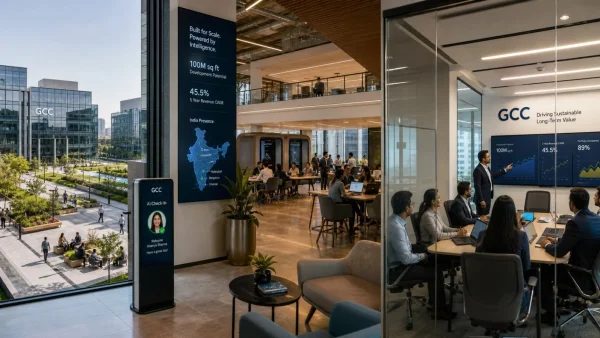
The way we do things has turned on its head. In Q1 CY26, myHQ says GCCs were responsible for 45.5% of all office leasing, so they are the one thing moving the needle for flex operators. You’ll find that enterprise is where most of the revenue comes from for every listed name in the book.
“We are done with the debate over whether flex is a viable model. The numbers put that to rest,” says Utkarsh Kawatra, co-founder and CEO of myHQ. In his view, the average deal is about twice as big as it was two years ago and people are sticking around longer.
Then again, the conversation has gone up the food chain. “It is no longer a facilities issue; the decision is made in the boardroom or by the CFO,” is how Karan Chopra, chairman and co-CEO of Table Space, puts it, when talking about the kind of strategy behind these new setups.
Operator scorecard: profitability trumps pure expansion
If there is a theme to close out FY26, it is a return to profit. The report points to steady occupancy and better EBITDA, a move away from the old ‘growth at any price’ mentality to a more measured approach with managed workspaces and the occasional long-term deal.
According to myHQ, you had five listed operators with double-digit growth in the quarter and some room on the P&L to show for it. They have put down roots in key hubs with sizeable campuses, but without letting utilisation slip – a sign of a business that is coming of age.
Some of the highlights from the quarter, in terms of both heft and margin, are hard to miss:
– WeWork India: A 292% jump in net profit to Rs 65.9 crore for Q4.
– Smartworks: 45% in year-on-year revenue and a portfolio that has put 10 million sq ft under its belt.
– Awfis: Brought in Rs 1,493 crore in FY26 with PAT of Rs 71 crore, 66% higher.
– IndiQube: Over Rs 400 crore in Q4 with 35.2% growth; VAS is 19.2% of the mix.
As for WeWork India, they are pulling in Rs 20,889 per member a month, which is 2.3 times what you would expect from the rest of the industry. That is premium pricing at work.
With a 10 million sq ft portfolio, Smartworks has put in a first for India’s listed flex workspace firms and in the process set a new standard for the category.
A structural change in how we search for space
If you look at the numbers from myHQ, you can see where the wind is blowing in India’s office market: there is a hard turn toward the flexible end of things, and it’s being driven by users on the ground as much as by enterprise needs.
The data doesn’t lie:
– 73% of all office searches are for some form of flex.
– You’ll see nearly five times as many queries for coworking as for old-fashioned leasing.
– In three years, meeting-room look-ups have jumped 187%.
– Virtual offices are up 99%, day passes 20%.
But this isn’t just a matter of putting more chairs in a room. The spike in demand for meeting and virtual spaces is a sign of hybrid policies and the kind of variable use that a flex operator can handle – and put a price on – in a way a conventional lease can’t.
Where we’re headed to FY27
Crisil has the sector on track to hit 140-145 million sq ft by FY28, and for the first time, they make an investment-grade case for it. But as the industry gets bigger, the focus is on value, not just volume.
"Value over volume” is the new mantra in the flexible workspace market, says Jai Agnani of CG Offices. “And the next generation of these spaces will be run on AI.”
You can see the momentum with up-and-comers like BHIVE, DevX, CO-WORKS and Table Space. BHIVE alone has put together a Rs 400 crore pre-IPO round with an eye on a 2027 listing.
Then there is the GCC factor. We are looking at 2,400-plus GCCs and $100 to 110 billion in revenue by the end of the decade, with the government’s nudge toward remote work only adding to the appetite for managed and flex offices.
WeWork’s own shareholder letter (as the report puts it) has one in three of its seats being AI-centric by 2030. That would put a higher premium on things like data security and top-shelf services.
Competition is no longer about who can fill a desk; it is about who can secure a multi-year, multi-city mandate. You need the right product mix and facilities that don’t let you down. Take IndiQube, for instance: 19.2% of their revenue now comes from value-added services, not just seat rentals.
“The race is as much about the relationship as the real estate,” says Kawatra. “We are seeing which operators have the depth to lead the next phase. I’d say the flex sector is in a position of real strength as we head into FY27.”
In the end, it will come down to who can grow their enterprise book without eroding their margins. With the country past 100 million sq ft and GCCs accounting for 45.5% of Q1 CY26 leasing, flex is not an afterthought anymore. It is how India’s big teams do business.