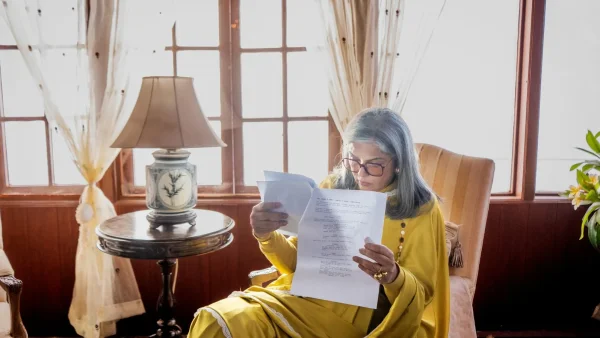
There is a certain sting to Zeenat’s no-nonsense view of her 1970s heyday. In a recent sit-down, she talks about how directors were after the shot of her in the downpour and the suits wanted to see more skin, even when she was trying to make her mark as a performer. You can see why her comments have some people talking again.
The label that would not leave
To a whole generation, Zeenat was the one and only screen siren of her time. But she says the reputation outlived the parts she was in and didn’t do justice to who you’d find away from the cameras.
Put simply: the ‘sex symbol’ thing was there, but the actual Zeenat was something else entirely.
A persona built for the gaze
She remembers people being taken aback to learn she wasn’t the character they saw on film. Talking to Shubra Aiyappa on YouTube, she puts it down to a career that was defined by what others expected of her, not by her own voice.
And that made all the difference in how her work was seen, and how much control she had over it.
What the cameras demanded
According to the actor, the producers were in it for the show, not the subtlety. On more than one movie she was told to give them ‘more cleavage, more of the back.’
Then you had the set pieces – like the rain numbers – that were all about making a visual for the men in the room.
Little space to be cerebral
The sets were a boys’ club, with maybe a hairdresser as the only other woman in sight. Even as the lead, she found herself left out of the creative side of things.
‘Nobody was interested in me being cerebral,’ she’ll tell you. ‘It was about singing, dancing, two lines of dialogue and getting wet in the rain.’
Style wars behind the scenes
Time in the US gave her a different way of seeing fashion. She worked with the likes of Bhanu Athaiya on costumes, but her own hand in it was limited.
Did they ever turn down her ideas for being too forward? She has a good laugh at that. The truth is, she was the one with the sensible notions; production was the one upping the ante.
Some of the stand-out moments she points to:
– Being asked for a lower neckline
– More of the back on display
– The drenched-in-rain look
Money, power, and who decides
As for the money, it was never fair, because the men held the purse strings. ‘Honestly, I think the financial powers lie mostly with men. Men are in charge of the finances and it is still a very patriarchal society and any commercial cinema, caters to that.’
Things have moved on, in her view, but not as fast or as far as you’d like.
Why this hits a nerve now
Her words come at a moment when we’re all asking who is really in control of the frame. When you hear her side of it, you see how a woman’s work on screen was once judged by how much of you could be seen, not by what you put into it.
It’s a bit of a contrast when you think of the variety in Hare Rama Hare Krishna, Don or Satyam Shivam Sundaram.
You get to know the person behind the glamour, and it changes how you look at some of those old movies and the headlines that went with them.
With talk of consent and credit in the air, she gives us a reality check. The rain might have been what put butts in the seats, but it also shows you who was holding the umbrella.